🚪 Xi Rolled Out the Red Carpet
We weren’t there. But the welcoming spectacle outside the Great Hall of the People looked like something assembled by a civilization that has spent several thousand years refining the art of political theater.
Rows of Chinese students in matching white-and-blue jackets waved American and Chinese flags beneath television floodlights while a military band played near the red carpet stretching out from Trump’s limousine.
Xi Jinping greeted the American delegation with warm language about cooperation, stability and the importance of the U.S.-China relationship. Trump smiled broadly through most of it, pausing often enough to absorb the spectacle like a casino owner inspecting a newly renovated lobby.
Once the cameras pulled back, the negotiations returned to the same hard edges both governments had brought to Beijing.
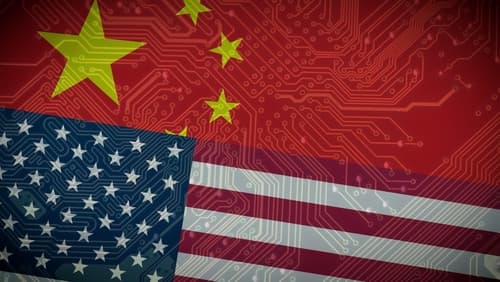
Xi wants limits on U.S. arms sales to Taiwan and fewer restrictions on advanced semiconductors. Trump wants broader access for American firms inside the Chinese economy and an extension of the temporary pause on rare-earth export restrictions.
Jensen Huang is going to sell some of Nvidia’s second-tier chips to a host of Chinese tech firms.
Nothing “breaking” came out of the first day of talks. Nothing like what we’re anticipating will be announced before the market close tomorrow, Friday, May 15, 2026. (Watch your inbox!)
🛢️ China, Iran and Oil
The Iran conflict now hangs over nearly every major economic negotiation happening in Beijing this week.
Marco Rubio appeared on Fox News urging China to take “a more active role” in ending the war, describing the conflict as a “huge source of instability.”
At nearly the same moment, reports surfaced that Chinese firms have discussed weapons sales to Iran while American intelligence analysts increasingly suspect Beijing views the conflict less as a crisis to resolve than as a strategic opportunity to observe.
Rubio wants the fire contained before it spreads. Wang Yi, his Chinese counterpart, appears to be warming his hands, amused. That distinction matters back home, because wars financed through debt move quickly, as we’ve seen, into bond markets, energy prices and household budgets.
The Pentagon now estimates the Iran conflict has already cost roughly $29 billion, with broader escalation scenarios potentially exceeding $100 billion.
Brent crude surged through April and May as shipping risks around the Strait of Hormuz intensified.
Gasoline prices climbed roughly 45% inside the United States while diesel prices rose nearly 50%, pushing transportation and distribution costs higher across the economy.
🏦 Kevin Warsh Confirmed
Back in Washington, Kevin Warsh spent two hours before the Senate Banking Committee trying to convince lawmakers he would not become what Elizabeth Warren called Trump’s “sock puppet” inside the Federal Reserve.
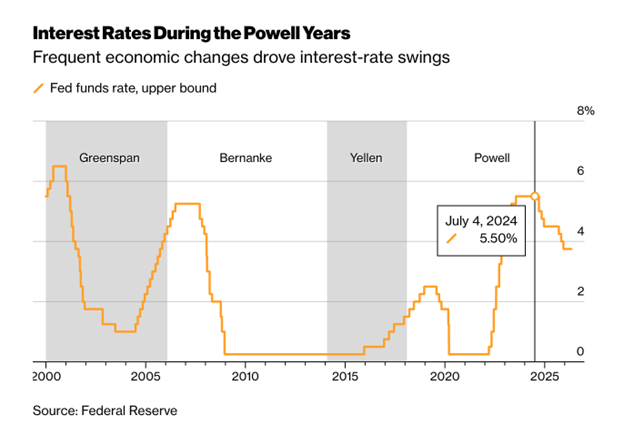
Under Jerome Powell, the Federal Reserve has walked a tightrope between fighting inflation and avoiding a recession — keeping markets hanging on every rate decision and economic forecast. (Source: Federal Reserve)
Economist Claudia Sahm reacted to the hearings with visible frustration, complaining that after two decades around central banking Warsh still sounded “like an enigma.” Yet the most revealing part of the hearings came when Warsh rejected the idea of forward guidance altogether.
“I don’t believe in forward guidance,” he told senators.
That statement marks a sharp departure from the Bernanke-Yellen-Powell era, during which the Fed tried to calm markets by telegraphing policy moves months in advance.
Warsh appears far more comfortable with the older Greenspan approach, where markets watched body language, vague phrasing and timing for clues about monetary policy.
The irony here is difficult to miss.
Jerome Powell spent much of the past decade trying to make the Fed more transparent while simultaneously presiding over the largest monetary interventions in modern history. Now Bloomberg is already framing Powell as the institutional defender of central-bank independence against Trump’s pressure campaign for lower rates.
Meanwhile, Warsh inherits a Fed trapped between inflation, war spending and Treasury issuance large enough to absorb entire oceans of global liquidity.
He also inherits a financial system that is changing beneath the central bank itself.
💵 Treasury Debt Must Go Digital
Warsh appears sympathetic to a new Treasury–Fed accord coordinating debt issuance, balance-sheet management and digital liquidity more closely than previous Fed chairs might have tolerated.
The coordination matters because traditional buyers of U.S. debt no longer behave the same way they did twenty years ago.
After Washington froze Russian reserves in 2022, China accelerated efforts to reduce Treasury exposure while increasing gold purchases. Beijing concluded — quite rationally — that physical bullion cannot be frozen electronically inside a sanctions regime.
Tether appears to agree.
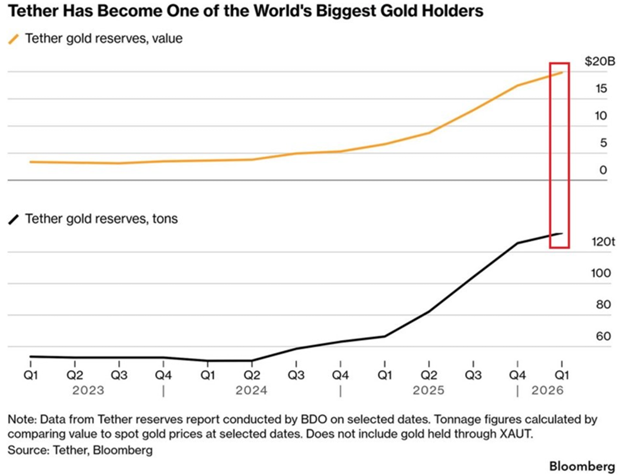
Tether has quietly grown into one of the world’s largest gold holders, using hard assets to help reinforce confidence in its rapidly expanding digital dollar empire. (Source: Bloomberg)
The stablecoin giant purchased another six tonnes of gold during the first quarter of 2026, bringing total holdings to roughly 132 tonnes worth nearly $20 billion. Only Poland, Uzbekistan, Kazakhstan and China purchased more gold during the quarter.
“Paper money systems survive,” we wrote two decades ago in Financial Reckoning Day, “only so long as people retain confidence in the institutions behind them.” Treasury Secretary Scott Bessent’s betting on Dollar 2.0 digital rails to not extend the shelf-life of that confidence… but broaden the market globally as fast as possible.
Bessent projects the stablecoin market could reach $3 trillion by 2030, and the Clarity Act, whose passage is imminent in the Senate, increasingly points toward a future where digital dollar infrastructure becomes deeply integrated into Treasury financing.
📉 Americans still feel the economy deteriorating faster than economists can explain it
The latest Economist/YouGov polling shows 61% of Americans now believe the economy is getting worse — the highest level recorded during a Trump presidency and the highest overall reading since 2022.
Employment numbers remain relatively solid. Markets remain elevated.
Yet households continue absorbing higher fuel costs, elevated financing rates and inflation pressures that linger stubbornly above the Federal Reserve’s target.
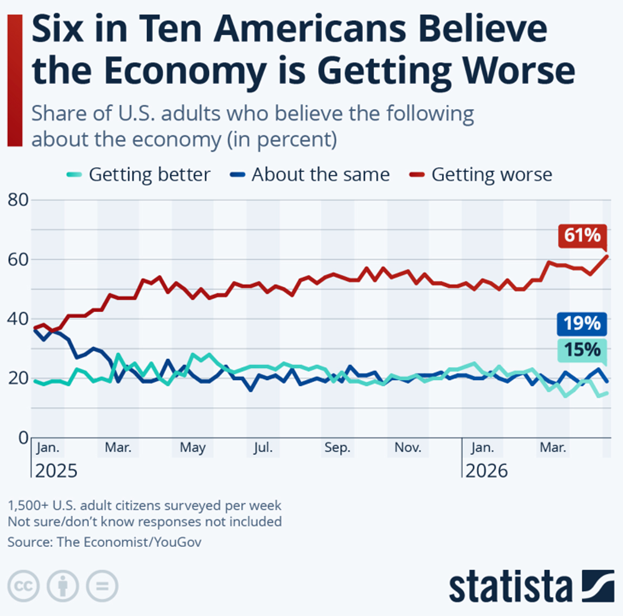
Even as some economic data improves, many Americans still feel like the economy is moving in the wrong direction — squeezed by high prices, elevated borrowing costs, and growing uncertainty about what comes next. (Source: Statista)
People experience the economy through transactions before they experience it through policy analysis.
They notice gasoline prices before Treasury auctions.
They notice grocery bills before CPI revisions.
They notice diesel surcharges before economists appear on television explaining why everything is technically fine.
🚣♂️ Lewis and Clark left St. Louis 222 years ago today
On May 14, 1804, Meriwether Lewis and William Clark departed St. Louis with maps incomplete enough to qualify as optimistic and instructions from Thomas Jefferson to explore territory the United States had only recently acquired through the Louisiana Purchase.
They traveled upriver in a 55-foot keelboat carrying trade goods, rifles, navigational instruments and assumptions large enough to push westward into terrain they did not fully understand.
Tonight, freight trains carrying transformers, semiconductors and industrial machinery continue to arrive in Beijing, while Treasury auctions continue financing deficits large enough to require entirely new categories of buyers.
~ Addison
P.S. In the first quarter of 2026, the only entities that purchased more gold than Tether were the central banks of Poland, Uzbekistan, Kazakhstan and China.
And a quick program note: on Friday, May 15, at 2 p.m. EST/11 a.m. PST, we’ll be hosting a live webinar on taxes and trading. Are you making the most of your tax status to save and invest money? Find out on Friday:

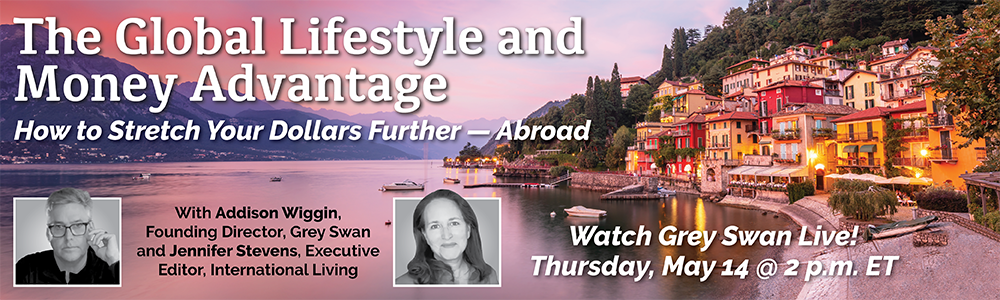
P.P.S. Also, this week’s Grey Swan Live! features Jennifer Stevens, publisher and executive editor for one of our favorite publications, International Living. We’ll be chatting it up with Jennifer at 2 p.m. EST/11 a.m. PST today – Thursday, May 14 – about making those tax savings go farther overseas:
We bumped into and had dinner with Jennifer in Panama City a few weeks back at the beginning of March.
Over some fresh fish and an Argentine Malbec, we started a conversation about what she calls the “value proposition” that those who choose to retire overseas seek. Here’s a snippet of the email conversation that followed our meetup:
What most people don’t realize is that you can have a lifestyle that’s a lot more interesting and affluent than most people realize. The key is to explore your options abroad.
Because outside the U.S.—in the right spots—good living costs quite a bit less than it does in the States.
A couple can live well on as little as $1,700 a month in some places. The trick is to know where to go. And that’s what we show people at IL.
And to be clear: You don’t have to upend your life to take advantage of this “arbitrage.”
- You could buy a place – outside the US, outside the dollar, protect some of that hard-earned money from whatever may be coming down the pike in the US – rent it out for income, watch it appreciate, and you could enjoy it, too.
- You could spend part of the year abroad…
- You could, in fact, up sticks and move…
We invited Jennifer to join us this Thursday, May 14, at 2 p.m. EST. If you’re looking for a way to make your pile stretch further, beat inflation, avoid politics and give you a life with some adventure in it… you’ll want to join us and hear what Jennifer has to say.