

Late April and early May brought a series of back-to-back-to-back conferences centered around digital technologies.
The first conference was the Bitcoin Conference, held this year in Las Vegas.
This marked my fifth time attending this event – and I have to say, it felt bittersweet
My first Bitcoin Conference was in 2021 down in Wynwood, Miami.
It was the first national conference since the COVID outbreak. The event space was substantially overbooked, and the audience felt like they were people who just wanted to get out, be free and intermingle in person with like-minded people.
The event kicked off with a speech from Ron Paul, who delivered a message on liberty.
That wasn’t the case with Bitcoin 2026.
Instead, it started with an industry day, which some on social media tried to claim was poorly attended and the conference was a failure. Rather, industry day just gives big money an extra day to meet and talk shop.
Days two and three were open to the general investing public and were much better attended.
But this year’s conference had a different vibe. There were more suits and fewer discussions of themes of liberty and monetary independence that have marked prior conferences.
Big discussions weren’t about liberty and “freedom money.” They were about the Clarity Act. How you could borrow against your bitcoin with bitcoin-backed credit cards and mortgages.

Discussions about bitcoin as a way of preserving financial freedom from runaway inflation or prying governments were relegated far from the main stage this year, compared with prior Bitcoin Conferences.
To some extent, this shows the rising institutionalization of bitcoin.
To some extent, it shows that a lot of the early reasons for getting into bitcoin have gone by the wayside.
That’s where most of my discussions ended up, largely because that’s where the conversation is in bitcoin right now.
Meeting in the Middle
Bitcoin is changing. But Wall Street is also changing with it.
For years, there has been a debate about which side would win. For now, both groups are converging in the middle.
The ethos of bitcoin, as its original libertarian independent money, is not working in the fiat system. It works better as a savings tool. And the blockchain technology underpinning it is incredibly useful in the digital age.
And Wall Street is now realizing that it can benefit from that technology. The “smart money” can use digital money for better settlement, faster settlement and general improvements.
In the long run, this adaptation is a good thing. But when you’ve grown up with bitcoin as an independent asset, free from central bank and governmental interference, something that stands athwart the endless creation of fiat money, the overall feeling of today’s changes to bitcoin is bittersweet.
That said, bitcoin’s adolescence still leaves plenty of room for further price growth. The Wall Street banks that have embraced the technology have given it their seal of approval.
Following the Bitcoin Conference, I headed closer to home for the Consensus Conference in Miami.
The day before Consensus, I attended a side conference, focusing on digital yield.
Bitcoin, like gold, doesn’t pay a yield. Some cryptos may pay a yield, but do so by issuing new coins or tokens, which devalues them over time.
Stablecoins, at least, offer what appear to be consistent yields, as they’re usually backed by assets such as U.S Treasurys, which we’ve been discussing as part of our Dollar 2.0 thesis.
For now, stablecoins have offered investors higher yields than they can get in a traditional bank account. For a big bank, even a 1% return on idle savings is a high yield right now.
Meanwhile, stablecoins backed by the U.S. dollar can return closer to 4%, largely from the interest they earn on U.S. Treasury holdings.
The banks have been pushing back heavily on this. It’s been the main issue that held up the Clarity Act last year.
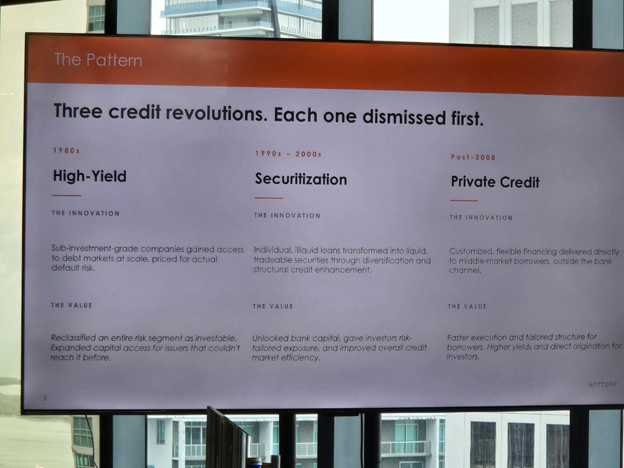
Deriving yield from bitcoin and crypto projects is a key discussion among institutional investors and policymakers today.
But one of the things that we discussed at this pre-conference was that stablecoins also offer their users superior settlement times.
With stablecoins and blockchain technology, you can settle instantly, and then it’s confirmed on the blockchain within minutes.
Compare that withthe existing banking system, which can often take three to five business days to settle a wire transfer.
During that time, they’ll hold your funds for a few days, preventing either the sender or receiver from collecting interest, and then still have the audacity to charge you a fee.
That could be one big reason the banks were upset about the rise in stablecoin transactions and why the Clarity Act was shelved late last year.
However, there appears to be a compromise in place.
Investors will be getting a lower yield on stablecoins to get the legislation passed. Meanwhile, the banks themselves are also pursuing stablecoin technology to reduce transfer times.
So there are definitely some benefits to this technology that we’re seeing in place – and which is about to become more integrated into the financial system shortly.
A Time for Building, Ahead of the Next Rip
Another key takeaway from Consensus was that nobody’s really resting on their laurels.
A successful crypto project from a few years ago, such as Ripple, is still out there working on some of its real-world settlement and payment processes and is working to improve its token even further.

Reid Hoffman, founder of LinkedIn, made the case for crypto projects like NFTs to make a comeback in the years ahead. (Maybe skip the monkey pictures and go for real assets like tokenizing a Picasso?)
We’ve also seen a massive shift in sentiment in the crypto space over the past few weeks. Bitcoin is back over $80,000, investors are moving into the space and the industry is finding a working medium that improves the existing financial system without a revolution.
Is there still room for cryptocurrencies like bitcoin to become a base payment layer instead of the dollar? Absolutely. And as long as that door is open, and as long as investors continue to embrace bitcoin, its best days remain ahead of it.
Even though bitcoin is growing up and reaching its adolescent phase, there are plenty of other problems in the financial system that other altcoin projects can solve.
Those projects are well underway and excited about what is happening next.
Our Dollar 2.0 thesis, which we first outlined last year, took a detour with the sidelining of the Clarity Act and the bitcoin bear market.
Amid all these positive announcements, bitcoin got some attention. But once it got back to the low $80,000 range and back to its 200-day moving average, bitcoin sold off sharply.
Now down under $70,000 this week, we’re getting a lot of talk about bitcoin being dead. Time has proven it wrong.
Long term? The future looks bright for this new asset class. And the infrastructure that’s going to take crypto to the next level is being built now, while fear reigns and investors look away from crypto and toward the latest round of AI plays.
~ Andrew Packer
P.S. This week on Grey Swan Live!, Mark Jeftovic will join us as we better unpack these latest developments in the crypto space – including the Clarity Act and the Fate of Dollar 2.0.
Crypto has taken a back seat to the AI trade in recent weeks, but those lamenting crypto’s poor performance may not have much longer to wait, with so many positive catalysts on the horizon.