The AI trade is taking a breather. The “Magnificent Seven” stocks shed nearly $797 billion in market value last Thursday alone during their steepest single-day drop since the Liberation Day rout in the first week of April 2025.
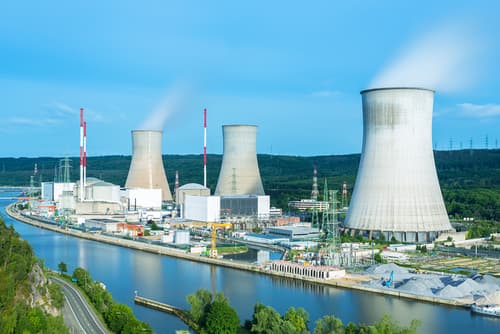
Regardless, the AI rollout needs energy.
Nuclear is a no-brainer. It offers clean, cheap, abundant power. There are no intermittency issues like with solar or wind. And it generates no greenhouse gases.
Even better, new technologies are making it possible to roll out small modular reactors (SMRs) — the next, more reasonable, generation of the nuclear buildout. SMR technology is primarily fission-based, which still generates nuclear waste and complicates cleanup.
The “holy grail” for a new reactor? Nuclear fusion. Cleaner, cheaper and no waste.
China unveiled its newest fusion reactor design last week:

China is making strides toward developing fusion power, something it calls the creation of an “artificial sun.” (Source: Global Sun)
Fusion combines light atomic nuclei (typically isotopes of hydrogen like deuterium and tritium) into heavier ones, releasing enormous energy — the same process that powers the sun.
Compared with fission, fusion offers several advantages: its fuel (hydrogen isotopes, often extracted from seawater or bred from lithium) is abundant and cheap. It produces no long-lived radioactive waste, since fusion byproducts (mostly helium) aren’t highly radioactive.
There’s also no risk of meltdown, since fusion reactions require extreme, hard-to-sustain conditions and simply stop if disrupted. And it can’t be weaponized in the way fission material can.
The core challenge is achieving and sustaining the conditions fusion requires — temperatures exceeding 100 million°C, hot enough to turn fuel into plasma, while confining that plasma long enough for reactions to occur.
Two main approaches exist: magnetic confinement (tokamaks, like ITER) and inertial confinement (laser-driven, like the National Ignition Facility).
Both face similar hurdles: materials that can withstand extreme heat and neutron bombardment without degrading, maintaining plasma stability (it wants to escape confinement), and — most critically — reaching “net energy gain,” where the reaction produces more energy than it consumes.
Progress has been real but incremental, and commercial-scale power generation remains years away, even after headline-grabbing ignition milestones.
The commercial fusion energy sector — which spans over 56 active companies globally — is almost entirely privately held and backed by venture capital, sovereign wealth, and private tech billionaires. There are a few public pure plays…
Today’s Grey Swan Pro looks at a nuclear company that’s been inking deals, but still needs some time to translate that into full operations and revenues — details here.
~ Addison