
It’s silly season for stocks. Name a stock, and there’s probably something silly going on.
In fact, the market is acting a bit like 2021. Retail investors are running wild, sending individual stocks soaring one day and diving the next.
Option volume is soaring, with over 70% on the call side, betting on further upside following an explosive rally. Again, much like 2021.
That’s not disciplined behavior, and, like the 2021 stock mania, it won’t end well.
Space Stocks Are Silly
Ahead of the SpaceX IPO, which I discussed yesterday, stocks in the same sector are soaring in sympathy.
What’s most interesting is the move higher in Virgin Galactic (SPCE).
Richard Branson’s space tourism company isn’t related to the serious infrastructure-building of space like most stocks in the sector.
Shares are up 134% year-to-date, largely because of its ticker symbol.
A closer look at the company’s fundamentals indicates that, well, there’s a failure to launch. Over a five-year period, Virgin Galactic shares have shed 98% of their value.
This stock is a virtual hot potato – and it was one of the poster child stocks for retail enthusiasm in 2021 ahead of the 2022 bear market.
Even a more nuanced space company like AST Space Mobile (ASTS) has seen some volatility. Its shares are “only” up 50% in the past month.
But following last week’s tragic Blue Origin rocket that blew up on the launch pad, shares are down over 20% from their peak – technically meaning the stock is in a bear market.
This feels a little bit like the market jamming on the brakes and the gas at the same time.
Semiconductors Are Silly
Do I even need to write anything here? Here’s a chart of Micron Technology (MU), which went from $60 billion to $1.2 trillion in 13 months:
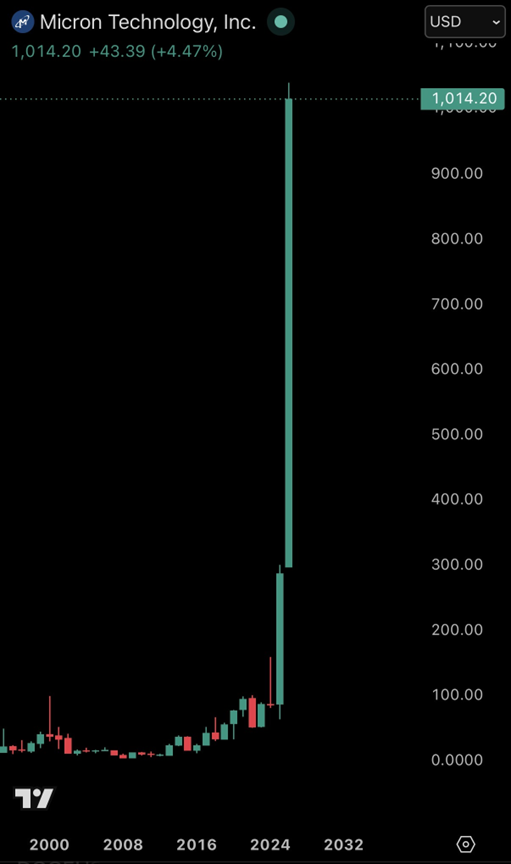
The silliness speaks for itself. This will probably become the next textbook example of a parabolic stock move. (Chart source: Trading View)
OK, I’ll note one thing here. If you own some shares of these stocks that have gone parabolic, take some profits.
In fact, if you ever find yourself taking a screenshot of your portfolio, sell at least 25% of whatever helped it get its biggest boost recently.
Big Tech Is Silly
Yesterday, Alphabet (GOOG), the company we all still refer to as Google, made a critical announcement – it is going to issue nearly $80 billion in stock to fund its AI projects.
Bear in mind, this is a company that’s had substantial returns over the past few years for doing the opposite: buying back shares.
Google currently has a $70 billion buyback program in place. And it bought back nearly 1 billion shares since 2018:
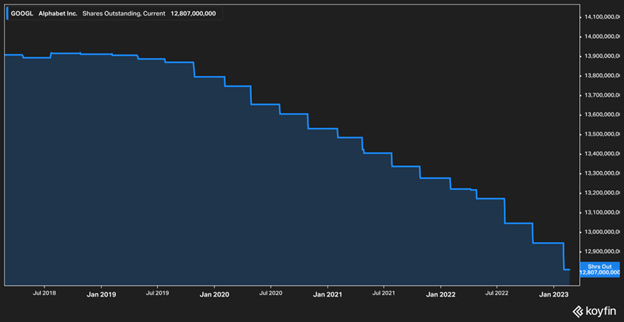
GOOGL shares outstanding have decreased substantially since 2018, a move that’s helped boost its share price considerably. (Source: Koyfin)
Amid the billion-share buyback, shares have soared 237%. Why? Over time, earnings matter. And you can increase earnings per share by growing your total earnings, buying back shares or a combo of both.
More earnings per share + fewer shares = happy investors.
If your earnings are in decline, and if you’re buying back shares fast enough, the market may take a while to notice.
Google’s tailwinds for investors are about to become headwinds as share counts creep higher. As more money is invested in AI, earnings growth goes down.
The market may not mind now as part of the AI story, but soon the math will look like this:
Fewer earnings per share + more shares = :(
Again, it feels a bit like the gas and brake pedals are hitting at once.
Case Study: Staying Serious In a Silly World
I get it, I’m good-humored. I enjoy cracking a good joke and lighting up a room. But not where your financial future is concerned.
I don’t mind down markets; over the long haul, it’s where the best money is made. But the most dangerous markets are the ones like today, when risk has become a four-letter word.
And right now, this market is getting too silly. It’s hard not to join in with the madness of crowds at a time like this.
There will be a time to buy great companies caught up in the silliness.
For instance, in 2022, I pitched to my then-publisher a company called Planet Labs (PL). The satellite imagery company was rapidly growing revenue and had gone public the year before.
The problem? It went public via SPAC.
The popularity of SPACs in 2021 was palpable. By 2022, any post-SPAC company was in the market’s equivalent of a leper colony.
My publisher, correctly, didn’t think the idea would gain traction as a busted SPAC deal.
So while I couldn’t write about it then, I did what any respectable analyst would do: I bought 400 shares, only partially out of spite.
From an IPO price of $10, shares fell under $3 in 2022. That’s where I picked them up. When the stock spiked to $25 last year, I sold half my position.
Earlier this month, I did something I’ve never been able to do before. I sold a covered call for $3.50, or more than 100% of my original purchase price for shares.
Here’s the receipt:

Right now, the stock has moved a bit higher, and even touched that $50 level. I’m fine taking shares off the table – after all, it’s gotten caught up in the space stock rally. If we get a cool-off by July, I’ll keep the $350 in call option premium I sold, and I’ll still have shares.
That’s a win-win. (I say that now, but check with me again if we get another 80% drawdown in space stocks.)
Bottom line, at this point, I’m not super bullish on stocks after their big run, at least through the election. There’s just too much (say it with me) silliness.
But I’m not super bearish either – a 5% pullback might be all this market needs. And a 10% pullback would really clear out the speculation. At today’s prices, a 10% pullback in markets would still be well above the March lows.
What I am trying to do today is be patient. And for an investor, that’s often the most important skill required. Let this be your reminder that it’s okay to be patient sometimes, too.
~ Andrew Packer
P.S. This week on Grey Swan Live!, Mark Jeftovic will join us as we cover the latest developments in the crypto space – including the Clarity Act and the Fate of Dollar 2.0.
Crypto has taken a backseat to the AI trade in recent weeks, but those lamenting the poor performance of crypto may not have much longer to wait with so many positive catalysts on the horizon.