
Nailed it.
Although, to be honest, you don’t need deep connections in Washington to see this coming from 832 miles away.
This morning, U.S. Attorney for D.C. Jeanine Pirro said she had directed her office to close the Justice Department’s criminal investigation into Jerome Powell.
The case had centered on renovation costs at the Federal Reserve, but it carried more weight as a political lever than a construction audit. It allowed lawmakers to keep pressure on the central bank while rate policy remained a live issue.
With the investigation dropped, the Senate turns back to the nomination of Kevin Warsh. We forecast earlier this week a) the Powell suit would be dropped b) Warsh will be confirmed before May 15 and c) phase one of Project 2026 – the plan to put money in your pocket before midterms – will kick in with a surprise rate cut… followed by another before November 3rd/
💵 Treasury Buyback Makes History
Something big is also in the works at the Treasury Department.
The Treasury this morning announced that it bought back $15 billion of its own bonds, the largest single-day buyback it has ever executed.
The transaction is simple. Treasury purchases the bonds, and the investors holding them—banks, funds, and asset managers—receive cash.
That cash did not stay idle. It landed in accounts and had to be reinvested. Some of it joined the rally in AI stocks on Wall Street. Futures, and some into options trades, are going crazy, too.
🧾 Treasury is preparing to sell more bills
From what we can tell, the buyback is one step in a larger sequence.
Treasury plans to increase the size of its short-term bond auctions to rebuild its cash balance toward $900 billion by the end of June. At the same time, the Federal Reserve has reduced its monthly Treasury purchases from $40 billion to $25 billion.
These details are a bit wonky. But we’re convinced it’s part of a coordinated effort to begin extracating the Fed from Treasury operations in line with Kevin Warsh proposal to reboot the 1951 Fed-Treasury Accord, which he said will allow the central bank to lower interest rates despite inflation… and accommodate borrowing needed to goose the housing market and the massive AI buildout that traders on Wall Street have bet big on.
Under the plan, more government debt will be sold to investors, while one of the largest buyers is stepping back. One step closer to floating interest rates and an independent Fed.
📊 Traders Immediately Bet Borrowing Costs Will Rise
Trading volume in futures tied to the gap between SOFR and the federal funds rate reached 56,590 contracts this week, the highest level on record. These contracts reflect expectations about borrowing costs.
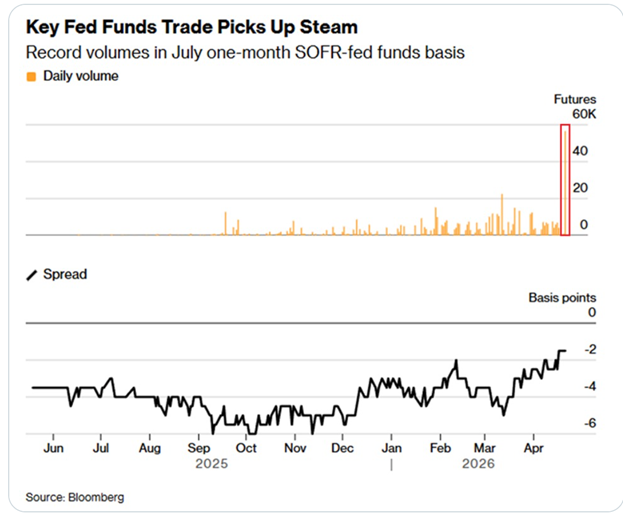
Traders have wasted no time pricing in higher borrowing costs, signaling expectations that rates are headed up. (Source: Bloomberg)
Right now, borrowing overnight using Treasuries as collateral costs 3.63%, just below the Federal Reserve’s rate of 3.64%.
That tells us cash is still available. The positions being built assume borrowing costs move higher as the Treasury increases new debt… and the Fed continues to step back.
Again, Project 2026 needs to move beyond the Iran war, higher energy prices… and keep the party going on Wall Street before November 3.
In mid-March, asset managers sold $36 billion of S&P 500 futures, the largest reduction on record. It was a fast move to cut exposure during the selloff. Within two weeks, they reversed course and started buying again.
By April 14, they had added $9.7 billion in Nasdaq futures, pushing net exposure to $39 billion, above last year’s peak. That is not a gradual shift. It is money leaving quickly and then returning in size.
🧠 Hedge Funds Are Getting In on The Action, Too
Hedge funds are loading up on government debt, in addition to buying in semiconductors, software, and communication companies. After several weeks of selling big tech names, they opened new long positions and increased leverage at the same time.
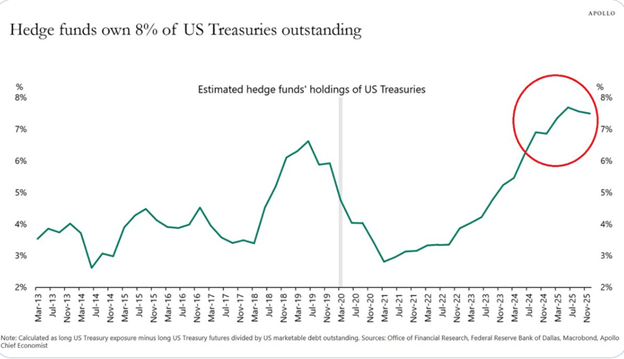 Following a recent shift in the ongoing AI revolution, hedge funds are piling into government debt, positioning for stability — or a shift in the AI story. (Source: Apollo)
Their exposure to technology stocks is now at the highest level in at least five years. Net leverage rose to 77%, reflecting the use of borrowed money to expand positions. They went back into the same companies and made those positions larger.
📊 Individual Investors Are Buying Again
Individual investors are following right along. This week, new stock purchases are far exceeding the tepid selling through much of the Iran war fears.
Survey data shows 46% of respondents expect stocks to rise over the next six months, up sharply from mid-March.
Trading data shows how that view was expressed. Retail investors bought stocks and used call options to bet on higher prices.
Net call option volume reached roughly 2 million contracts on a five-day average, the highest on record. The call-to-put ratio rose to 1.50, and total call volume has more than doubled since March.
If Project 2026 works… the market will edge ever closer to the Crack Up Boom we forecasted for mid-2026 during our annual forecasts back in December 2025.
In total, the S&P 500 has climbed about 12% from its late March low.
Many individual stocks in the index remain well below their own highs. Which makes them ripe targets for our Shadow Stock recommendations.
🛢️ Energy Markets Are Still Getting Squeezed
While equities moved on capital flows, energy markets responded to supply constraints.
The conflict in the Middle East has settled into a tense standoff after a series of ceasefires, but it has drawn heavily on U.S. and allied stockpiles. American forces used thousands of missiles in attacks on Iran, and allies depleted their inventories defending against strikes. Replenishing air-defense systems could take years, with estimates as long as six years for certain systems needed in a Taiwan scenario, according to reporting in The Wall Street Journal.
At the same time, energy infrastructure has taken damage. Iranian attacks on liquefied natural gas facilities in Qatar are expected to constrain LNG supply through next year, according to the International Energy Agency.
Analysts at Barclays warned yesterday that traders may be underestimating the risk of further disruptions, while JPMorgan’s commodities team said U.S. gasoline prices could rise into the summer driving season, adding pressure ahead of midterm elections.
📉 Pension funds are preparing to sell into the rally
While hedge funds and individual investors have been buying, pension funds are preparing to reduce exposure.
Goldman Sachs estimates that pensions may sell about $23 billion in equities this month as part of routine rebalancing. That would be the largest non-quarterly monthly sale on record going back to 2000. These funds follow allocation targets, so when stock prices rise quickly, they trim positions to bring portfolios back into line.
📜 AI development is moving toward systems that act
Research from Goldman Sachs describes the next stage of AI as a shift toward systems that can test decisions and evaluate outcomes before acting. Current models generate text and code effectively, but they struggle when asked to manage processes where mistakes carry real costs.
At the same time, competition is expanding.
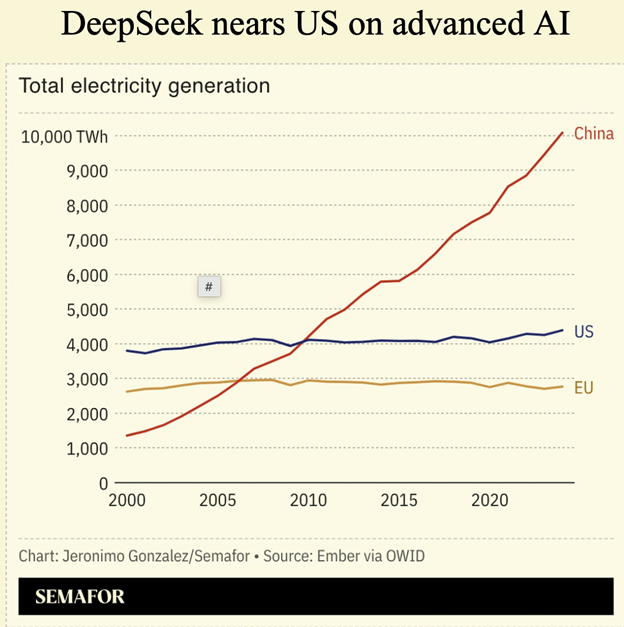
AI is shifting from tools that respond to systems that take action, marking a move toward more autonomous technology. (Source: Ember via OWID)
A Chinese firm, DeepSeek, you may recall, spooked investors in Nvidia in January 2025.
There are still nipping at the U.S. AI trade’s heels.
Deepskeee has released an open-source model it says can compete with products from U.S. companies, building on earlier work that delivered near top-tier performance at lower cost.
Even without access to the most advanced chips, Chinese developers are using abundant energy and larger volumes of less efficient hardware to close the gap, a point Jensen Huang recently emphasized.
Zoltan Istvan has spent years studying how technological change plays out after capital has already moved in. The early phase brings money and attention. The next phase changes how companies operate and how governments respond.
That second phase is where the effects show up in hiring, pricing, and regulation. It’s worth your time to check out the conversation we had yesterday with Zoltan on Grey Swan Live!
~ Addison
P.S. Last week on Grey Swan Live!, we showcased our latest research on Shadow Stocks – volatile stocks that move rapidly up and down beneath the surface of the calm indexes.

Earnings season is a ripe time for cherry-picking stocks. Along with the research, we are launching an upgrade to your Grey Swan forecast emails that will include up to five stock or trade recommendations a week.
To kick it off, we’re going to give you three stocks free of charge. Gratis. On the house. The research is excellent, and the upgraded Grey Swan Pro will be worth your time to consider. Take a look here.
And in this week’s Grey Swan Live!, Zoltan Istvan joined us to discuss how the constantly evolving AI revolution could reshape every major asset class along the way.