Among the challenges the Trump administration faces leading into the midterm election season: plummeting consumer sentiment.
The University of Michigan’s consumer sentiment survey is currently as low as it was at the beginning of the 2020 pandemic lockdowns.
A Gallup poll released yesterday shows declining sentiment as well:
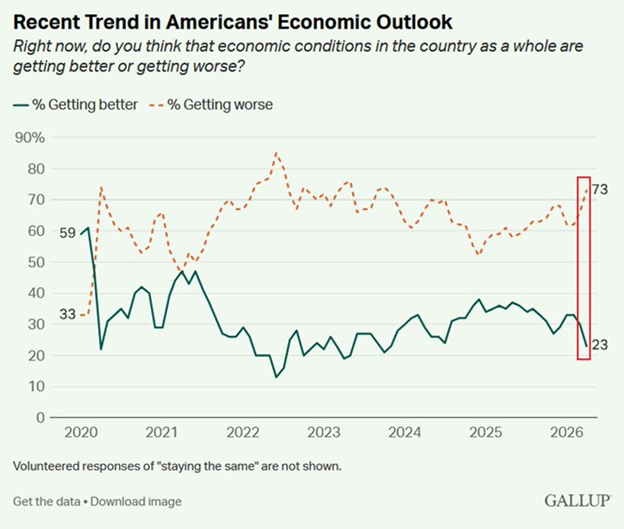
Consumers have a worsening view of the economy, now lower than April 2020 levels. (Source: Gallup)
On Friday, we took a gut check of our asset allocation and Grey Swan Model Portfolio. The few dividend-paying consumer goods companies in the portfolio are off their historic highs but were helped by a brief “rotation” rally – capital moving out of software and financial stocks into consumer stocks and other sectors in the market.
Consumer services stocks catering to travel, such as Carnival Cruise Lines (CCL) and Marriott (MAR), have held up well even amid higher oil prices in March and April.
In the K-shaped economy, high-income earners are resolute in their spending on travel, vacations and luxury items.
At the same time, consumer credit shows the lower leg of the K-shaped economy is continuing to deteriorate. Higher gas, heating and food prices are taking a serious bite out of an ever-larger share of lower- and middle-income budgets.
The upper half of the K owns the company that builds and sells those tools. Gains in AI-related stocks have lifted portfolios and extended spending power, even while the job market underneath is shifting. That’s where the split shows up — income tied to labor reacts fast, income tied to assets holds up longer.
The lower half of the K is tied to wages that move when companies cut hours, automate tasks or delay hiring. As AI tools take over routine work, those paychecks adjust quickly because the jobs themselves are easier to replace or shrink.
Political resistance to new facilities, delays in permits and rising energy constraints slow that buildout. When projects get pushed out or scaled back, the expected earnings tied to them move with them.
The K-shape is a convenient metaphor for popular media. The K shows an exposure to risk in innovation on the upside and the politics of inequality on the downside. One side depends on capital projects that must be approved, financed and built before the revenue materializes. The other depends on hiring decisions made quarter to quarter.
The midterms in 2026 are shaping up to be the epic political battle of our time.
We’ve suggested a few hedge ideas in your membership upgrade: Grey Swan Pro.
Today, we recommend a “defensive” stock that will benefit from upside in the stock market, is resilient to recessions in the real economy and harnesses what Einstein called the “eighth wonder of the modern world”: compound interest.
If you’re interested, you can upgrade your own Grey Swan membership to Pro status by clicking here.
~ Addison
P.S. If you missed Grey Swan Live! last week with Zoltan Istvan, we got a whirlwind view of the future, Zoltan-style, which we dubbed “Robots, UBI, and Wine”…

In one stirring anecdote, Mr. Istvan described a recent letter he wrote to his wife. After three decades of buying, trading and developing real estate using the credit markets, they are planning for a “black swan” deflationary environment by deleveraging their real estate, something he’s never done with his own money…
I tried to persuade him to use the term “grey swan” instead, since it’s a trend he can see comin’. We’ll see if he comes around.
One curious story, while he’s planting more vines in his vineyard in Napa, he knows several other grape growers who are ripping their vines out of the ground, because it’s cheaper to let the land lie fallow than pay to deal with California’s onerous regulatory environment. Another sign of things to come?
Perhaps. Check out Zoltan’s interesting and very unique perspective on AI, the acceleration of change, and the future of value in the markets… stocks, bonds, real estate and tech. All very thought-provoking and worth a listen.