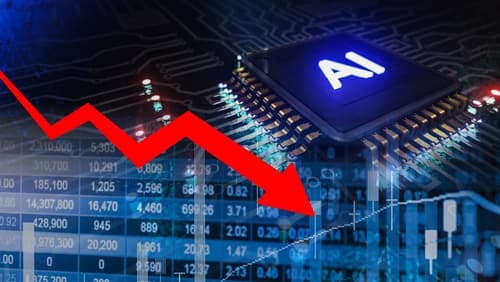
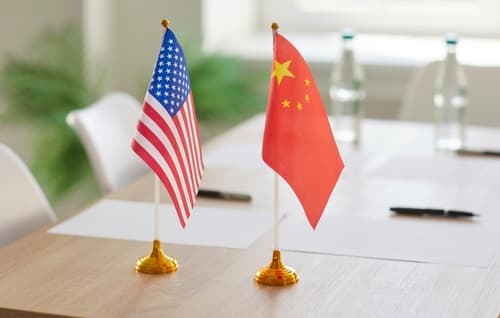
When the band was playin’ not and the crowd pushed too close to the stage at a Grateful Dead show, the late Bobby Weir didn’t stop the music. He leaned into the microphone and sang it out—half amused, half cautionary. He called it “America’s new fun-filled game, ‘Take a Step Back.’ The band would join in with a funky bassline and drum beat.
Slowly, everyone would take a step back.
Physics expressed as etiquette. Unstoppable momentum meeting immovable force. The poor hippies in the front row were getting crushed.
Trump’s CEO-laden trip to Beijing this week gave us all a chance to take a step back and see the shape of things to come.
Since the second term began, the administration has been on what amounts to a World Order Reboot Tour. It started with tariffs and the attempt to reset trade flows. It moved through Venezuela and Greenland, into NATO and Ukraine, then into Saudi Arabia and the Iran campaign, where energy routes and military action became inseparable at the Strait of Hormuz.
In China, with a $20 trillion delegation of CEOs whose businesses depend on semiconductors, data centers, shipping lanes, and capital markets. Perhaps, now, upon return, they can take a step back themselves and settle into laying down a groovy set of policies that help everyday American voters address the “affordability crisis.”
The sequence the Trump administration, Wall Street, corporate America and the Western banking system have followed isn’t random. It traces the outline of a system being reorganized—energy, trade, security and technology—around a single question: how the United States positions itself against China in the next phase of industrial competition.
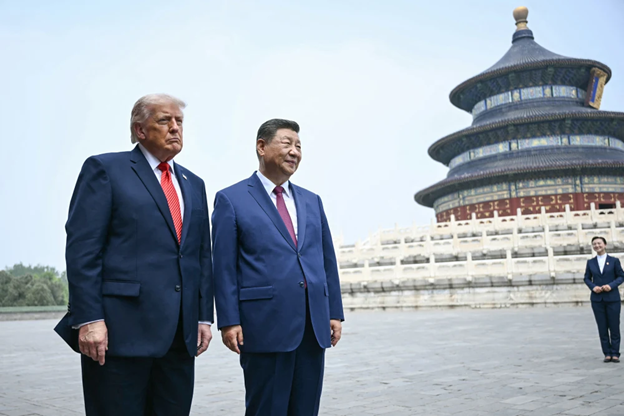
The U.S.-China relationship is starting to mirror the Thucydides Trap, where fear, rivalry and shifting power dynamics can escalate tensions even when neither side wants direct conflict. (Source: Getty Images)
The Beijing visit gives us a chance to step back from the daily tape and look at what both countries are actually carrying into that contest.
📊 Producer Prices Rise 18% Annualized in April
The first thing you see when you take that step back is that costs, including producer costs, are screaming higher. Tariffs and the unfortunately timed Iranian excursion are taking their toll.
Yesterday, Wolf Richter, crunching the data par excellence, showed the Producer Price Index (PPI) rising 1.5% in April from March—18% annualized—after an 9% annualized increase in March and steady gains earlier in the year before energy prices surged.
Producer prices just delivered another inflation shock, with services inflation surging alongside rising energy costs — a combination that threatens to keep price pressures running hotter for longer.
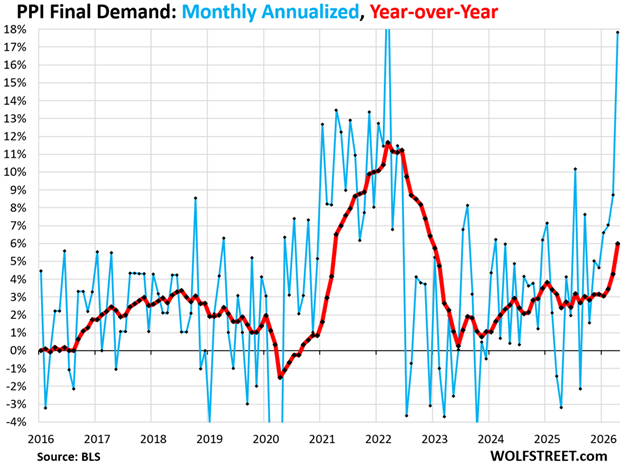
Producer prices just delivered another inflation shock, with services inflation surging alongside rising energy costs — a combination that threatens to keep price pressures running hotter for longer. (Source: BLS)
Year over year, the index is up 6%.
The makeup of the increase matters more than the headline number. Services, which account for roughly 68% of the index, rose more than 1% in April – 15% annualized. Trade services increased 3% in a single month. Transportation and warehousing rose 5%.
Those are the costs associated with moving, storing, financing, and delivering goods. When those numbers rise together, procurement departments revise contracts, distributors adjust margins and retailers update prices. The increases move from balance sheet to balance sheet until they reach the consumer.
Eventually, and ultimately, the cost comes out of your wallet.
👴World Trend: China’s Retirees Rise To 52 per 100 Workers
While those prices move through the economy, you can almost hear the refrain we’ve been hearing our entire career: “deficits, debt and inflation don’t matter because we’re to grow our way out of this.”
Trouble with growing is… it also means aging. Sure, the economy exists separately from an individual’s life. And you could repeat Keynes famous phrase that “in the long run we’re all dead.” In the meantime, an aging population is passing on deficits, debt and inflation to fewer and fewer young people.
UN projections show China’s old-age dependency ratio rising from roughly 22 retirees per 100 workers today to more than 52 by mid-century. The United States moves as well, but more gradually, from about 29 to 38.
That ratio determines how pensions, health care systems, and public obligations are funded. As it rises, more people draw income from the system while fewer generate the income that supports it.
Two decades ago, when we were writing about China’s ascent in The Demise of the Dollar, the story looked very different. China still had a massive demographic tailwind. Workers were moving from rural provinces into factories, and production capacity was expanding almost without constraint. America, by contrast, was financing consumption with credit while outsourcing production.
Today, the positions have shifted.
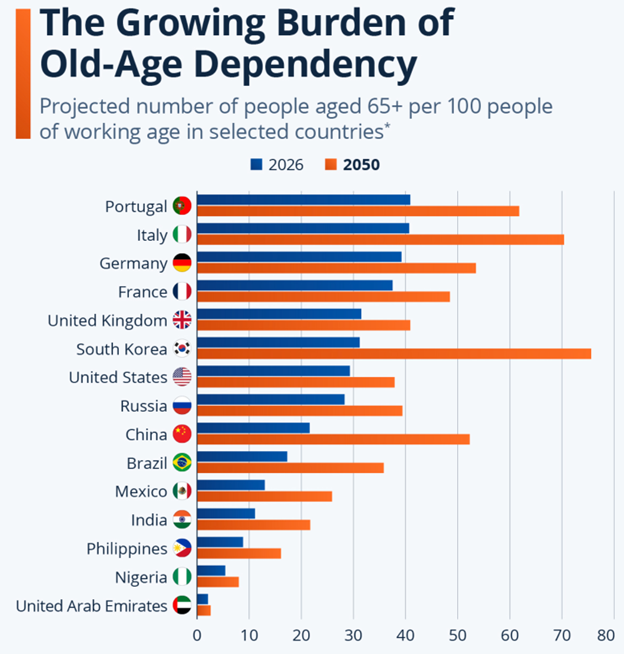 More elderly workers are clocking in each year as inflation, longer lifespans, and financial pressure make retirement harder to reach. (Source: Statista.com)
China’s workforce is shrinking. Birth rates have collapsed. Local governments that relied on ever-rising land sales now face declining revenues and mounting debt.
The United States still carries an enormous debt burden, but it retains deeper capital markets, higher consumption and the dollar’s central role in global finance.
Both countries are aging. But they are aging from very different starting points.
🏗️ A Tale Of Two Systems
That’s what makes the Trump Global Reset Tour Beijing stop more than a diplomatic visit.
The administration increasingly treats AI as an industrial system rather than a software story. Data centers require electricity at scale. Chips require fabrication plants that take years to build. Supply chains require shipping routes that can be secured during conflict. Rare earth minerals have to be mined, refined, and delivered without interruption.
China controls large portions of the critical minerals supply chain. The United States controls the deepest capital markets and the currency that still clears global trade.
Both sides are trying to close their gaps.
The Trump delegation matters. In the West, we’ve also counted on chaotic innovation to get us from A to B. When you bring the heads of technology firms, banks, manufacturers, and energy companies into the room, the discussion isn’t theoretical. It’s about capacity—who builds it, who finances it, and who controls it.
Back in the early 2000s, globalization ran on efficiency. Production moved to wherever it could be done cheapest, and the system held together because energy was abundant and geopolitics were relatively stable.
Now the organizing principle is resilience.
Countries are willing to pay more to secure supply chains, build domestic capacity, and control key inputs because they no longer assume the old system will hold.
🇺🇸 US Deficit Exceeds 100% of GDP With $1 trillion Annual Interest
This is where the two systems diverge in practice.
The United States finances its obligations through markets. Treasury issues debt, rolls maturities, and relies on global demand for dollar assets to absorb the supply. Debt has crossed 100% of GDP, and interest payments exceed $1 trillion annually, but the system continues to function because capital still flows toward it during periods of stress.
China finances its obligations through the state. Local governments borrowed heavily against land sales that depended on population growth. As that growth slowed, the central government began absorbing those liabilities, shifting them onto the national balance sheet.
The debt doesn’t disappear in either system. It accumulates in different places.
The comparison we made years ago—China rising on production while the United States relied on credit—has evolved into something more complex. China’s demographic engine is slowing even as its debt load is rising.
The United States continues to rely on credit, but it does so with a currency that remains indispensable to global finance. Dollar 2.0 digital assets, crypto tokenization on buys us time… and a larger market of people who rely on credit to survive and thrive.
📜 Parliament orders colonies to house British troops in 1765
Every day, we find parallels in history. And since we are marking the 250th anniversary of the United States, it’s worth recalling how sensitive systems can be to cost assignment.
On May 15, 1765, Parliament passed the Quartering Act, requiring American colonies to house British soldiers in barracks, inns, stables, and unoccupied buildings when necessary. The law did not call for private homes to be seized in the dramatic way often imagined, but it did assume that the colonies would accept costs imposed from London.
New York refused to comply, preferring to consent rather than be commanded. Parliament responded by restricting the colony’s legislative authority until it complied. In Massachusetts, British troops pitched tents on Boston Common when barracks proved insufficient, placing soldiers directly among a population already agitated by new taxes and trade restrictions.
Friction followed. Street confrontations escalated. In 1770, the tension broke in the Boston Massacre, where five colonists were killed and trust between the city and British authorities collapsed.
The Quartering Act was designed to allocate costs across an empire.
The reaction turned on how those costs were imposed—and who was expected to carry them.
Two and a half centuries later, the question remains in a different form.
As the United States and China position themselves for a long competition over technology, resources, and capital, each system is asking its population to carry a growing share of the burden.
The difference lies in how long and how hot each can do it without the crowd getting crushed at the front of the stage.
~ Addison
P.S. It doesn’t matter how smart you are or how much money you make in the stock market if you give all your gains to Uncle Sam. Today in Grey Swan Live!, we hosted Nick and friends from Prime Corporate Services for a tax webinar to help you be confident you’re getting all the write-offs that properly structured individual investors are entitled to. As we discussed, you’ll be surprised by how much you may be leaving on the table.