
On July 18, 2025, we held a special session of Grey Swan Live! announcing a “seismic shift” in the monetary system. Congress had passed the Genius Act, paving the way for reliable regulations in the digital assets, including crypto, stablecoins and tokenization.
By October, our Dollar 2.0 theses had reached historic heights. Bitcoin reached $124,000. Coinbase, Ethereum and a few select companies have been building the “rails” for nearly a decade.
The sector hit a snag in the Senate Banking Committee over the Clarity Act, as the threat of blockchain disruption to the traditional banking system began to slow the progress of Genius.
Yesterday, Coinbase CEO Brian Armstrong said an agreement has been reached with the banking lobby over the last sticking point: “rewards” for stablecoin holders.
Coinbase aims to be the exchange of choice for investors seeking to trade USDC and USDT… stablecoins backed by the U.S. Dollar and Treasurys.
In short, the U.S. dollar is going digital. The blockchain rails will create a faster, more efficient and cheaper trading environment. Tokenization will enable fast transfers of digital assets, such as a “tokenized” Tesla share. The market for digital assets will be global, spanning every country and trading 24/7.
Because of the global reach and ease of use, Treasury Secretary Scott Bessent has gone on record saying a healthy “ecosystem” for stablecoins will be a vital tool for financing the U.S. $39 trillion in national debt moving forward.
Besssent anticipates the stablecoin market reaching $3 trillion by 2030.
Case in point? A soaring quantity of U.S. Treasurys, $8 billion, are now tokenized just on the Ethereum network:
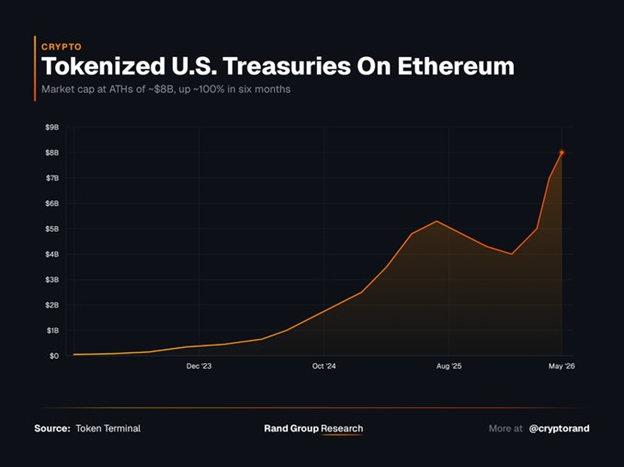
While Ethereum has trailed bitcoin in recent years, its growing role in tokenization and digital finance may justify significantly higher valuations moving forward. (Source: Rand Group)
Look how early this trend is. The U.S. has over $39 trillion in outstanding debt, yet only $8 billion of it has been tokenized.
That’s a 100% increase in just the past six months. And it’s still incredibly early.
It’s an early trend, and one likely to benefit the infrastructure plays, including the Ethereum cryptocurrency itself.
Tech bull Tom Lee, whose company Bitmine is aggressively buying Ethereum, sees the crypto moving to over $20,000 on its next bull run — nearly a 10X return from its current price near $2,250.
While Ethereum has lagged behind bitcoin’s performance since switching from proof-of-work to proof-of-stake, Ethereum’s real-world use cases justify significantly higher prices.
To get our top play for crypto’s upcoming regulatory glow-up, become a member of Grey Swan Pro — details here.
~ Addison
P.S. Quick program note: on Friday, May 15, at 2 p.m. EST/11 a.m. PST, we’ll be hosting a live webinar on taxes and trading. Are you making the most of your tax status to save and invest money? Find out on Friday:

P.P.S. Also, this week’s Grey Swan Live! features Jennifer Stevens, publisher and executive editor for one of our favorite publications, International Living. We’ll be chatting it up with Jennifer at 2 p.m. EST/11 a.m. PST today – Thursday, May 14 – about making those tax savings go farther overseas:

We bumped into and had dinner with Jennifer in Panama City a few weeks back at the beginning of March.
Over some fresh fish and an Argentine Malbec, we started a conversation about what she calls the “value proposition” that those who choose to retire overseas seek. Here’s a snippet of the email conversation that followed our meetup:
What most people don’t realize is that you can have a lifestyle that’s a lot more interesting and affluent than most people realize. The key is to explore your options abroad.
Because outside the U.S.—in the right spots—good living costs quite a bit less than it does in the States.
A couple can live well on as little as $1,700 a month in some places. The trick is to know where to go. And that’s what we show people at IL.
And to be clear: You don’t have to upend your life to take advantage of this “arbitrage.”
- You could buy a place – outside the US, outside the dollar, protect some of that hard-earned money from whatever may be coming down the pike in the US – rent it out for income, watch it appreciate, and you could enjoy it, too.
- You could spend part of the year abroad…
- You could, in fact, up sticks and move…
We invited Jennifer to join us this Thursday, May 14, at 2 p.m. EST. If you’re looking for a way to make your pile stretch further, beat inflation, avoid politics and give you a life with some adventure in it… you’ll want to join us and hear what Jennifer has to say.
As always, if you have any questions for us, send them to Feedback@GreySwanFraternity.com.