
Like a confused tourist peeking through the window of an overpriced wine bar, the S&P 500 came within pennies of its all-time high yesterday—before deciding it had somewhere else to be.
The index closed just 0.1% off its February peak, an improbable rebound after April’s tariff-induced nosedive.
Nasdaq? Already partying—logging its highest-ever close on Tuesday, boosted by a new wave of tech enthusiasm and hope that the Israel-Iran ceasefire might stick longer than last month’s avocado shortage.
Fair warning for today’s Swan Dive: We got a ton of economic data yesterday.
It’s fair to say, the market’s resilience isn’t coming from strength in the real economy—it’s running on the fumes of AI exuberance, deregulation promises, and the chance that the Trump administration might delay its July 9 tariff hammer.
That alone gave stocks another jolt yesterday, after the White House said the deadline “is not critical.”
One high flyer: Bitcoin mining company Core Scientific surged after rumors it might get swallowed by AI darling CoreWeave. The future, in market terms, belongs to companies who plug into – or are at least building – the Matrix.
Okay, then, let’s play data roulette…
 Spin the Indicator, Win a Headache
Durable goods orders jumped 16.4% last month—the biggest gain in 11 years.
That’s good news.
But before we celebrate Trump’s Great Reset, let’s also note that the boost in orders was almost entirely due to Boeing, which went from eight plane orders in April to 303 in May.
One corporate purchase does not a recovery make.
Weekly jobless claims dropped by 10,000—a good sign—yet continuing claims climbed to 1.97 million, their highest since 2021. Translation: layoffs are slowing, but the folks already out of work are staying there longer.
Meanwhile, GDP for the first quarter was revised down from an already mild 0.2% contraction to a firmer 0.5% drop, after it became clear Americans weren’t spending as much as originally thought.
Consumer outlays rose just 0.5% instead of 1.2%, the weakest showing since the COVID shutdowns.
Trump’s Worst Financial Nightmare Revealed (You Can’t Unsee This)
If you think President Trump, Wall Street or the Federal Reserve have the economy under control… you really need to see this eye-opening video…

It’s a system-wide lie. One that props up the entire U.S. economy — and is now starting to collapse. This story is unraveling quickly—yet no one is talking about—though they should be, and they soon will be. WATCH NOW.
 Consumers: Not Buying It
The Michigan Index of Consumer Sentiment remains stuck near historic lows after a 29% plunge earlier this year. That kind of collapse almost always signals recession—even if the charts haven’t caught up yet.
“Dangerous to overlook,” warns survey director Joanne Hsu. But overlook it we do, as Wall Street continues its keg stand.
This might have something to do with the consumer “vibe”:
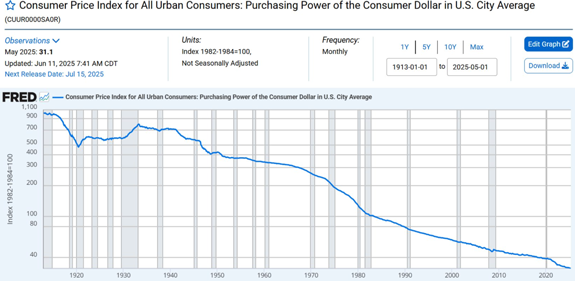
A measure of US consumer purchasing power ticks to all-new lows, once again. (Source: St Louis. Federal Reserve
 Trade Gap Widens, Predictably
The trade deficit in goods surged 11.1% in May to $96.6 billion. Exports fell 5.2%—the biggest drop since 2020—while imports stayed put.
And the current account deficit?

The quants at Kobeissi attribute the outsized trade deficit to global pre-orders in advance of tariff price hikes
(soure: X, The Kobeissi Letter)
The trade gap increased $138 billion in the first quarter alone, now clocking in at a cool $450 billion. That’s 6% of GDP—the widest gap since George W. Bush was still mispronouncing “nuculer.”
At an annualized rate, the U.S. is now running a $1.8 trillion tab with the rest of the world.
These are alarming numbers. But we can expect a reversal in this trend as data rolls in accounting for the Trump tariffs.
 A Witches Brew in Employment Data
Marc Benioff, spiritual leader of Salesforce and honorary member of the Optimism Industrial Complex, says AI now does 30% to 50% of his company’s work—including coding, support, and engineering.
“We can move on to higher-value work,” he told Bloomberg, presumably while high-fiving a server rack.

New AI-task masters and the Trump tariff regime are creating an interesting set of forecasts for employment moving forward. (Source: Bloomberg)
Salesforce laid off ~1,000 humans in February, even as it ramped up its AI division. Its new product, Agent Force, is live with 5,000 clients and gunning for a billion bot deployments by year-end.
Asked if AI might replace him, Benioff smirked: “I hope so.” Somewhere, a recently unemployed engineer is muttering, “same.”
 Fed Loosens the Belt, Banks Unbuckle
No, this isn’t Grey Swan After Dark.
In fact, we’ve been waiting for this announcement since the banking crisis that got swept under the rug March-May 2023.
The Federal Reserve voted yesterday to reduce the enhanced supplementary leverage ratio—a fancy way of saying banks like JPMorgan and Citi can now hold less capital in reserve. The vote was 5–2, with Fed Governor Michael Barr warning it “would significantly increase the risk” of a bank failure.
Wall Street, ever consistent in its short-term memory, cheered the news. Bank stocks rose. Lessons from 2008 stayed buried in the basement next to Lehman Brothers swag.
 Crypto on the Mortgage Menu
The Federal Housing Finance Agency issued an order for Fannie Mae and Freddie Mac to start considering cryptocurrency when evaluating mortgage applications. But only if those assets are stored on U.S.-regulated exchanges and documented properly.
Hmm.
The agencies that helped crash the economy with mispriced mortgage risk are now warming to Ethereum reserves. Somewhere, a 2006-era mortgage broker is kicking himself for being too early.
 Eric Adams: “Hands Up, Not Handouts”
Mayor Eric Adams responded to Zohran Mamdani’s socialist primary win with a speech that combined old-school grit and motivational flair.
“This is not a city of handouts,” he declared. “This is a city of hands up.” He went on to describe New York as a place where a dishwasher can become a restaurant owner, and a cabbie a doctor.
He then led the crowd in a chant: “Focus, no distractions, and grind.” You may disagree with the politics—but as Friday mantras go, it beats “FIRE Jerome Powell.”
The election isn’t until November. But this race has already encouraged thousands of hours of social media handwringing across the national political landscape. Only the details will matter from here. More to come…
 The Accidental Arms Dealer
We end the week with this finance blooper: Jane Street co-founder Robert Granieri, who admitted he was duped into donating $7 million to what he believed was a human rights group. It turned out to be a coup operation in South Sudan. The money was used to buy AK-47s, Stinger missiles, and grenades.
If you’ve ever misread an invoice, take comfort: at least your clerical error didn’t arm a rebel militia.
This week set the stage for our tale of two Americas. On one side: the market, basking in the glow of AI, deregulation, and geopolitical breathers. On the other: consumers pulling back, deficits ballooning, and sentiment collapsing. Politics picking and choosing winners and losers along the way.
You could say it’s just the season. But heat waves don’t last forever.
~ Addison
p.s. Crypto exchange Kraken launched a super app for crypto and tiat transfers yesterday. The peer-to-peer app to rival Venmo and Cash App.
It works in over 100 countries, supports 300 assets, and promises instant blockchain-based transfers—plus fiat transactions handled internally.
It’s slick, fast, and has regulators already reaching for their blood pressure meds.
We got a master class in crypto assets, the evolution of the digital economy and the fast-moving regulatory environment from Ian King in yesterday’s Grey Swan Live!
Paid up members will want to make sure they tune in. The video is posted in the Grey Swan Fraternity Video archives, right here.
Your thoughts? Please send them here: addison@greyswanfraternity.com