Beneath the Surface
Grey Swan Forecast #6: China Annexes Taiwan — Without a Shot Fired

December 26, 2025 • 7 minute, 15 second read
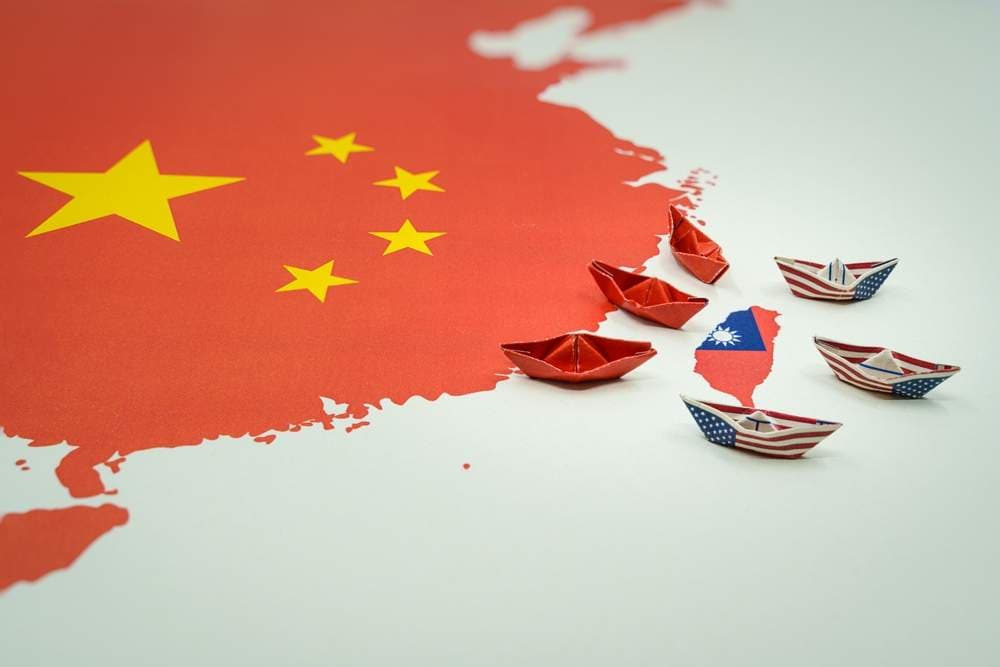
“A war in the Taiwan Strait would destroy China’s international relations overnight. It would destroy Chinese – Japanese relations, not to mention Chinese – American relations.”
-William Kirby
December 26, 2025 — There are moments in history when power moves quietly, deliberately, and in full view — and most observers still miss it.
The year 2026 will be remembered as the year China completes the long game in Taiwan. No amphibious landing. No missile salvos. No drones. No cinematic shock.
The annexation will unfold through incentives, dependencies, and timing. The tools are trade, capital, logistics, elections, and exhaustion.
This Grey Swan does not require war. Disagreement or violence. It requires patience — and Beijing has been patient for decades.
 The Setup Beijing Has Been Building For Years
Taiwan sits at the center of the global technology stack and at the edge of China’s political imagination. Semiconductor dominance made it indispensable. Cultural proximity made it familiar. Economic gravity made it vulnerable.
By 2026, China will judge that conditions favor absorption rather than invasion.
Western military planners still model Taiwan as a kinetic scenario. Beijing no longer does. The lesson from Ukraine’s drone war has been absorbed. Wars of attrition are expensive, slow, and politically corrosive. Occupation destroys value.
Influence preserves value.
The Financial Times captured the shift in tone last year, noting that Beijing’s Taiwan policy had moved toward “persistent pressure paired with selective incentives,” rather than escalation. Bloomberg described China’s approach as “economic encirclement with diplomatic off-ramps.”
Those off-ramps matter.
 Long-Game Tools: Bribery, Supply Chains, and Fatigue
China will deploy three instruments simultaneously:
First: Economic inducement.
Preferential trade access. Guaranteed chip demand. Joint ventures structured to preserve management autonomy while transferring strategic alignment. Quiet debt relief for Taiwanese firms with mainland exposure.
Second: Supply-chain leverage.
The Trump tariffs accelerate regional reshoring and fragment global trade. Taiwan’s export model becomes more sensitive to Chinese demand at the exact moment the U.S. turns inward. Beijing fills the gap.
Reuters reported this year that Taiwanese manufacturers have already expanded mainland capacity “to hedge geopolitical uncertainty.” Hedging becomes habit. Habit becomes dependence.
Third: Political timing.
The United States enters 2026 in election mode, distracted by debt, markets, and domestic conflict. That is, if the political cycle allows them to consider such trivial things.
Washington’s appetite for confrontation declines as fiscal capacity tightens. One would think.
The Monroe Doctrine draws attention to the South. Asia becomes a topic of discussion rather than a theater of war. Remember, this is a forecast.
In Empire of Debt we warned years ago that empires lose leverage abroad when balance sheets weaken at home. Strategic ambiguity tends to decay most rapidly under budget pressure.
You wouldn’t know that at all from what the media reports on Pete Hegseth’s actual spoken words. The political motive behind foreign policy right now is as calculated as it’s been since Reagan vowed to spend the Soviet Union into obsolescence.
Hegseth is a convenient punching bag.
 The Cultural Argument Beijing Will Lean On
China will frame annexation of Taiwan as a form of reconciliation rather than conquest.
The Han Chinese share a language with Taiwan. They claim shared ancestry. Shared prosperity. A “one country, many systems” pitch refurbished for a new generation — with cash flow substituting for ideology, at times effectively.
President Trump in his current iteration as president, is behaving as he always has: transactionally.
The Wall Street Journal recently observed that Beijing’s messaging on Taiwan has shifted from emphasizing military inevitability to emphasizing “historical completion.”
That phrasing matters. History feels less negotiable than long-game strategy.
Taiwanese voters will face a narrowing set of options: economic friction, political uncertainty, or managed integration with guarantees that appear credible in the short term. If they are afflicted with the European impulse to favor climate initiatives to furnish the global commodity what it needs… or wants… well more power to them.
It’ll be interesting to see how slow annexations work. The Taiwanese, except for the nationalists, will feel the incentives, voluntarily, until the golden handcuffs are firmly in place.
Washington retains an enormous military capacity. There aren’t a lot of folks left in the world that would dispute that fact. What the establishment will lack in 2026 is political bandwidth.
It’s mundane and a bit pedantic to say: Debt service competes with defense spending.
The Congressional Budget Office projects that interest costs will consume an ever-larger share of fiscal output unless spending is reined in. Growing our way out of the enormous federal debt is a fiction we delude ourselves with.
We’re at the point we described in Financial Reckoning Day at a formative phase in my own understanding of the world economy. A quick sum of those thoughts: the difficult moment arrives when an empire continues to project military power, even if it’s just for YouTube views, all the while negotiating behind the scenes for respectable limits.
The Pentagon can deter a landing. It cannot reverse a referendum shaped by economics. As one senior U.S. defense official told Politico this year, “Deterrence works best when you’re willing to use it.” Willingness erodes under electoral pressure.
Tough spot.
Beijing is keenly aware.
 Markets Will Understand Before Diplomats Do
Markets will not treat this as a crisis. There are professional money managers who understand what will happen if they are bad at reading the tea leaves.
Semiconductor equities will adjust to political realities. Defense stocks will spike briefly on announcements regarding the conflicts around the world Trump has publicly claimed he has solved.
On the ground, shipping insurance will get more difficult. The Taiwan dollar will weaken modestly. Capital will likely rotate toward mainland beneficiaries.
The absence of panic is what we’ll be looking for to see whether the incentives in place for the Taiwanese make sense… for them!.
Systemic transitions initially appear as reallocations, or a specific line item on a balance sheet. Our sound bite world conditions us to expect something dramatic in the news.
Not in this case, at all.
Taiwan’s shift will look orderly because capital prefers order — even when politics does not.
Expect Wall Street research notes to describe the outcome as “stabilizing” and “clarifying.” Expect policymakers to echo the language after the fact. Somehow, the voting public in the US will come to accept Taiwan’s fate with little more than a “huh?”
The business interests will be seeking a more transactional outcome… a kind of “what’s in it for me?” to a complex cultural and political shift “no one sees coming.”
 Annexation by Accretion
The way they’ve been operating since the early 1990s, China does not need to announce victory. As they’ve been demonstrating since their reemergence on the global stage, their historical claim is less about control than alignment of incentives – both carrots and sticks.
Joint regulatory frameworks. Coordinated monetary policy. Shared digital infrastructure. Security guarantees that sound reassuring and arrive with conditions.
A Financial Times columnist wrote recently that “the most successful territorial expansions in history rarely involved fireworks.” They involved paperwork. Tedious and slow… paperwork.
China’s much-ballyhooed advance on Taiwan will, too. Why would it be any different?
 Why This Is Grey Swan #6
Our forecast will feel obvious in hindsight and controversial in advance — the hallmark of a Grey Swan.
Most analysts we speak to are thinking in terms of the history of Western conflict.
They expect full-frontal military engagement.
Beijing, from our modest perch, prefers resolution because resolution compounds its power. Why sacrifice the workshop of the world, when cajoling and bribery will do?
Taiwan will not fall.
It will merge.
I am secretly hoping someone will prove us wrong…
When Taiwan is no longer a strategic asset in the global chess game of natural resources, the international order will adjust quietly, markets will reprice calmly, and historians will debate the date it truly occurred.
Our guess? 2026 is when the process becomes undeniable. Who knows what the Trump administration’s response will be? They’ll have their hands full duking the Chinese out in a covert resource war in South America.
Addison
Next up: Grey Swan #5 — Europe Fractures Under the Weight of War, Debt, and Bureaucracy.
P.S. There’s one positive Grey Swan event for 2026 – we’re putting an AI-powered patent to work in our Grey Swan Trading Fraternity.
This patent allows us to harness knowledge about what’s moving in the options market – filtering out a lot of the typical “noise” in unusual options activity to detect actual big-money moves.
Big moves in the options market often precede a big move in an underlying stock – providing better opportunities.
Our research goes live soon – click here to sign up and get on the waitlist.