“Cynics were delighted at the spectacle of a country trying to collect debts from abroad and at the same time shutting out the import goods that could alone have provided the payment for those debts.”
– Paul Samuelson, discussing the Smoot-Hawley Tariff
August 30, 2024 – We’ve got another dot to connect today.
The dots include gold hitting new all-time highs, the value of the U.S. dollar, as we discussed yesterday, and … the simmering election issue of trade tariffs.
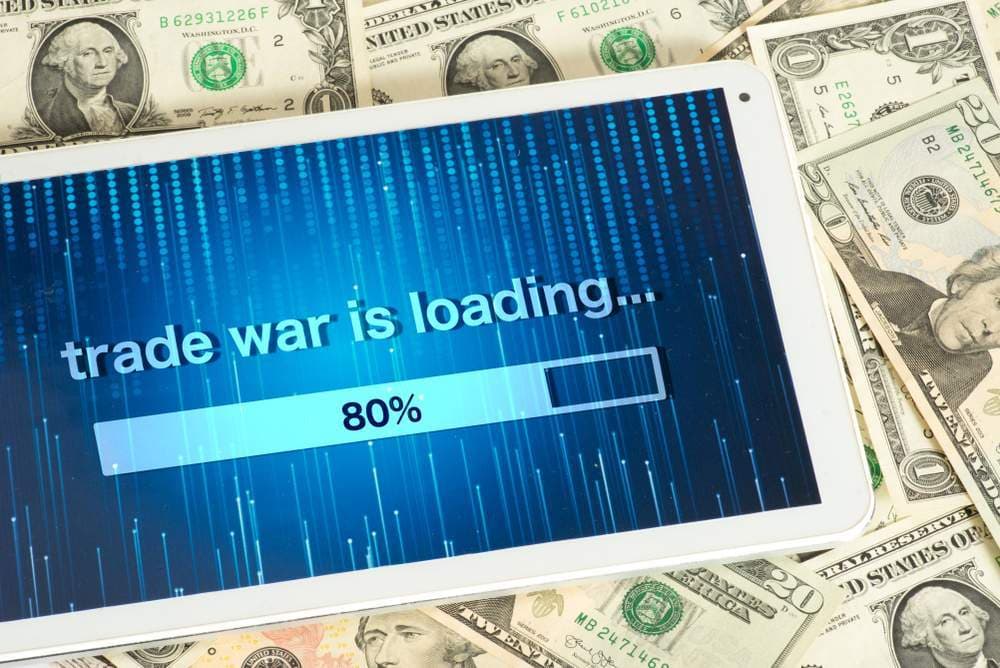
Former President Trump was a fan of instigating “trade wars” usually by using an executive power to tax goods coming in from another country for some reason or another.
The sardonic ol’ apprentice firer even once boasted that trade wars were “fun” and “easy to win.”
Regrettably, the trade war enthusiasm transcends party lines. Neither party is particularly fond of free trade these days. President Biden has joined in, rather famously banning the export of high-end American semiconductor chips to China.
History teaches us that free trade is best. It allows countries to employ their comparative advantage. America’s brains and capital create all sorts of interesting new gadgets (and technological services).
The rest of the world has the physical labor to make all sorts of goods at a low price, from the high-tech to the low-tech.
With the prospect of Trump’s return to the White House, still running about 50/50 in the betting markets, it’s prudent to look at how America’s trade policy could be guided by Trump in the near future.
If Kamala wins, also a 50/50 shot, and the pattern holds, she’ll merely co-opt Trump’s or even one-up Trump’s trade policy.
Financial analyst, freedom fiend and fraternity friend Joel Bowman helps us with a forecast either way, below. Enjoy ~~ Addison
Mr. Trump’s Trade War
Joel Bowman, Notes From the End of the World
What’s in a price?
Much in the news of late, the concept of the “fair price” is so simple, so obvious, it takes an advanced degree in economics to misunderstand it.
In a free market, a “fair price” is whatever the buyer and seller agree to. Nothing more. Nothing less. If the price is not deemed “fair,” and neither party is compelled to enter the trade, the trade does not take place and each party goes his own way, the one preferring the money in his pocket, the other the good on his shelf.
Only when coercive actors – usually the State…but also common thugs, gangs, frauds and other petty aggressors – enter the market does the concept of an “unfair price” even become a possibility, much less a reality.
Misnomers and malapropisms like “price gouging,” “profiteering” and “greedflation” may appear on politicians’ lips but, as the astute reader will readily observe, only when these alleged angels are promoting a “solution” to the imagined problem… one that involves their trespassing directly into the market, their pudgy thumbs ever in search of a scale, their hungry pockets ever open to their (unfair) share of the proceeds.
Ultimately, fair prices are free prices. That is, prices agreed upon during the voluntary trade of free individuals (and parties comprised thereof). Moreover, absent coercion, the result is always and everywhere a net positive, each party having procured his preferred end, be it a good, service or recompense in exchange of the same.
Disaster vs. Catastrophe
As it happens, the aforementioned political class – from one end of the Americas to the other – is full of geniuses with patrician degrees and plebeian intellects. And so, where we ought to have clear-headed thinking, we have instead muddle-brained market distortions.
In the Games of the 2024 United States Presidential Olympics, two competitors presume to know what prices ought to be. Both are wrong, though not in the same way. One proposes merely a disaster; the other, a full-blown catastrophe. Over the next couple of Notes, we will take a closer look at both…
On the one side, Donald J. Trump promises to impose his will on prices by introducing a slew of trade tariffs; 10% on goods coming in from around the world… up to 60% on goods from China.
“It’s basically you hurt us, and we hurt you,” Mr. Trump told supporters at a rally in Pennsylvania last week, talking tough on the subject of introducing reciprocal tariffs on trading partners.
“It’s an eye for an eye,” added the former president, who evidently doesn’t see much value in Ghandi’s “leaves the whole world blind” addendum.
And yet real, visionary leadership would be to negotiate tariffs and trade barriers down, not up. After all, trade wars have a nasty tendency of turning into hot wars. As the old saying goes, “When goods do not cross borders, soldiers will.” Better the former.
Ignoring all that over the weekend, Trump told supporters in Wilkes-Barre, PA, “a tariff is a tax on a foreign country: That’s the way it is, whether you like it or not.”
When he added, “It’s a tax that doesn’t affect our country,” he must have left some to wonder, “So, why bother?”
Enter, politics.
Minding the Gap
Tariffs have long been proposed by protectionists who wish to be seen punishing foreign nations while coddling domestic industry. As such, they are popular with workers of preferred industries, who pledge their vote in the vain hope that their jobs will be “protected.”
In reality, the unintended consequence of such policies is to impose a tax, albeit an indirect one, on consumers at home – including those same “protected” workers – who are now forced to subsidize a given industry by paying more for its products.
In this case, it is the American consumer – at both the retail and commercial levels – who will pay higher prices, not only for imported goods, but domestically produced ones, too (raising the price floor on foreign suppliers practically guarantees domestic producers will do likewise to fill the gap).
Moreover, higher prices do not obediently confine themselves to a single sector or industry. Rather, they domino along the entire value chain, such that a tariff which raises prices on (say) steel, ends up raising prices on finished goods that employ the underlying commodity. A steelworker whose job is “protected” ends up paying more for finished goods using steel…and any other goods or services in which steel forms part of the value chain.
Pretty soon, those additional costs add up. The Peterson Institute for International Economics ran the numbers:
A lower-bound estimate of costs to consumers indicates that the tariffs would reduce after-tax incomes by about 3.5 percent for those in the bottom half of the income distribution; tariffs would cost a typical household in the middle of the income distribution at least $1,700 in increased taxes each year. If executed, Trump’s latest tariff proposals would increase manifold the distortions and burdens created by the rounds of tariffs levied during the Trump administration (and sustained during the Biden administration), while inflicting significant collateral damage on the US economy.
In addition to higher prices for retail customers and businesses, along with increased lobbying for special interests and political favoritism, to say nothing of escalating retaliatory tariffs, consumers across the board also suffer from diminished market choice, as foreign goods are priced out of the market and/or find their way to friendlier shores, where consumers in other countries (including competing international businesses) are able to enjoy the bounty of free(r) trade.
The Wealth of Nations
Simply stated, managed trade is not free trade, and free trade is the cornerstone of economics going back at least as far as Adam Smith’s Wealth of Nations. American presidents, of all people, ought to know this, given that Smith’s momentous work was published in the very same year America, itself, became a nation (1776). Wrote Smith of the inherent advantages of free trade:
“In every country it always is and must be the interest of the great body of the people to buy whatever they want of those who sell it cheapest.”
Smith considered free trade as an fundamental aspect of the specialization of labor when he expounded:
It is the maxim of every prudent master of a family, never to attempt to make at home what it will cost him more to make than to buy.
The tailor does not attempt to make his own shoes, but buys them of the shoemaker. The shoemaker does not attempt to make his own clothes, but employs a tailor. The farmer attempts to make neither the one nor the other, but employs those different artificers. All of them find it for their interest to employ their whole industry in a way in which they have some advantage over their neighbors, and to purchase with a part of its produce, or what is the same thing, with the price of part of it, whatever else they have occasion for. What is prudence in the conduct of every private family can scare be folly in that of a great kingdom.
Might vs Rights
If a foreign business makes a sweater, or a sneaker, or an automobile cheaper than does an American business, let them! And let American consumers – including American enterprises – be the beneficiary of that relatively low cost good. Then let American businesses, having thus benefited from cheaper goods, “employ their whole industry in a way in which they have some advantage over their neighbors,” whatever that may be.
What right does the tailor or shoemaker or auto-manufacturer have to employ an agent of force – his own government, no less – to deny his fellow citizen the opportunity to purchase a good of equal quality at a lower price, or of superior quality at the same price, whether that manufacturer be from another city, another state or another country?
And how is it beneficial to a home, a business or a nation, to impose on itself a tax that guarantees higher and higher priced goods? Or to pursue (and pretend to protect) industry in which it has little or no competitive advantage? To continually “attempt to make at home what it will cost him more to make than to buy”?
Most people know all this instinctively, as a matter of common sense, that we enjoy a comparative advantage when we have access to cheaper goods, as furnished by free trade, not more expensive ones, as guaranteed by trade wars. Alas, there is something in our “Us vs. Them” genetic composition that mankind struggles to shed…and that politicians are only too willing to exploit.
And yet, while Mr. Trump’s trade war tariffs propose a mere disaster for America, they tremble in comparison to the full blown catastrophe promised by his opponent, Kamala “The Price Czar” Harris.
We’ll address all that in the next installment of Notes From the End of the World…
Cheers
~~ Joel Bowman, Notes From the End of the World
So it goes,
Addison Wiggin,
Grey Swan