
Officials at the International Energy Agency (IEA) have recommended the largest coordinated release of oil reserves in the organization’s fifty-year history.
The proposal circulating among member governments calls for 400 million barrels from strategic stockpiles, according to reporting in The Wall Street Journal.
The IEA was created in 1974 after the Arab oil embargo, when industrial economies organized a coordinated response to supply shocks.
Today, its 31 member countries maintain roughly 1.2 billion barrels of emergency reserves, each country holding inventories equal to 90 days of net imports.
When disruptions threaten supply, those reserves move into the market. “Disruptions” like, say, a U.S.-Israeli led military “excursion” that would, umn, shut the Strait of Hormuz to oil tanker traffic.
Or… something along those lines.
Analysts at JPMorgan estimate a coordinated release could supply roughly 1.2 million barrels per day. Historical emergency drawdowns have reached 1.4 million barrels per day when several countries peaked in different months.
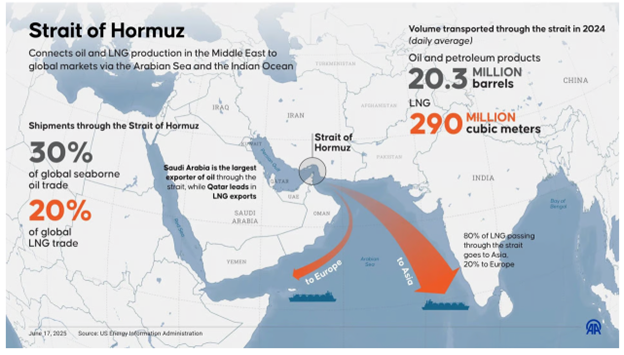
Shipping through the Strait of Hormuz normally carries roughly 16 million barrels per day of oil. Forced production shut-ins could remove about 12 million barrels per day from global supply within two weeks if tanker traffic continues to slow.
A 1.2 million barrel per day reserve release replaces roughly 7.5% of that flow.
Strategic reserves ostensibly provide breathing room while producers adjust, insurers get more gumption and shipping lanes reopen.
🌏 China and India Respond Differently
Large energy consumers outside the IEA system are responding in their own ways.
India has declined to participate in the coordinated release, telling Reuters that its 5.33 million tonnes of strategic reserves are intended to protect domestic supply rather than stabilize global markets.
The decision comes as the Indian rupee touched a record low against the U.S. dollar, raising the cost of imported crude. Indian officials have been arranging alternative cargoes and recently secured a temporary waiver allowing the purchase of Russian oil shipments stranded at sea.
China is approaching the disruption with deeper inventories.
Estimates place China’s strategic and commercial reserves near 1.2 billion barrels, providing roughly 100 days of import coverage. Chinese refiners continue purchasing Russian crude and other discounted cargoes while settling some transactions outside the dollar system.
While the IEA coordinates releases among Western economies, China and India continue sourcing oil through parallel supply channels.
🇺🇸 Washington Debates the Strategic Reserve
The United States has not yet committed to the proposed release. Reporting from both Politico and The Wall Street Journal indicates the White House has placed a Strategic Petroleum Reserve drawdown “on the table” as fuel prices rise following the Iran conflict.
But, the IEA, we remind you, is among the institutional components of the post-World War II Pax Americana world order that Donald Trump has been suspicious of his entire adult life.
In the president’s cabinet, Energy Secretary Chris Wright has argued that recent price moves reflect market fear and perception rather than a physical shortage of crude.
Like a phrentic child coming down off a sugar high, Senate Majority Leader Chuck Schumer has been (inanely) urging the administration to release reserves to shield consumers from rising gasoline prices.
If the IEA proposal moves forward after the G7 meeting chaired by France today, analysts expect the United States and Japan to provide the largest shares of any coordinated release.
The U.S. Strategic Petroleum Reserve currently holds about 415–416 million barrels, well below its 727-million-barrel capacity after the large drawdowns of 2022.
🚢 Ships Moving Quietly Through Hormuz
According to TankerTrackers, at least 11.7 million barrels of Iranian crude have passed through the Strait of Hormuz since February 28, nearly all of it bound for China.
Several vessels switched off their GPS transponders while transiting the waterway. Shipping analysts refer to the maneuver as “going dark.”
Other tankers, say confident tweeters on X, have adopted the practice of falsely flying the Chinese flag to prevent being targeted by Iranian drones.
Iran has resumed loading tankers at the Jask terminal on the Gulf of Oman, a port that bypasses the Strait entirely. A supertanker can take up to ten days to load at Jask, compared with one to two days at Iran’s main export hub on Kharg Island.
The United Kingdom Maritime Trade Operations agency reported that three vessels transiting the Strait were struck by projectiles, adding another layer of uncertainty to traffic through the corridor.
Earlier intelligence reports suggested Iranian forces had begun placing mines in the channel. President Donald Trump warned that mines should be removed or Iran would face “military consequences at a level never seen before.”
Traders responded through the options market.
The one-month call-put skew on WTI crude futures climbed to roughly 30, the highest level in four years.
Our own Andrew Packer recommends an energy stock play, as higher oil prices in general – no matter how much they bounce around – should be good for the profitability of energy companies in Q1 and Q2 2026.
💻 Artificial Intelligence and the Billionaire Count
Across the technology sector, capital continues flowing toward artificial intelligence. According to Forbes, there are now 86 AI billionaires worth a combined $2.9 trillion.
Forty-five new billionaires joined the Forbes list during the past year alone.
One of the newest entrants is Edwin Chen, founder of Surge AI, whose data-labeling company has lifted his estimated net worth to $18 billion. Chen retained more than 75% ownership by avoiding traditional venture capital funding.
Artificial-intelligence branding has spread across industries that previously had little connection to machine learning. Consulting firms, research labs, healthcare companies and defense contractors now describe themselves as AI companies.
Much of the valuation expansion has occurred in private markets.
Professional traders in the public markets have shown more skepticism and restraint. Retail investors? Well, they still loooove the AI trade.
Oracle shares jumped 8% in after-hours trading on Tuesday after stronger-than-expected cloud revenue.
Larry Ellison’s stock remains down 56% from its September peak, the worst performance among S&P 500 companies during that stretch.
💰 The President’s Balance Sheet
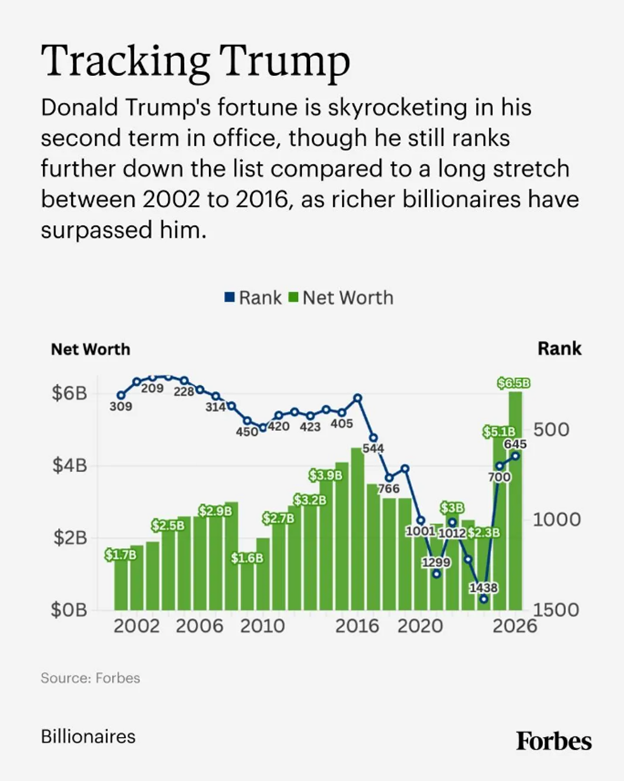
Forbes couldn’t help but take a whack at the president either. According to the Forbes list, President Donald Trump’s net worth has reached $6.5 billion, roughly $1.4 billion higher than a year ago.
A large portion of that increase came from the president’s cryptocurrency venture World Liberty Financial, which sold digital tokens and a 49% stake to a firm backed by UAE national security adviser Sheikh Tahnoon bin Zayed Al Nahyan. Forbes estimates the transaction delivered $200 million to Trump.
Token sales added roughly $550 million more.
Trump still holds large stakes in World Liberty Financial ($WLFI) and his $TRUMP memecoin, together valued near $570 million after liquidity discounts.
Meanwhile, Trump Media & Technology Group, the parent company of Truth Social, reported $712 million in losses in 2025 on $3.7 million of revenue.
Program note: The Grey Swan research team recently undertook our own study of the investments in Trump’s portfolio. While the crypto angle gets a thumbs up from the president, those are largely to placate his son Eric.
Trump recently stated he thought the Dow, noticeably lighter on tech stocks than the S&P 500 or Nasdaq, would reach 100,00. Yes, 100k on the Dow. That would be a big bet on AI’s application to stocks in the real economy.
Even then, the most striking balance of Trump’s personal portfolio reflects his “America First” agenda in an old-school, “boring,” some would say, way. You’re going to be surprisedby what investments we found under the hood of Trump’s portfolio. The report is all but finished… details when we’re ready to publish.
🏦 They Don’t Make ‘Em Like Ed Hale Anymore
Yesterday, we had lunch with Ed Hale in Baltimore’s Rosedale neighborhood.
After starting his career at the Port of Baltimore in the late 1960s, Ed founded Hale Intermodal Trucking and expanded into barge companies and logistics businesses. That early foray into barges led to one of the East Coast’s most interconnected, sophisticated transport systems.
In 1991, he launched a proxy battle for control of the Bank of Baltimore and later founded First Mariner Bancorp, which grew into a regional bank with $1.2 billion in assets and was integral to business development across the Mid-Atlantic region and specifically Baltimore’s Inner-Harbor, Harbor East and the waterfront along the Patapsco in Fell’s Point and Canton.
He’s a character. Folks have called him “the John Dutton of Maryland.”
Over lunch, Hale said he explained why he’s running for governor.
He spoke about Maryland’s disastrous climate paranoid energy policy, which has, despite the state’s vast natural resources, weakened industrial capacity, forced the state to import the preponderance of its energy from the surrounding states and driven residential utility rates to unaffordable highs for most of its residents.
Hale also pointed to the incomprehensible delay in reconstructing the Francis Scott Key Bridge, whose collapse disrupted one of the busiest ports on the East Coast.
“The harbor is the lifeblood of the city,” he said. The economic impact of the closure of the waterway following the bridge collapse on March 26, 2024 is estimated to have been $15 million per day.
Currently, Maryland officials have said they plan to replace the bridge by late 2030; initial cost estimates of $1.7 billion to $1.9 billion were later revised to $4.3 billion to $5.2 billion.
The banker in Ed bristles at the delay and cost overrides.
He’s also fired up about a Wed Moore’s abdication of gubernatorial duties – like a balanced state budget – in favor of national exposure for the Democratic machine. “Why he insists on poking the bear [Trump] and losing business for the state,” Ed mumbled while we were talking, “I don’t know.”
Under Moore’s tenure as governor of Maryland, the State has lost a contract to build a new FBI headquarters in Greenbelt and shunned the buildout of AI data centers leaving them to Virginia and Pennsylvania.
Ed laments the loss of the Washington Commanders NFL team who are vacating their long premises in Landover, MD, and the closure of Six Flags in Prince George’s County.
Ed’s planning a press conference at the site of the 500-acre vacated location where the amusement park stood, and will propose the build-out of a nuclear energy facility on the site.
“I know how to build them, finance them, depreciate their value,” Mr. Hale says of the modern nuke plants. “It’s what I do.”
Don’t even get the man started on rampant crime in his native city…
🌍 Chokepoints In Memory
On March 11, 2011, a 9.0 magnitude earthquake off Japan’s northeastern coast triggered the Tōhoku tsunami, which led to the Fukushima Daiichi nuclear disaster. Backup cooling systems failed after the quake.
Reactor cores overheated, and hydrogen explosions damaged the plant over several days.
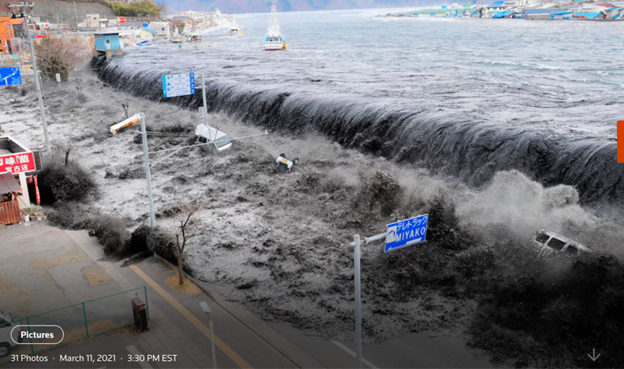
More than 18,000 people died in the Fukushima earthquake and tsunami, and 150,000 residents evacuated the surrounding region. (Source: Shutterstock)
We remember the exact moment the news hit about the tsunami overwhelming the nuke plant. That particular morning, we were standing in the lobby of a hotel in Bogotá, Colombia, just after meeting with bankers outlining infrastructure plans around a gold mine.
An eerie calm had descended across the lobby. Television screens above the bar in the corner showed seawater sweeping across Japanese farmland.
The Fukushima Catastrophe set back the nuclear revival that had been underway for at least a decade.
And came right at the height of climate change hysteria that had started with Al Gore’s documentary “An Inconvenient Truth” and culminated with President Obama’s Clean Power Plan to limit power plant emissions, investing heavily in solar and wind energy, and securing the international Paris Agreement.
Last month, the Trump administration revoked the 2009 EPA Greenhouse Gas Endangerment Finding, removing the legal basis for regulating greenhouse gases from vehicles and power plants.
~ Addison
P.S. We’ve spent a lot of time in Nicaragua, some in Costa Rica and Colombia. But never in Panama. Tomorrow, we’re going to fix that.
We’re traveling to join The Gathering, a group of investors in an international real estate project led by friend and associate Ronan McMahon and his team at Real Estate Trend Alert.

Ronan stuck in the sand in Baja California – living the life!
Along with Alfredo Alemán we’ll be examining Panama’s 20-year outlook in a world where chokepoints and liquidity matter more than headlines. As well as some choice properties in Panama’s most cosmopolitan city.
The Ipanema and Beachwalk briefings will provide us with context on jurisdiction, infrastructure, and the long-term prospects for allocating some of our capital to vacation rentals across Latin America and in select places in Europe.
We’re looking forward to it. The Gathering was a unique experience in Playa del Carmen, Mexico last year. We expect nothing less of Panama City this year. Learn more here…