
When news hit that the Clarity Act was getting a markup in the Senate Banking Committee, crypto got a boost.
But since then? Prices have been less than exciting for the individual investor. After getting back to its 200-day moving average, bitcoin prices have slumped again.
While that price action is frustrating, this current crypto winter is offering investors something far more interesting – the fusion of traditional finance and crypto-backed projects.
Case in point? On-chain crypto card payment volume continues to soar:
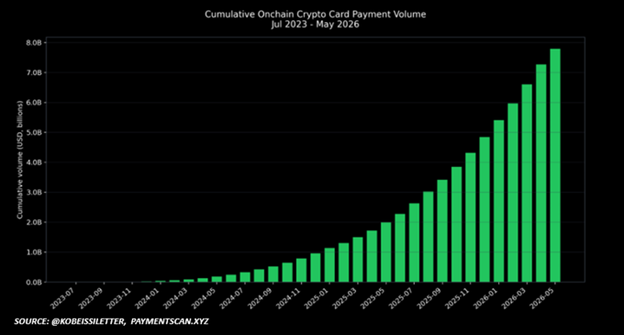
Card payments backed by stablecoins are soaring, even ahead of better regulations such as the Clarity Act. (Source: Kobeissi Letter)
This is the sign that Dollar 2.0 stablecoins are proving their mettle. And that payment systems can be improved in the 21st century. The industry is well on its way to Treasury Secretary Scott Bessent’s forecast that a healthy stablecoin ecosystem will reach $3 trillion by 2030.
Here’s the rub: The world isn’t migrating to a crypto payment system. The legacy financial system is merging with crypto instead.
The end result is still beneficial for end users: Lower fees, faster transaction settlement times and clarity on the blockchain for exactly when and where a payment went.
Yes, crypto has been rather boring lately. Most of the investors who would have poured capital into altcoins right now have moved on to high-flying semiconductor and space stocks.
Never fear… the infrastructure is being built. And the growth will bring profits to the companies best positioned to benefit from soaring stablecoin volume.
There’s more than one way to play this trend, and one of the best ways may be with a traditional financial company with a strong moat and fat profit margins – which the rise of stablecoin transactions could make even better. To learn more, become a member of Grey Swan Pro — details here.
~ Addison
P.S. This morning’s data shows persistent inflation may become a feature of the economy in the years ahead as we move from an era of structural disinflation to structural inflation.
The most notable signal is rising long-term rates in the face of Fed efforts to cut the short-term. The signal we propose will trigger a rotation of up to $17 trillion into an unloved and overlooked segment of the S&P 500.
Investors need to prepare.

Grey Swan Live! returns this afternoon with a closer look at our latest research: The Great Race.
A global scramble is now underway for:
- Energy.
- Semiconductors.
- Industrial capacity.
- Strategic minerals.
- AI dominance.
- And monetary control.
Most people still see tariffs, gold, stablecoins, Saudi Arabia, AI, and the bond market as separate stories.
They aren’t.
They are all symptoms of the same transition: The world moving from an era of structural disinflation … to structural inflation.
And that changes everything about investing.
The physical economy is reasserting itself after decades where finance and software dominated nearly everything.
That may become the defining investment shift of the next decade.
👉 Join us Thursday at 2 p.m. ET for Grey Swan Live!
Because the race is already underway.
Most investors just haven’t realized it yet.
If you have any questions for us, send them to Feedback@GreySwanFraternity.com.