Ripple Effect
One Sign that Government Spending Is At a Crisis Point

August 7, 2026 • 2 minute, 53 second read
Let’s see, “yuppies” were in… brick-sized mobile phones, Rolex watches and women’s “power suits” with exaggerated shoulder pads.
The 1980s left us with cliché emblems of this “decade of excess” and fond memories of Reagan’s Cold War, when consumers followed the government’s lead and tried to spend the Soviet Union out of existence.
But it wasn’t all designer cologne, drop-top sports cars and gentrified urban lofts…
To get there, the persistent inflation of the 1970s had to be crushed. Paul Volcker, Fed Chairman at the time, chased short-term interest rates up to nearly 20% just to finance government operations… mortgage and farm loans went for the ride with them.
During a severe economic downturn, commonly referred to as the “Recession of ‘82”, the economy endured 16 months of cathartic ruin.
At its peak, those historically high interest rates helped savers and punished borrowers. The U.S. government itself ended up paying nearly 3% of GDP in interest payments alone.
Not exactly loved at the time, Volcker earned the title “inflation slayer”, saved the currency and cleared the deck for 40 years of declining bond yields. Most investors today have only known one direction for interest rates: down.
We remember the cliches and bury the memories for a reason today:
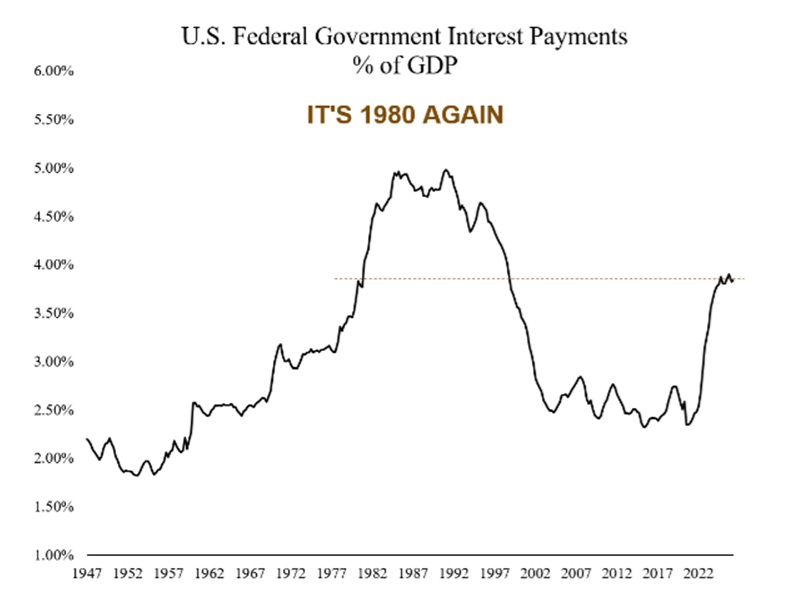
Higher interest rates and soaring debt mean the government is on track to pay the largest percentage of GDP towards interest since 1980. (Source: MurrayGunnEWI via X)
This time is different. We’re not at 20% interest rates. We’re not even at the peak of interest-rate cycles we were at two years ago. Interest rates are a tame 4% – the lower side of the trend since the end of World War II.
When we first started our documentary I.O.U.S.A. nearly 20 years ago, featuring, among other notables, Volcker himself, the concern over deficit spending was already high. But the total national debt was still under $10 trillion, not approaching $40 trillion as it is today.
Debt-to-GDP is at levels only seen during major crises and wartime. Interest on the debt is already the third largest line-item on the government balance sheet.
There is a lot Congress could do to fix it. But they won’t. Much like company executives fixated on the next quarterly numbers, elected officials are just focused on the next election.
It’s a midterm election year. Have you heard a single campaign promise anywhere in the neighborhood of responsible stewardship of the nation’s money?
We haven’t either.
Debts and deficits will eventually cause a crisis. Treasury Secretary Scott Bessent’s effort to help bail out the Japanese Yen this week is entirely motivated by self-preservation. The contagion signal flashing in Japanese bonds since late ‘25 is infecting the BOJ, which may be forced to sell U.S. Treasurys to stabilize its own currency.
Central banks globally have been swapping their Treasurys for gold at a historic pace for a decade, accelerating after the pandemic spending spree.
We already know the bitter taste. During the pandemic, a small series of stimulus checks gave consumers a shot in the arm. The inflationary hangover was rough – second only to the inflation of the late 1970s.
Voters have yet to demand fiscally sound spending. Inflating away the debt will be the government’s only recourse. As in the 70s and early 80s, it will be better not to think of your net worth in terms not of how many dollars you have, but of how much gold you own.