
“Experience has proved to us that a dollar of silver disappears for every dollar of paper emitted.”
– Thomas Jefferson
June 16, 2025 — With silver classically lagging behind gold during the yellow metal’s stunning recent rise, the long-anticipated bull market for silver is finally here in earnest. And in a bull market, silver tends to outperform gold—once it finally catches up.
Anyone watching the gold-silver ratio this year could clearly see that a breakout was coming for gold’s closest companion. As May turned to June, the market heated up and silver rocketed upward.
Silver to USD, 1-Month Chart
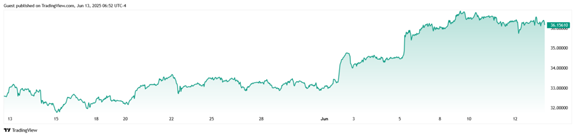
The gold-silver ratio, which had stubbornly hovered above 80:1 for much of the past year, began collapsing toward 70:1—a clear signal that silver was catching up. Silver is finally stepping out of gold’s shadow, and the reasons are as fundamental as they are undeniable.
Silver’s unique dual role as both a monetary metal and an industrial commodity makes it a powerhouse in today’s economy, especially with the never ending obsession with green energy. From solar panels to typical electronics and medical applications, demand has been quietly surging. Last year, industrial silver demand hit a new record when it surpassed 680 million ounces, following three straight previous years of records.
Global silver consumption for solar alone is projected to hit new highs, with 85% of silver paste demand going straight to solar panel production. The newer N-type solar panels, which now dominate the market, are more efficient and stable than P-type panels—and they require more silver to produce, not less.
Meanwhile, mine production is flatlining. The world’s top silver-producing countries, like Mexico and Peru, are struggling with declining ore grades and regulatory headaches. Total global mine output in 2024 barely crept above 800 million ounces, while demand is pushing toward 1.2 billion. You don’t need a PhD in economics to see the squeeze coming.
Continued Below…
Will Trump Use This Boom to Win a Third Term?
A massive U.S. chip boom is gaining steam. Billions flooding back to American soil… small towns transforming… and some say it could hand Trump the ultimate political weapon for a historic third-term run. “Made in America” is no longer just a slogan. It’s becoming government policy. This convergence could trigger one of the biggest wealth-creation events in modern history. Click here now to discover how you can potentially profit from America’s next wealth explosion. |

The U.S. dollar, once the world’s unassailable reserve currency, is losing its grip as BRICS nations push for USD alternatives and central banks hoard gold at record rates. Silver, the more volatile cousin, can benefit disproportionately when trust in paper money collapses. Investors are waking up to the reality that silver, at under $40 an ounce, is still absurdly undervalued compared to gold’s $3,400 price tag. Historically, the gold-silver ratio has averaged closer to 50:1 or lower in bull markets. If that holds, silver could easily reach $50 an ounce before gold moves higher.
But don’t expect the mainstream media or Wall Street to cheer this on. The financial establishment loves to dismiss silver as “speculative” while peddling overpriced tech stocks and government bonds yielding negative real returns. They’ll tell you inflation is “under control” while conveniently ignoring that real-world costs—housing, energy, groceries—are rising much faster. The CPI is a rigged game, and savers are losing. Silver, unlike manipulated paper assets, is a hard asset that can’t be printed or devalued by central bankers. That’s why the smart money—central bankers, hedge funds, family offices, even retail investors—are piling in.
The silver breakout we’re seeing now was telegraphed months ago. Technical traders could have anticipated patterns signaling a major move, and the fundamentals back it up. Add in the geopolitical chaos—trade wars, sanctions, and debt crises—and it’s no surprise that safe-haven demand for precious metals is spiking. Silver’s volatility makes it a wild ride, but that’s exactly why the upside is so explosive.
The U.S. economy is a house of cards built on debt and delusion. The national debt is now $36 trillion, with interest payments alone eating up $1 trillion annually. The Fed can’t raise rates without crashing the system, and they can’t cut rates without igniting more inflation. It’s a trap, and silver is the escape hatch. Gold is an enduring store of value, but silver’s industrial demand gives it an extra kicker. As green energy and tech sectors grow, silver’s necessity only increases.
So, what’s next? If the gold-silver ratio continues to compress, silver could hit $40 or higher by year-end, with $50 not far behind. The silver market is waking up, and the window to buy silver at these levels is closing fast. Don’t wait for CNBC to tell you it’s time to buy. By then, the train will have left the station.
Stack physical silver. Central bank balance sheets will remain bloated, the fiat system is crumbling, and silver’s breakout is just the beginning.
Peter Schiff,
Schiff Gold & Grey Swan
P.S. from Addison: Back in February, I visited my friend Ronan McMahon at Playa Del Carmen in Mexico. Ronan is the founder of Real Estate Trend Alert – RETA – a group that finds the best investment opportunities in international real estate, from city living to beachfront condos in the Caribbean.
Ronan says:
Cap Cana isn’t just a resort—it’s a Caribbean luxury city-state, with 30,000 acres of 5-star living. Azul Garden is planted in the most prestigious zone, just a short stroll from the iconic Juanillo Beach near the planned $500-million Juanillo Village.
We’re locking in two-bedroom condos from just $380,400—in Cap Cana’s luxury district where condos nearby will be from $600,000.
To put this in context…
We have a handful of ultra-premium penthouses with small pools for lounging and relaxing. They start at a RETA-only $645,000. That’s a screaming deal! In size they begin at over 2,077 square feet and go up. That includes a huge and indulgent terrace area of over 598 square feet to enjoy the tropical weather with friends and family. I expect these penthouses will be worth well over $1 million five years after delivery.
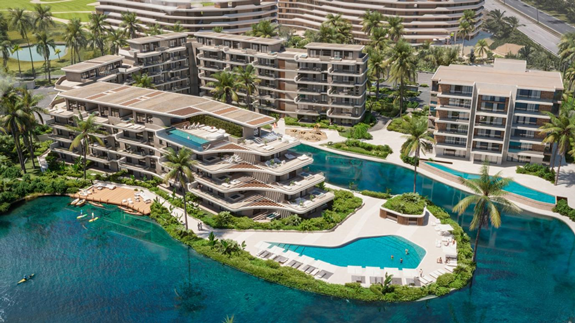
Every condo available to us is RETA grade and a stunning off-market deal. And I’m really impressed with the lagoon views we will have and the width of our condos — it’s a great shape and aspect with the widest part facing out to those water views.
Ronan’s deal goes live on Wednesday, but you can review the Cap Cana deal here. It may be just the kind of overseas dream home you’ve envisioned for your retirement – or for your next real estate investment.
Meanwhile, our Portfolio Director, Andrew Packer, will be attending the Rule Investment Symposium in Boca Raton FL, July 7-11, 2025. Click here to view the stellar speaker line up and learn how you can attend yourself.
Your thoughts? Please send them here: addison@greyswanfraternity.com