On paper, November looked almost respectable.
The Trump team will assure you that their economic strategy is working. The U.S. budget shortfall shrank by more than half year over year, with revenues jumping 18% and spending dipping.
Cue the victory laps.
With a slightly wider lens, the story reveals a severe crack in the US democratic system.

In just the first two months of Fiscal Year 2026, the deficit already totals $458 billion — the second-largest start on record.
More troubling still, the net interest expense hit $179 billion, outrunning Medicare, defense, and healthcare. At this pace, interest will again be the fastest-growing line item in the federal budget.

Once again, we have to thank the Peterson Foundation for pointing out what denial looks like in spreadsheet form.
Members of Congress, including how they get put there in the first place, are incapable of dealing with the most pressing issue of our current fiscal state: we need to get a handle on the automatic spending of the failed 20th-century welfare state… before we destroy our money, economy and civil society with it.
We can celebrate a good month. But it’d be a mistake to ignore the trajectory.
 The Bond Market Won’t Play Along
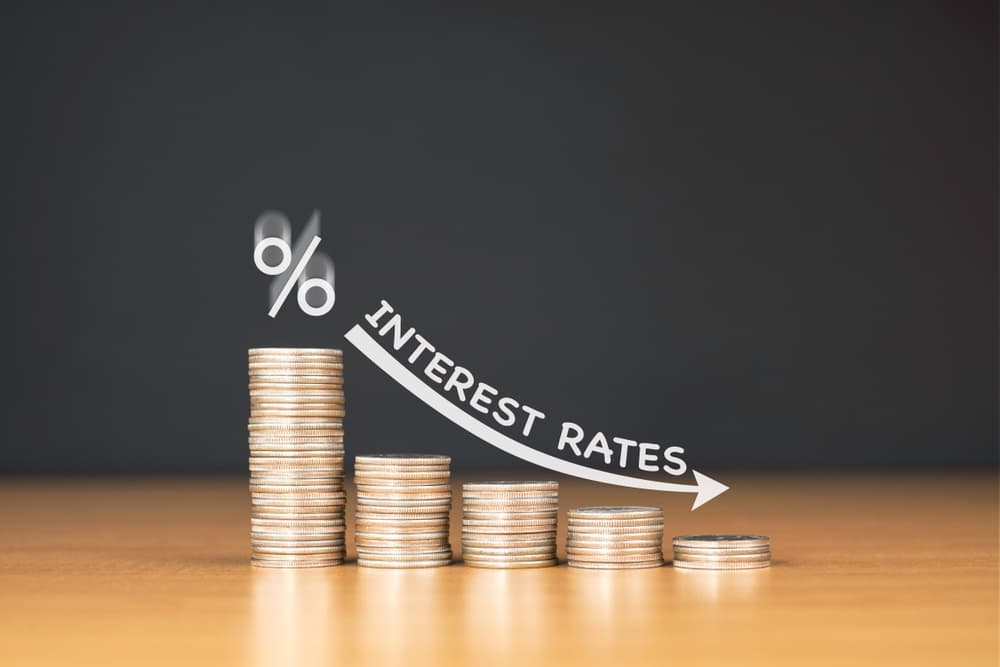
The stock market anticipated, maybe even appreciated, the Federal Reserve’s cut last week. They have now cut rates by 75 basis points since September.
Alas, the bond market shrugged, again.

The 30-year Treasury yield has risen 19 basis points over the same span and closed Friday near 4.84%.
The spread between long-term yields and the Fed’s policy rate has blown out to roughly 120 basis points.
The yield curve has steepened sharply, nearly uninverting, not because growth is roaring but because investors are demanding compensation for inflation risk and relentless Treasury issuance.
The message of the bond vigilantes is matter-of-fact: short-term rates obey policy; long-term rates obey arithmetic.
Inflation erodes purchasing power, and bondholders refuse to ignore this reality.
 Why This Spooks More Than Traders
Cutting rates to accelerate inflation doesn’t just unsettle markets; it unsettles voters. Inflation isn’t an abstract statistic — it’s groceries, rent, insurance, and utilities.
You can see it in something as mundane as Campbell’s Tomato Soup, a product so consistent over 128 years that it strips away shrinkflation tricks and marketing sleight of hand.
Prices fluctuated sharply after the gold standard was abandoned in 1971 and again as debt levels skyrocketed in recent years. Denial won’t help incumbent Republicans seeking to hold their majority 11 months from now.
 Markets Watch Santa, Bonds Watch Reality
Retail investors remain ambivalent. As we made our rounds at dinner and cocktail parties, it was clear even folks in our own business are seeking ways to declare “this time really is different.”
The last trading days of the year after Christmas and before New Year’s Eve, plus the first two days of January have seen a rally 78% of all years on record. We’re still on pace for that Santa Claus Rally this year.
Most investors are teed up and ready with ways to discount delayed government data that’ll come trickling out this week. Earnings optimism, especially from AI companies, lingers.
Chipmaker Micron, up more than 175% this year, reports soon as investors hunt for proof that AI demand extends beyond Nvidia.
Maybe it will.
 AI: The New Fault Line Isn’t Left vs. Right
As we review our Grey Swan forecasts, one contender for 2026 stands out: a cultural backlash against AI.
President Trump’s recent executive order aimed at blocking state-level AI regulation in favor of a single national framework has triggered rare bipartisan dissent.
Ron DeSantis called it a subsidy to Big Tech. Steve Bannon labeled AI “the most dangerous technology in the history of mankind.” Bernie Sanders nodded along from the other side.
Polls show 80% of Americans want AI safety prioritized — even at the cost of slower growth.
The anxiety is real. Part of it stems from a rising tide of concern that individual jobs and skill sets are getting replaced by corporate boards promising shareholders increased profits from “productivity” gains at the feet of the AI altar.
That is what it is. We’ll have plenty of time to parse the numbers and take issue with the underlying “productivity” assumption. There are numerous examples to compare against from the dawn of the information age on Wall Street, 25 years ago.
 When Breakdown Gets the Wrong Brand
Our belief is that economic anxiety runs much deeper. There was a persistent, nagging toothache in the economy before Wall Street was even aware that OpenAI had launched a retail AI application called ChatGPT.
In an apt analogy, Chat GPT was like the gateway drug for Wall Street’s binge on AI infrastructure spending. That drug allows the baby boomers, who, over the next two decades, will oversee the passing of an estimated $70–80 trillion in assets to Gen X and millennials, to sleep well at night.
The Great Wealth Transfer 2026-2050 will likely be the most significant wealth transfer in human history, accompanied by significant economic and political changes. And more than its own historic share of economic anxiety.
Pre-GPT in 2023, we were already forecasting a rise in “political violence” ourselves, unaware that the bubble in AI stocks was on the horizon.
Andrew sent us this photo after flying home from last week’s market interlude in Baltimore:

“We haven’t noted that the mainstream media is catching up to our forecasts all that much this year. But here’s some proof from an airport newsstand.” (Source: Andrew Packer)
The news reels are full of first-person accounts of the shooting at Bondi Beach in Sydney over the weekend. And another at Brown University in Providence, Rhode Island.
There’s also some heart-wrenching news that the Hollywood legend, Rob Reiner and his wife had their throats slit by their middle child, a long-time drug addict.
We, collectively, prefer to refer to this part of the news cycle as “political violence.” It softens the blow. It implies that ideology caused the harm.
But violence isn’t political. It’s violence.
No religion permits it. Every moral system converges on some version of the Golden Rule, treat others the way you would want to be treated.
No one wants to be shot at a beach holiday festival, while attending school or have their throat slit while sleeping in their own bed.
Violence erupts when economic order frays, when people lose confidence in the system meant to anchor daily life. Calling it “political” grants justification before the act. It’s denial dressed up as media analysis.
Coming out of the pandemic, we assembled a “documentary” out of the over 300 hours of interviews we conducted from our basement studio.
The opening segment for the trailer of the series, which we called “What Went Wrong With the 21st Century?” was a short clip of an interview we’d done with Bill Bonner.
It resonates today.
“When the money goes bad,” Bill said, summarizing a point he’d been making, “the center cannot hold.”
Civil society is the first to go.
~Addison
P.S. Grey Swan Live! On Thursday, we’ll be joined on Grey Swan Live! by our long-time friend and forensic accountant, Dan Amoss — one of the few who saw both the tech bust and the mortgage crisis early and played them in the market successfully.
Dan’s going to walk us through why 2026 could challenge investors even more than 2000–01 or 2008–09, and how to think clearly when denial is the consensus. More details soon.
If you have requests for new guests you’d like to see join us for Grey Swan Live!, or have any questions for our guests, send them here.