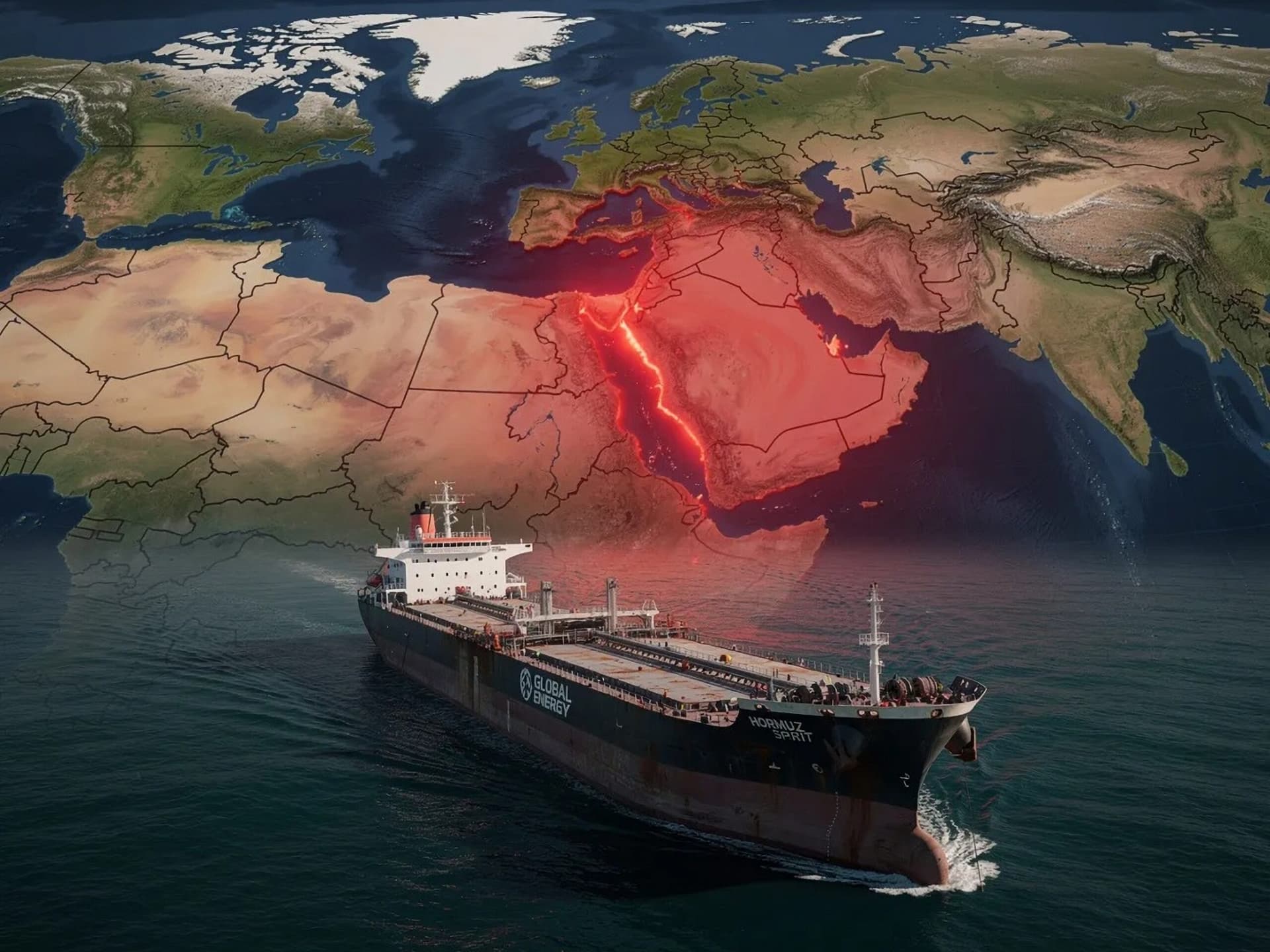
A litany of foreign policy writers in the Empire Salon group, of which I’m a member, have written and published dire warnings that the battle for the Strait of Hormuz could be the ‘Suez Moment’ for the U.S. Empire.
The 1956 Suez Crisis, it is widely accepted, marked the high-water mark of the British Empire. Rather, it’s death knell.
We detailed the story with the help of David Walker, then top dawg at the Government Accountability Office (GAO), and government archives in our documentary I.O.U.S.A. 20 years ago.
Quick and dirty: In October 1956, Britain, France, and Israel moved to seize the canal after Gamal Abdel Nasser nationalized it. British paratroopers took key positions. The Royal Navy controlled access points. Then the financing cracked.
The United States refused to back the pound sterling. And warned the Brits (and France and Israel) they’d better remove their troops from the area, or the U.S. would trigger a run on the imperial currency.
By 1956, the Bank of England had already burned through reserves defending the currency in two World Wars and its own bout with the Great Depression, as foreign holders sold pounds for dollars.
Within weeks, Prime Minister Anthony Eden reversed course and withdrew troops from Egypt under pressure from Washington and the IMF.
That is the moment, David Walker would say, that Great Britain ceded its imperial ambition to the United States.
Why Keir Starmer didn’t remind President Trump of the threat when he was berating the UK for not helping in the Gulf on this latest attempt to corral (or destroy) Iran is a question for British historians, not our aim today.
Over the weekend, that episode resurfaced across desks and columns, including our writing partner for Empire of Debt.
“The British Empire came to a final, wimpy end in the Suez Crisis of 1956,” Bill Bonner writes,” Allied with France and Israel, Britain set out to take back the canal from Egypt.”
“In WWI,” Mr. Bonner summarizes, “the British Empire found itself fighting for no reason. It had been fighting for centuries. That’s what empires do. But this was fighting on a scale it couldn’t afford. Is it cause…or effect? We don’t know. But successful empires need to provide a tolerable level of security…and money you can trust. Take away the strong currency and the strength of the empire seems to go away too.”
The Hormuz situation across all the posts we have read is largely being viewed not as an analogy, but as sequence. Critics forecast some difficulty in the financial markets, concluding: “Military action.” Specious objective. Central banks and currency markets remove the option to hold it.
Bill dug up a description of the imperial life of British citizens, which is worth sharing:
“What a great time to an Englishman! Power, wealth and status — he had it all. John Maynard Keynes, a leading economist of the 20th century, described his good fortune:
‘The inhabitant of London could order by telephone, sipping his morning tea in bed, the various products of the whole earth, in such quantity as he might see fit, and reasonably expect their early delivery upon his doorstep; he could at the same moment and by the same means adventure his wealth in the natural resources and new enterprises of any quarter of the world, and share, without exertion or even trouble, in their prospective fruits and advantages; or he could decide to couple the security of his fortunes with the good faith of the townspeople of any substantial municipality in any continent that fancy or information might recommend. He could secure forthwith, if he wished it, cheap and comfortable means of transit to any country or climate without passport or other formality, could despatch his servant to the neighbouring office of a bank for such supply of the precious metals as might seem convenient, and could then proceed abroad to foreign quarters, without knowledge of their religion, language, or customs, bearing coined wealth upon his person, and would consider himself greatly aggrieved and much surprised at the least interference.’
‘But, most important of all, he regarded this state of affairs as normal, certain, and permanent, except in the direction of further improvement, and any deviation from it as aberrant, scandalous, and avoidable.’
‘The projects and politics of militarism and imperialism, of racial and cultural rivalries, of monopolies, restrictions, and exclusion, which were to play the serpent to this paradise, were little more than the amusements of his daily newspaper, and appeared to exercise almost no influence at all on the ordinary course of social and economic life, the internationalisation of which was nearly complete in practice.’
“Sound familiar?
“Today, it might apply to the average New Yorker or Nevadan. Until very recently, he could enjoy entertainments, fruits and gadgets from all over the world, with rarely an interruption.”
🧭 The Interruption
Recent weeks have heightened that risk, of course.
Gulf producers cut output by roughly 10 million barrels per day. Tankers rerouted around the Cape of Good Hope added 3,500 to 4,000 nautical miles per voyage, extending delivery times by up to two weeks.
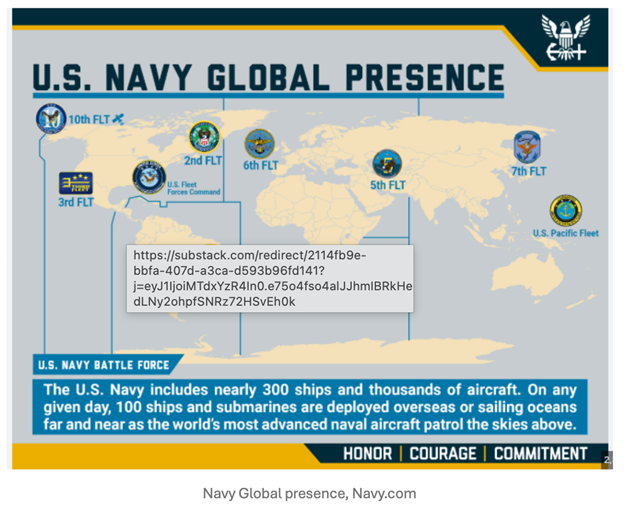 The U.S. imperial footprint at the outset of hostilities on February 28, 2026. (Source: U.S. Naval Institute)
“The Strait of Hormuz is not simply another chokepoint,” writes Pablo Hill, “Roughly 25–30% of energy-related maritime resources flow through it, and its function depends on more than navigability. Saudi Arabia’s East–West Pipeline to Yanbu and the UAE’s pipeline to Fujairah provide only partial alternatives. The remainder depends on continuous maritime flow supported by both naval security and financial infrastructure.”
The dependency actually resides with some of the U.S. strongest trade partners. Japan sources roughly 73% of its crude through the Gulf. South Korea approaches 70%. Pakistan and Taiwan sit near 60%. India and China each operate near 40%. Refiners in those markets bid for cargo based on arrival certainty as much as price.
If the U.S. doesn’t “finish the job” and open Hormuz up to free-flowing tanker traffic, the unanimous conclusions of the host of opinions in my inbox suggest, the U.S. will indeed meet its Suez Moment.
🪙 Reserve Share Slips
Already, IMF data from the fourth quarter of 2025 shows U.S. dollar–denominated reserves at 56.8% of global foreign exchange holdings, the lowest share since 1994.
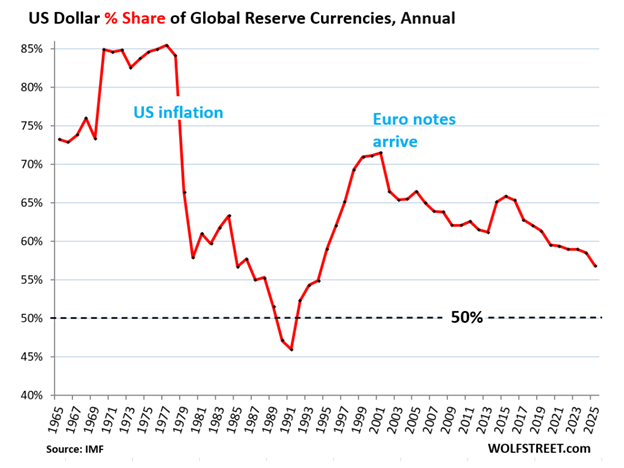
What the data shows is key to the Dollar 2.0 argument we’ve been championing here in Swan Dive.
The dollar’s reserve share has not declined, per se. Rather, new reserves have accumulated outside the dollar system, including in gold, faster than existing dollar holdings have grown.
That’s without a hot war in the Gulf.
Foreign central banks held roughly $7.5 trillion in U.S. securities at the end of 2025, a figure largely unchanged from levels a decade earlier. Reserve managers added exposure to other currencies—both major and a growing list of “non-traditional” units—and increased allocations to gold.
Two of the four deficits we featured in I.O.U.S.A. — trade and fiscal deficits – are dependent on global economic transactions settling in U.S. dollar-denominated assets and in central banks around the globe holding U.S. Treasurys as a store of wealth.
One could argue the other two deficits the U.S. habitually runs – savings and leadership – are also dependent on the U.S. dollar maintaining its hord-worthiness.
Program note: If you’re following along with our discussion of the stablecoin ecosystem tied to U.S. Treasurys, you know what’s at stake for getting the Clarity Act passed with acceptable regulatory guardrails. Extending the dollar into 24-hour digital rails would make Treasury Secretary Scott Bessent’s job a whole lot easier.
We’ll have an update on the Clarity Act undergoing “K-Street violence” during this week’s Grey Swan Live!. Watch for it.
🛢️ Energy Markets Reset the Agenda
In Houston, Daniel Yergin hosted CERA Week, an annual confab of global energy producers sponsored by S&P Global.
Yergin is the best-selling author of The Prize: The Epic Quest for Oil, Money & Power, now available in an illustrated coffee table edition. (Yergin’s epic documentary on the Commanding Heights, a look at the development of global economics throughout the 20th century, was, by chance, our inspiration for turning our own best-selling Empire of Debt into the film I.O.U.S.A.)
Yergin opened this year’s conference by discarding the prepared agenda. The 44th annual gathering had been built around artificial intelligence, data centers, and electrification. Within hours, panels shifted toward security of supply.
Yergin described the disruption tied to Hormuz as “the largest dislocation in oil markets in modern history,” placing it ahead of the 1973 Arab embargo and the 1979 Iranian Revolution in terms of immediate impact on flows. He told attendees the defining variables had changed: “Security and affordability now outrank transition.”
Yergin characterized the conflict as “decades in the making,” tracing it through tanker wars, sanctions cycles, and proxy conflicts across the Gulf. He also noted that while the global system carries more redundancy today—through U.S. shale output and diversified supply—the absence of a diplomatic mechanism to reopen Hormuz leaves pricing to logistics rather than policy.
🏦 Capital Flows Through the Saudi Channel
Not that you could discern U.S. policy from the President’s remarks at the Future Investment Initiative summit last Friday in Miami Beach.
Speaking at the Faena Forum under the theme “Capital in Motion,” Trump described Iran as “militarily decimated” and stated that reopening the Strait of Hormuz stands as a non-negotiable condition for any settlement.
The only soundbite that circulated on legacy media was the disdain reviewers had for the moment when Trump “mistakenly” called the waterway the “Strait of Trump.”
Otherwise, the President argued that stabilized shipping lanes would anchor both energy pricing and investment confidence “very soon.”
Trump reiterated the impact of roughly $1 trillion in Saudi investment into U.S. industries, including artificial intelligence infrastructure, energy systems, and critical minerals. For good measure, he threw in a reference to Toyota’s $10 billion commitment to U.S.-based manufacturing capacity.
In an unscripted moment during the Q&A, Trump remarked that “Cuba’s next,” before walking it back with a laugh and telling the audience to “pretend I didn’t say that.” That comment circulated quickly across diplomatic channels and trading desks…
⚙️ Modern War Depends on Cheap, Fast Production
Ultimately, the conflict over the Strait of Hormuz – and, by extension, the U.S. dollar’s reserve status – could come down to how quickly the U.S. military-industrial complex acknowledges the profound paradigm shift in tactics that has occurred during the 4-year Russian invasion of Ukraine.
You may recall, we touched on this in the October issue of the Grey Swan Bulletin, soon after an event we attended in Washington, D.C., featuring Palmer Luckey, co-founder of Anduril Industries.
Luckey is adamant that the sooner we move away from what he calls “exquisite systems” toward mass-produced, autonomous ones, the sooner we’ll be able to restore global trade through Hormuz.
The United States builds a small number of platforms that cost tens or hundreds of millions of dollars per unit. Adversaries deploy thousands of systems that cost a few thousand each and are designed specifically to destroy those platforms.
Luckey, who we’ve dubbed the next Elon Musk, points to similar paradigm shifts in military history to make his point.
The move from bronze to iron, where weapons became cheaper, more abundant, and no longer reserved for a narrow elite, has been handed down to us in the epic tale of David defeating Goliath in the Battle of the Valley of Elah.
Closer to our own time, the Gatling gun was first used in battle during the American Civil War, specifically at the Siege of Petersburg, Virginia, between June 1864 and April 1865, rendering cavalry charges obsolete.
In both cases, the side that scaled production—not craftsmanship—set the terms of conflict, prevailed and dictated the terms of the peace that followed.
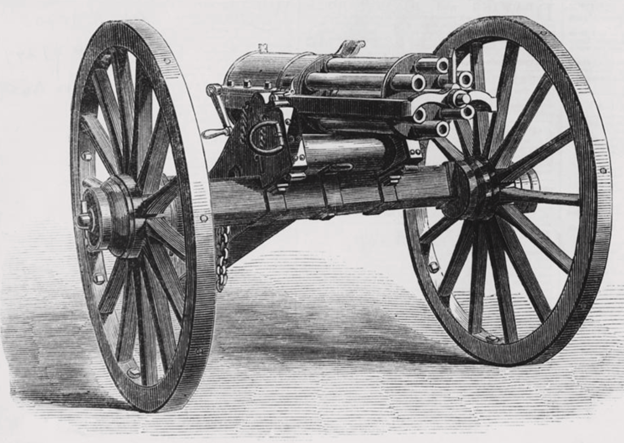 The Gatling gun, introduced at the Siege of Petersburg, Virginia, in 1864, proved a decisive innovation, rendering cavalry charges obsolete. (Original image: Illustrated London News, pub 23rd March 1867 (Photo by Illustrated London News/Hulton Archive/Getty Images)
“You don’t win by having a few really expensive things,” Luckey said during the event. “You win by having a lot of cheap things that are smart enough to get the job done.”
In modern drone warfare, the intelligence sits in software. Once written, it replicates across thousands of units at near-zero marginal cost. The actual hardware becomes disposable. And no human lives are lost in the process.
The adaptation to the new war paradigm immediately changes the math. And disrupts the entire post-World War II military industrial complex – where billions of dollars are committed to decades of contracts to produce “exquisite” weapons which are vulnerable to DIY drones at a fraction of the cost.
On any given day in the Ukraine conflict, a $20,000 autonomous drone will destroy a $10 million armored vehicle. Swarms replace a squadron. One operator manages hundreds of systems through a single interface.
Production lines matter more than procurement cycles tied to unit cost. Output replaces budget as the relevant measure.
Luckey calls this moving from “brawn to brains.” If the U.S. is smart, Luckey argues, we’d be the “gunstore” to the world, getting cheap weapons in the hands of the folks who need them fast.
So far, in the Gulf, the U.S. and Israel are following the playbook followed in the last Gulf war. Both the defense industry and the imperial currency hang in the balance.
🔫 The President Who Forgot to Duck
On March 30, 1981, President Ronald Reagan exited the Washington Hilton after addressing a labor meeting and walked toward his limousine. John Hinckley Jr. fired six shots from a crowd of reporters.
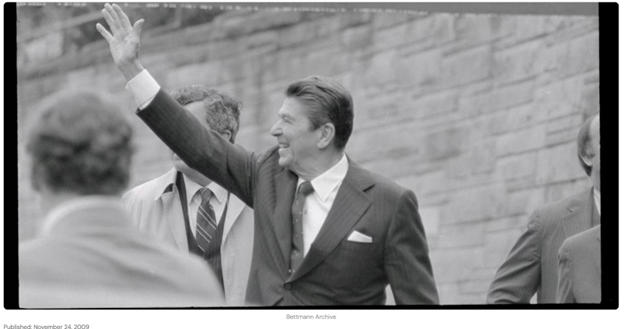 The moment a .22 caliber bullet struck Reagan in the left lung and missed his heart by inches. (Source: History Channel)
In Hinckley’s attack, White House Press Secretary James Brady was shot in the head and critically wounded. President Reagan, apparently unaware that he’d been shot, was shoved into his limousine by a Secret Service agent and rushed to the hospital.
At George Washington University Hospital, Reagan walked inside under his own power. When Nancy Reagan made it to the hospital Reagan famously retorted, “
Honey, I forgot to duck. Moments before surgeons put him under he looked at them and said: “Please tell me you’re Republicans.”
The next day, he signed several executive orders from his hospital bed.
~ Addison
P.S. It could be a good time to look at real estate, too. Or just turn off your news feed and set off for new horizons.
On last week’s Grey Swan Live, we dove into international real estate with the piece we filmed in Panama. We sat down with Ronan McMahon at The Gathering, hosted by Ronan and our friends at Real Estate Trend Alert (RETA).
RETA members are able to get exclusive discounts on real estate projects in top destinations like Panama, Mexico, Portugal and more.
We’ve also published the 2026 RETA Index report with Ronan’s top destinations to buy in 2026 with the replay.
Ronan and his team will also make their masterclass in international real estate available to paid-up members of the Grey Swan Investment Fraternity.
This masterclass is your complete road map to owning overseas in 2026. In six videos, they will take you through everything you need to know, starting right at the beginning.
They aren’t holding anything back. Ronan is sharing all the key lessons he’s learned in two and a half decades of buying and scouting real estate overseas.