
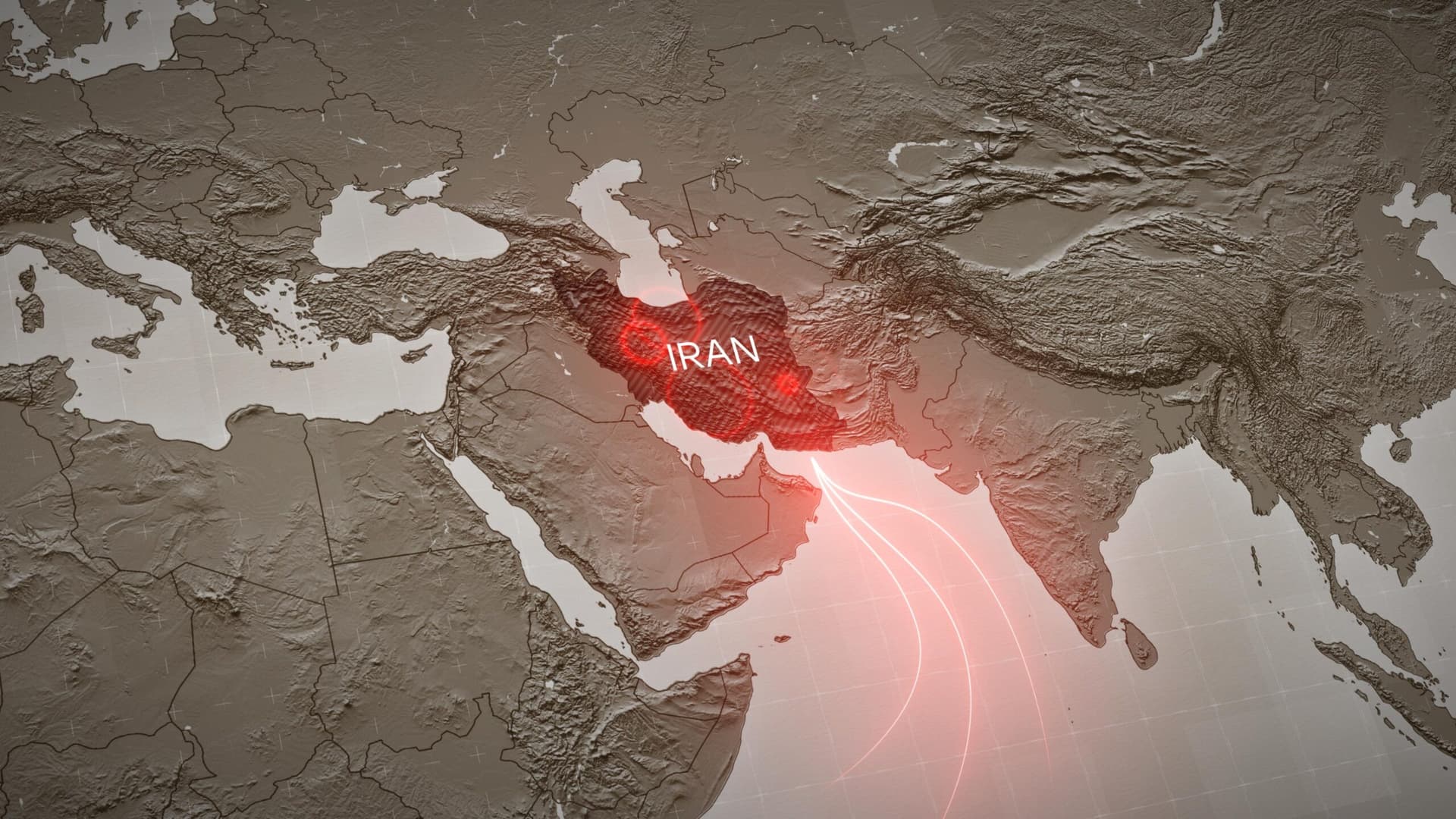
Neither war nor rhetoric paused for religious observance over the weekend.
Over the weekend, President Donald Trump set a deadline on Truth Social, telling Tehran to reopen the Strait of Hormuz or face strikes on bridges and power plants. The language was tactful, like passing gas in an elevator.
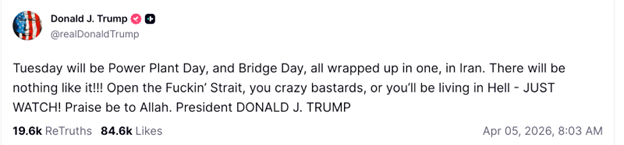
Just 48 hours earlier, the administration had been signaling that Iran’s military position was collapsing and that the end of the conflict was within reach.
Then Iranian forces shot down two American aircraft, and the war reintroduced itself as something that still required time, resources and a degree of caution that doesn’t fit neatly into a social media post.
U.S. officials now describe the air campaign in terms that reflect that adjustment. “Pockets of air superiority” is the phrase making its way through briefings, which is what commanders say when aircraft can operate, but not without risk.
Bombers have only recently begun flying over Iranian territory, and even now, the distinction between air superiority and full air supremacy remains intact. Iran’s air defenses, though degraded, continue to function at lower altitudes, and new domestically produced systems are being deployed as the campaign stretches into its sixth week.
At sea, Iran has shifted toward an asymmetric approach, relying on drones, anti-ship missiles and intermittent disruptions to tanker traffic to assert control over the Strait.
The goal is not to defeat the U.S. Navy outright, but to change the conditions under which oil moves through one of the world’s most important chokepoints. And harass the West with higher oil prices.
Every tanker that hesitates, reroutes or pays a higher insurance premium becomes part of that calculation.
🛢️ The Strait Becomes A Negotiating Table
Overnight, Pakistani intermediaries circulated a ceasefire proposal between Washington and Tehran, with Field Marshal Asim Munir coordinating calls with Vice President JD Vance, envoy Steve Witkoff and Iranian Foreign Minister Abbas Araqchi.
The framework under discussion ties an immediate ceasefire to the reopening of the Strait, followed by a short window — roughly two to three weeks — to formalize a broader agreement.
A longer 45-day truce sits behind that as a possible extension.
Iran’s posture in those talks reflects some bravado, tactful or otherwise. Gregory Brew of Eurasia Group described control over Hormuz as something Tehran now sees less as a temporary bargaining chip and more as an asset it can institutionalize.
We suspect their attitude might shift slightly before the war finds a diplomatic conclusion.
✈️ Air Power Meets Attrition
Despite the President’s Truth Social threats, the pace of operations indicates a campaign that is expanding rather than concluding.
The U.S. air campaign has been extensive by any measure, with more than 12,000 strikes carried out across roughly 13,000 combat sorties.
Gen. Dan Caine, chairman of the Joint Chiefs, has been careful to describe progress as the gradual establishment and expansion of control zones, as modern militaries do when a fight requires persistence rather than a single decisive blow.
In Afghanistan and Iraq, U.S. forces operated against adversaries without integrated air defenses, which allowed aircraft to move freely across the battlespace.
In Iran, the presence of layered defenses — even degraded ones — changes the tempo. Aircraft must establish access before they can exploit it, and maintaining that access becomes an ongoing requirement rather than a one-time achievement.
By continuing to contest the airspace with cheap drones and one-of successes, what’s left of leadership in Tehran extends the timeline and forces the United States to commit resources over a longer period. Attrition and the survival of decentralized units is the best outcome the IRGC can hope for.
That may be enough to disrupt U.S. politics as the midterm election ticks closer.
🏗️ Saudi Construction Meets Missile Range
The economic side of those calculations is already visible in Saudi Arabia, where Vision 2030 continues to advertise a future built on diversification, technology and global capital.
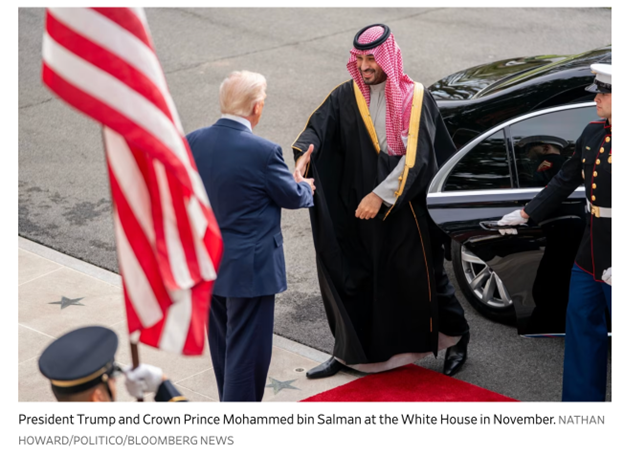
We’ve been tracking the grand bargain President Trump and Crown Prince Mohammed bin Salman (MBS) struck back in November at the White House.
MBS announced Vision 2030 in Riyadh a decade ago.
The prince’s vast ambition includes U.S. security guarantees in the region and the opportunity for the House of Saud to position the kingdom as a hub for investment and development, with projects like Neom intended to signal a shift away from reliance on oil revenues.
So far, the Hormuz disruption has only complicated that narrative. Saudi oil exports have fallen to roughly half their normal capacity, offshore production has been curtailed, and one of the world’s largest petrochemical facilities has suspended operations.
Iranian drones and ballistic missiles have crossed Saudi airspace, and while most have been intercepted, the effect on perception has been immediate. Major events have been canceled, foreign firms have told staff to work remotely and key business districts have temporarily closed.
The financial impact has already exceeded $10 billion in lost revenues and additional costs, according to people familiar with the matter.
At Neom, plans for a 106-mile mirrored city have been scaled back, leaving a 75-mile trench across the desert.
A $38 billion mountain resort project has been halted, and partially completed infrastructure — including a large dam — now sits in a state that suggests pause rather than momentum.
The projects remain, but the assumptions behind them have shifted. The grand bargain hangs in the balance.
⛽ The 1970s Echo In The Data
The economic backdrop carries its own set of parallels.
Lawrence Summers, persona non grata at Harvard these days, has pointed to an inflation pattern that resembles the mid-1970s, when an initial decline in price pressures was followed by a second surge tied to energy disruptions originating in Iran.
That comparison, once dismissed as coincidental, has gained traction as inflation proves more persistent than expected and as the Strait of Hormuz returns to the center of global attention.
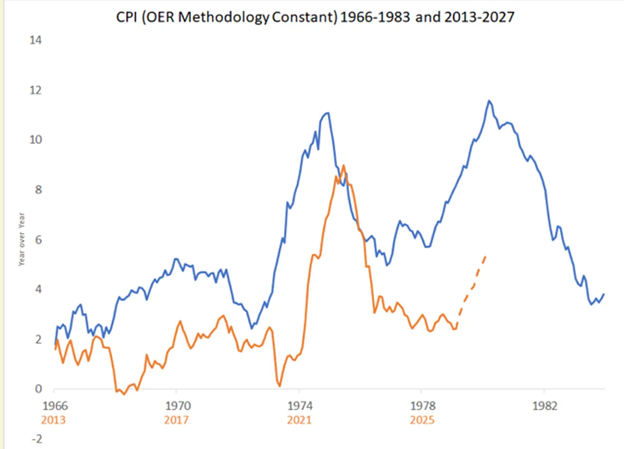 In 2026, Iran and Saudi Arabia have once again interjected themselves into the midterm debate over the U.S. economy, just as they did in 1978. (Source: Larry Summers, update supplied by SEMAFOR since Larry’s nowhere to be found following his resignation from Harvard over the Epstein File scandal.)
One significant difference between the 1970s inflation gone wild episode(s)?
The United States enters the current period with roughly $39 trillion in federal debt and with a fiscal policy that continues to support demand.
For U.S. citizens, there are a few non-war highlights to remain optimistic about: Treasury officials expect approximately $150 billion in tax refunds; corporate investment rules allow full expensing of capital purchases; and discussions of additional stimulus remain active. Growth has held up in the near term, with gross domestic product expanding at a 4.3% annualized rate in the third quarter.
In 2026, the uncertainty of war and energy supply introduces a familiar tension. BlackRock CEO Larry Fink has prepared his traders for equally likely outcomes:
Best-Case Scenario (Abundance): If Iran is accepted back by the international community and its oil returns to the market, oil prices could drop to $40 a barrel.
Worst-Case Scenario (Recession): If Iran continues to threaten the Strait of Hormuz and trade, oil could stay above $100 — closer to $150 — for years, causing a “stark and steep” global recession.
Demand for Treasurys shows signs of softening, and longer-term concerns about deficits are becoming harder to ignore even as short-term growth remains intact.
On that front, Treasury Secretary Scott Bessent awaits word on whether the Clarity Act includes an agreement between banks and crypto companies on rewards paid to stablecoin holders.
For greater detail on the Clarity Act and specific updates on each of our Dollar 2.0 recommendations, see Grey Swan Live! below.
⚓ 1917: From Reluctance To Entry
There was a time when the United States went to considerable lengths to avoid stepping into foreign wars.
In 1914, when fighting broke out across Europe, Woodrow Wilson declared neutrality, reflecting a public that preferred distance over entanglement.
American ships continued to trade, passengers continued to cross the Atlantic, and Washington attempted to operate as if geography still provided insulation.
That position held until the mechanics of war reached into commerce. German U-boats began targeting vessels moving toward Britain. The American freighter William P. Frye was sunk.
Then came the Lusitania — a passenger liner carrying nearly 2,000 people, including 128 Americans, torpedoed off the Irish coast. Berlin argued the ship carried munitions. Washington demanded an end to attacks on civilian vessels.
Germany then resumed unrestricted submarine warfare in early 1917.
Within weeks, multiple American merchant ships were sent to the bottom. Insurance markets seized. Shipping routes adjusted. Cargo slowed. Congress authorized $250 million for military readiness before a formal declaration had even been signed.
On April 6, 1917, the Senate voted to go to war with Germany. Not by following Wilson’s global vision (or a Truth Social post!) but because ships could no longer move goods safely in the Atlantic Ocean.
~ Addison
P.S. Grey Swan Live! was in top form last week with Ian King. We had attendees from the four corners of the continent, from Seattle to Boca Raton, Ontario to Baton Rouge. Arizona and Alabama. If you’re a Grey Swan member, it’s worth your time to join Grey Swan Live! on Thursdays. It’s one of the primary benefits of your membership!
Ian’s been out front on the crypto revolution for a decade. The K-Street rumor mill is hot in Washington, D.C. this week with breakthrough news of a deal between the banking lobby and digital asset innovators.

Ian explained how and why the banking cartel is trying to defend its monopoly over the nation’s savings, and how the innovators at crypto companies have positioned themselves to benefit their customers when the Clarity Act finally gets sent up to the Oval Office.
The implications on everything from tokenization to Defi are profound. We specifically ran through all of the companies listed in the “Dollar 2.0” recommendations in our digital asset special report in the Grey Swan library.