Jamie Dimon opened earnings season with his usual Wall Street gravitas, announcing the U.S. economy remains “resilient.” But his warning was sharp: investors are ignoring “sticky inflation, elevated asset prices, and complex geopolitical conditions.”
Those weren’t idle words.
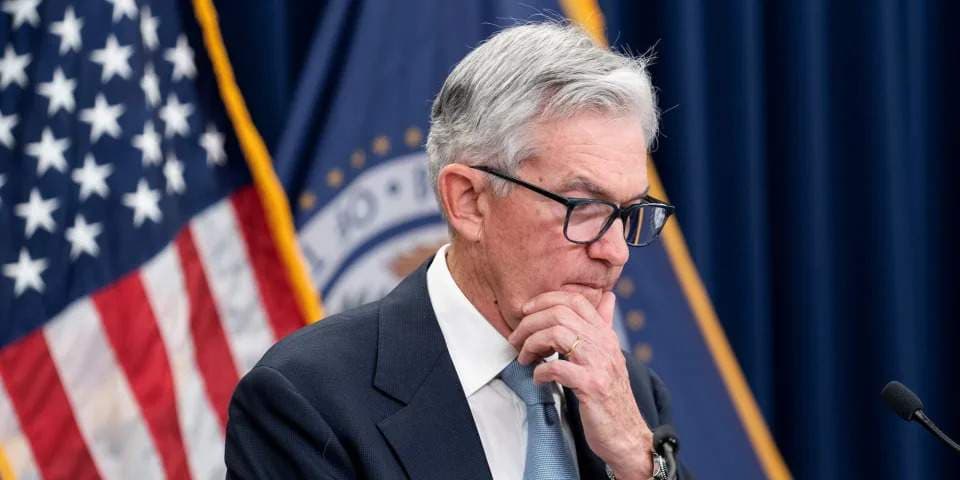
However, the ground had already shifted. A Justice Department investigation into Fed Chair Jerome Powell burst into the open Sunday night — not a leak, but a formal criminal probe.
Reflecting today’s markets, the announcement came with a whimper — then a shrug.
Cries from Powell supporters to the effect that “the Fed must remain independent!” are falling on deaf ears… the Fed has been late to the game for several decades now. As our peer Stephanie Pomboy has articulated well, “the Fed levers” are broken.
Stocks dipped at the open on the news Monday. Gold jumped 2.4% to another record. Treasury yields spiked.
But by close, the Dow and S&P 500 had brushed off the chaos and clocked their own fresh all-time highs.
This is where we are now: markets treating institutional collapse like mild weather. Our “most terrifying bull” thesis is well intact.
 Trump vs. Powell: The Last Fed Fight
Sunday night, Powell addressed the probe head-on in a video post — a rarity. He accused the White House of using cost overruns in the Fed’s HQ renovation as a pretext for political interference.
The White House denied involvement. But few in Washington believed it.
What followed was bipartisan condemnation of the investigation. Greenspan, Bernanke, and Yellen co-signed a blistering rebuke, warning the U.S. was starting to resemble “emerging markets with weak institutions.”

Only Christopher Waller on this list above is being considered for Fed Chair following the end of Powell’s term on May 5, 2026. Lawmakers on the Hill have already announced they will not confirm a new chairman if the Department of Justice investigation is still hanging over Powell’s head. (Source: Bloomberg)
Even markets, temporarily rattled, understood the stakes. If Powell falls and Trump appoints a loyalist before May — when Powell’s term ends — monetary policy becomes a tool of electoral politics.
In a Substack post this morning, Morgan Stanley’s global strategist Stephen Roach was quite verbose in declaring he saw this style of political bullying of the Fed up close in personal as an upstart economist in the Arthur Burns era under President Nixon.
We tend to fall under the illusion that every time Mr. Trump does something, it’s a) the worst thing to ever happen and b) no one has seen such brazen abuse of executive power in the history of the country.
Both a) and b) are patently untrue.
 10% APR — or Else
While Powell was fending off subpoenas, Trump dropped another populist bomb: a proposed 10% cap on credit card interest rates.
We mentioned it briefly yesterday, but this one bears a second look today.
Credit card issuers tumbled all day yesterday. Capital One, Bread Financial, and Synchrony — all got hit. Even JPMorgan and Citi took collateral damage.
At first glance, it sounds like retail politics. But it’s more than that.

The administration knows it has “do something” to influence key levers of consumer finance — by executive order, by agency fiat, and by public pressure – so its claim that tariffs are working and the economy is growing doesn’t fall on incredulous ears as they did under the 4-year Biden tenure at the top spot in government.
Likewise, it knows the employment data coming out of the Bureau of Labor Statistics (BLS) is both bad… and bogus.
News over the weekend revealed that the jobs numbers were revised down in every month of 2025. Or said another way, every month since Trump retook his seat in the Oval Office.
We expect more domestic “carrots” – and “sticks” – to be deployed over the months between now and July 4, 2026.
 Tariffs as Foreign Policy: Trump Targets Iran’s Partners
With the Iranian crackdown death toll officially up to 646 protesters, Trump took to Truth Social with a threat: any country doing business with Iran will face a 25% tariff on “all business” with the U.S.
India. China. The UAE. All are now in the crosshairs.
Earlier in the week, Tehran reportedly offered to negotiate over its nuclear program. U.S. officials say military options are still on the table. But in the interim, tariffs are the president’s chosen weapon.
And it’s another data point in a broader trend: trade tools being repurposed as a form of hard power.
As headlines and videos decry violence on the streets all across cities in Iran, it’s worth paying attention to Trump’s efforts to bend the uprising to U.S. advantage in the region.
 Cold War in the Twin Cities
Not that he needs to look halfway around the world for street protests at all.
Last week’s fatal ICE shooting of Renee Nicole Good in Minneapolis has triggered a constitutional crisis in real-time.
The state of Minnesota, joined by Minneapolis and St. Paul, filed a lawsuit to halt what it calls an “unprecedented surge” in federal immigration enforcement. State Attorney General Keith Ellison referred to it as a “federal invasion.”
The Department of Homeland Security deployed 2,000 more officers.
 Look Up in the Sky: Elon’s Space Cloud
For most people, SpaceX is still a rocket company.
Ahead of a much-anticipated IPO, that classification is already antiquated.
Elon Musk is also building the next layer of global infrastructure. In his view, it won’t sit on land, pay property taxes, or be constrained by borders, weather, or power grids.

Over the last year, Musk has gone on record: training artificial intelligence in space is the goal. Why? Power is abundant. Cooling is free. Latency is globally optimized.
In other words: data centers without the bottlenecks.
SpaceX has already rewritten the rules:
- Reusable rockets, launching nonstop
- The largest satellite constellation in human history
- A global comms backbone (Starlink)
- And now, the infrastructure layer for AI compute… in orbit
Down here on Earth, AI data centers face limits: land, energy, cooling, and politics. In space? Those limits vanish.
Power scales with the sun. Cooling scales with the -160°F void of space. Coverage scales with 42,000 satellites — a mega-constellation blanketing the globe.
The new space race is a big deal:
- Rockefeller didn’t just sell oil. He built the pipelines.
- Carnegie didn’t just sell steel. He built the rails.
SpaceX is building the operating system for AI. The IPO is expected later this year. The valuation? Some (Musk) put it at $1.5 trillion. Either way, it’s likely to be the biggest in history.
By the time most people understand what’s happening, the opportunity will have already passed.
As you should already be aware, we’re watching it closely in The Grey Swan Investment Fraternity. Because if history is any guide, 100x returns are not just possible — they’re probable. But only for those who are connected early. (More to come…)
 Mamdani’s Magical Thinking
In New York City, the new Mayor Zohran Mamdani has unveiled a platform that reads like a political Mad Libs of economic disaster:
- $30/hr minimum wage by 2030.
- City-owned grocery stores “without a profit motive.”
- A statewide housing guarantee, including “the abolition of private property.”
We’ve seen how this ends. In California, a $20/hr fast food wage killed 36,000 jobs and pushed menu prices up 10% faster than the national average.
In Argentina, rent controls annihilated the private rental market. Properties sat vacant. Landlords disappeared. The peso cratered.
Joel Bowman, who’ll be joining us on next week’s Grey Swan Live! (January 22, 2026) writing from a perch at the other End of the World in Buenos Aires, it calls it “a massive loan of blood from the brain to the heart.”
Good intentions; catastrophic outcomes.
Yet the mainstream press cheers Mamdani on:
- “Mamdani Paused to Socialize With Spielberg” — NYT, January 8
- “Free Tickets, Theater Should Not Be a Luxury” — NYT, January 9
- “Affordability Push Hits Film Office” — NYT, January 13
Meanwhile, the hard math of collectivism continues to grind away — in housing, in food, in energy.
There is another way. It’s not utopian. It’s just functional.
It’s the way of self-determination. Liberty. Rugged individualism. The kind that doesn’t expect salvation from the state… and doesn’t wait to be rescued.
Javier Milei, down at the End of the World, still believes it. Not in our lifetimes have we seen two such diametrically opposed ideologies play out at the same time on segregated social platforms.
Our conversation with Joel will be enlightening.
~ Addison
P.S. This week’s Grey Swan Live! on Thursday, January 15, at 2 p.m. ET/11 a.m. PST will be with resource investing wizard Shad Marquitz.
One particular company Shad has his eye on has labeled itself a gold and silver miner because of regulations that have restricted their sale of existing copper and antimony (used in drones and other defense tech). Those restrictions are being lifted this month.
The details of this one company alone are telling for investors interested in capitalizing on the wave of retail investor interest in critical minerals and precious metals.
We’ll also dig into the bottlenecks and breakthroughs in strategic metals, from uranium to rare earths. And identify new resource producers high on the Fast41 list of companies that the Department of War has identified as critical producers in their effort to reinforce U.S. national security. It’ll be intense. You won’t want to miss it.

If you have requests for new guests you’d like to see join us for Grey Swan Live!, or have any questions for our guests, send them here.