
“The safest road to hell is the gradual one — the gentle slope, soft underfoot, without sudden turnings, without milestones, without signposts.”
–C.S. Lewis

The coming weeks will push the dollar to further irrelevance…
October 7, 2024 – Before it was a Taylor Swift song, the idea of a “death by a thousand cuts” had a long, rich history.
In China, the concept was known as lingchi, or “slow slicing.” And it was used from the 10th to 20th centuries.
A 1,000 year period is about four times as long as an empire lasts … or about 10-20 times as long as a world reserve currency.
The U.S. dollar lost its final tie to gold in 1971, just over 50 years ago. It’s showing its age. But the dollar was the world’s reserve currency in reality, if not acknowledged, since the end of the First World War. Call it 100 years.
The buck still looks attractive, compared to the Euro, or the Yen, the Pound, and every currency below that. When there’s a crisis, it’s dollars that international investors want.
But that trend will only last until it doesn’t. We can’t put an expiration date on the death of the dollar. It’s being killed by a thousand cuts. Will the 287th cut set the dollar on the permanent path to demise, or the 835th? Even historians, writing from the distant future, will disagree.
All we know is that the dollar is under attack. A big attack is underway, as developing nations look to create their own dollar alternative.
The BRICS+ bloc – Brazil, Russia, India, China, South Africa, and others, hope to do for the dollar what OPEC has tried to do with oil — assert some control over their own monetary fate in global trade.
The U.S. dollar has carried an “exorbitant privilege,” a fancy way of saying that Uncle Sam has been able to export a significant amount of inflation, thanks to the dollar’s status as the world’s reserve currency.
Later this month, BRICS+ will meet. At this meeting, they may devise a plan to seal the dollar’s fate — or just deliver a particularly nasty blow in the form of increased cooperation without the use of the dollar in bilateral trade.
For the full details on how we’ve reached this point in the dollar’s lingchi, we turn to Grey Swan Investment Fraternity contributor John Rubino who goes into detail on the rise of the BRICS bloc. Enjoy ~~ Addison
De-dollarization Just Got Real
John Rubino, John Rubino’s Substack
The BRICS countries are meeting in a couple of weeks — in Russia with Vladimir Putin hosting — so speculation is rife on whether they’ll induct new high-profile members, update their plans for a gold-backed currency, or spring some other “October surprise” on the world.
I’ll post more specifics about this meeting as the date approaches, but in the meantime here’s a backgrounder from March of 2023 that explains why the whole BRICS thing is happening:
Originally published March 23, 2023
Since the 1970s it’s been virtually impossible for a country to function without access to US dollars. And Washington maintained this highly-favorable status quo by putting various kinds of pressure — from sanctions to asset confiscation to outright invasion — on anyone who stepped out of line.
This weaponization of the world’s reserve currency has, not surprisingly, created resentment in a lot of foreign capitals. And after a long gestation period, that resentment is now erupting into a rebellion against dollar hegemony. Among the big recent events:
The BRICS coalition has become the hottest ticket in geopolitics.
Brazil, Russia, India, China, and South Africa (the BRICS) have been toying with the idea of forming a political/monetary counterweight to U.S. dominance since 2001. But beyond some aggressive gold buying by Russia and China, there was more talk than action.
Then the floodgates opened. Whether due to the pandemic’s supply chain disruptions, heavy-handed sanctions imposed by US-led NATO during the Russia-Ukraine war, or just the fact that de-dollarization was an idea whose time had finally come, the BRICS alliance has suddenly become the hottest ticket in town. In just the past year, Argentina, Indonesia, Saudi Arabia, Iran, Mexico, Turkey, the United Arab Emirates (UAE), and Egypt have either applied to join or expressed an interest in doing so. And new bilateral trade deals that bypass the dollar are being discussed all over the place.
Combine the land mass, population, and natural resources of the BRICS countries with those of the potential new members, and the result is more or less half the world. And now things are getting real:
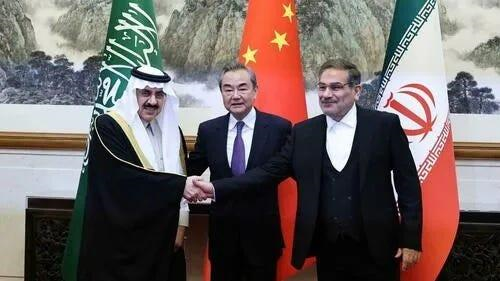
China brokers a peace deal between Saudia Arabie and Iran, two bitter historical enemies who want to join the BRICS alliance but can’t if they’re in an undeclared war. Should they stop competing and start cooperating they could dominate the Middle East and raise China’s clout in the region, at the petrodollar’s expense. An example of the press coverage:
Eurasia’s geo-economic integration took a great leap forward as a result of the Iranian–Saudi rapprochement, which unlocks the Gulf Cooperation Council’s (GCC) trade potential with Russia and China. Its wealthy members can now tap into two series of Iranian-transiting megaprojects in one fell swoop through this deal, with the North-South Transport Corridor (NSTC) connecting them to Russia while the China-Central Asia-West Asia Economic Corridor (CCAWAEC) will do the same vis-à-vis China…
…Only two weeks after Saudi Arabia announced an effort to establish diplomatic ties to Iran in a deal mediated by China, more news surfaced that Saudi Arabia was also planning to reopen its embassy in Syria for the first time in over a decade. Rumors are swirling that Iran, Saudi Arabia and Syria are on the verge of geopolitical and economic agreements that sidestep the U.S.
Russia and India agree to trade oil for rupees. Russia is now India’s largest oil supplier, with 35% of that massive, growing country’s imports. The U.S. is not happy about this — but India doesn’t seem to care. From a recent article:
“Even the US itself seems to have finally accepted that it can’t reverse this trend, which is evidenced by former Indian Ambassador to Russia Kanwal Sibal recently telling TASS that “Lately, the discourse from Washington has changed and India is no longer being asked to stop buying oil from Russia. In a recent visit to India, the US Treasury Secretary actually said that India can buy discounted oil from Russia as much as it wants so long as western tankers and insurance companies are not used.”
African leaders travel to Moscow. Representatives of 40 African nations traveled to Rissia for the Second International Parliamentary Conference “Russia – Africa in a Multipolar World.” According to the press release, the attendees:
… discussed the potential for collaboration across a range of sectors, their contribution to the African continent’s economy and security, and their work in the realms of science and education, politics, and techno-military area.
During the conference, the African continent was invited to work together to form a new multipolar world order. This is especially important given the significant human resources of Africa, which is home to more than 1.5 billion people and has enormous mineral reserves in its soil.
Brazil and Argentina announce a common currency. In February, the two dominant Latin American economies announced plans for a common currency called the “sur” for use in bilateral trade. South America is a big, resource-rich place with numerous grudges against its intrusive northern neighbor. So a de-dollarization movement there, while not as immediately consequential as what’s happening in the Middle East or Asia, is both plausible and potentially serious for the dollar.
Lower Dollar, Higher Gold
Even in an emerging multi-polar world, there’s no obvious replacement for the deep, liquid US capital markets. So the dollar won’t disappear from global trade. However:
- If the BRICS have the commodities and the US and its allies are left with finance, pricing power for crucial things like oil and gold will shift to Russia, China, and the Middle East.
- Falling demand for dollar-denominated bonds as reserve assets will send trillions of dollars now outside the U.S. back home, raising domestic prices (which is to say lowering the dollar’s purchasing power and exchange rate).
- The loss of its weaponized reserve currency will lessen the US’ ability to impose its will on the rest of the world (witness China as Middle-East peacemaker and India buying Russian oil with rupees).
To sum up, tomorrow’s world is multi-polar, and for the US and its allies, inflationary. That means a commodities bull market — at least in dollar terms — and extreme financial instability as the U.S. Empire is forced to live within its means. It won’t be pretty but for gold bugs and commodity bulls, it might be extremely profitable. ~~ John Rubino, John Rubino’s Substack
So it goes,

Addison Wiggin,
Grey Swan
P.S. We continue to enjoy your feedback on a variety of topics… we certainly covered a significant amount of ground last week.
Scott writes in about Israel’s pager attack on Hezbollah:
Seems like there are people who think it was so clever and cunning to devise a bomb so elaborate to do all the explosive damage it did. How long will it be before we see it being used all over the world and here in the US? I believe it won’t be long. Could come back to haunt us and strike a new fear about electronic devices.
That’s one “problem” with asymmetric warfare. The first surprise becomes future strategy. You can already see how vastly expensive defending against a future attack against the West will be. Now, you have to defend the entire communications supply chain network.
But the idea of using our own technology is hardly new in warfare.
The 9/11 attackers used airplanes as missiles and took advantage of the fact that airline hijackings usually involved a demand for money and a trip to Cuba, with the preservation of passenger lives as the key to pulling it off. Those days are long gone, as we’re reminded when we go through the latest TSA scanning technology.
Thank you if you have written in. We’re thrilled with the evolving community at Grey Swan. Special thanks to the regulars – you know who you are. Keep your ideas flowing, here: addison@greyswanfraternity.com
We’ll continue to share insightful comments. And have in mind an online community we can all use to better share and disseminate these ideas. In the meantime, be confident all emails are being read and considered. Cheers!