
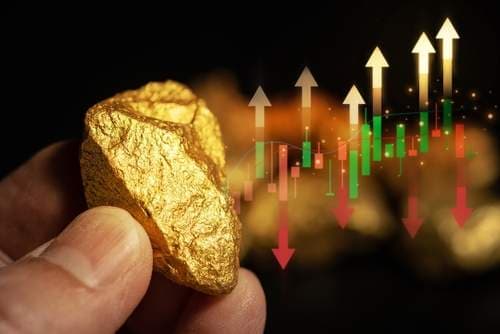
“It’s asset allocation, not stock selection, that makes the most difference for most investors. Being in the right place at the right time is what really matters. And among leading 21st century places — stocks, bonds, gold, commodities — nothing beat gold.”
–Bill Bonner
April 14, 2025 — Gold has reached a new all-time high, surpassing $3,100 per ounce. I anticipate it could climb even higher in the near future.
It’s interesting to see the dollar strong and the dollar price of gold strong at the same time. Normally a strong dollar means a lower dollar price for gold. You get more gold for your dollar. That’s not happening.
The dollar’s going up against all the other major currencies, but it’s not going up against gold. Gold’s going up against the dollar, meaning it takes more dollars to buy an ounce of gold. If you’re long dollars and long gold, you’re doing well on both accounts.
Central Bank Gold Holdings Are Surging
One reason for gold’s surge is the role of central banks. Retail and institutional investors may not be that interested in gold, but central banks definitely are.
In recent years, central bank holdings of gold have surged from 33,000 metric tonnes to over 36,000 metric tonnes, a 9.0% gain measured by weight.
This increase has been heavily concentrated in two countries – Russia and China. Russian gold reserves have risen from 600 metric tonnes in 2008 to 2,335 metric tonnes today, a gain of 1,735 metric tonnes or nearly 300% from the 2008 base.
China also had about 600 metric tonnes in 2008 and today has 2,280 metric tonnes, a 275% gain. (There is good reason to conclude that China has undisclosed gold reserves which would make those total and percentage gains ever higher).
The Big Ten holders of gold include the usual suspects – the US, Germany, Italy, France, Switzerland and Japan. But the list also includes some newcomers such as Russia, China and India.
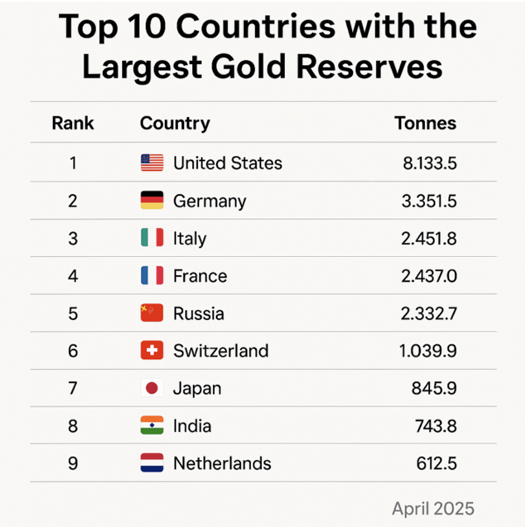
Why the large gold holdings and why the rapid additions to gold reserves if gold is not a monetary asset? The question answers itself. Gold is a monetary asset.
Central bank net buying is equivalent to about 20% of annual gold mining output. That does not indicate a gold shortage, but it does put a firm floor under the dollar price of gold.
The Asymmetric Gold Trade
That creates what we call an asymmetric trade. On the upside, the sky’s the limit, but on the downside, the central banks have your back to some extent because they will definitely buy the dips to increase their gold hoards. That’s the best type of trade to be in.
So, the stage is set. The simple maths of easier percentage gains for constant dollar gains is the dynamic that can set off a buying frenzy and lead to super-spikes in the dollar price of gold.
Central bank buying causes a relentless increase in the dollar price of gold and offers limited downside because they will buy the dips. All that is needed to set off the super-spike is an unexpected development that is not already priced in.
True to form, we may have it. Trump announced his tariff plans for Canada, Mexico and China. Tariffs on the EU are not far behind. These tariffs would come on top of existing ones, which are quite high in the case of China.
No doubt those tariff threats are the starting place for all three countries to negotiate with Trump on a bilateral basis to arrive at policy changes (or not) that could avert or mitigate the added tariffs. Still, no one should doubt Trump’s willingness to move forward with the tariffs if he is not satisfied with the response.
‘BRICS Is Dead’
In a press conference, President Trump repeated his warning from months ago. He said he would impose 100% tariffs on any BRICS member that took steps to create a new BRICS currency that would rival the US dollar. He believes the BRICS nations have backed off since this threat and called the group ‘dead’.
Here’s the X post by Trump on this matter back in November:
Of course, 100% tariffs are extreme by any measure and are more like an act of war than a legitimate economic policy. Still, today he stood by what he said back in November.
What’s Important to Keep in Mind
The BRICS are a multilateral economic organisation including Brazil, Russia, India, China, South Africa, Iran, the UAE and several other nations. At least twenty other countries, including some large economies such as Malaysia and Turkey, have applied for membership.
Collectively the BRICS represent about half the population of the planet and about 30% of global GDP (or over 50% of global GDP if the purchasing power parity method of calculation is used). The BRICS are not some polyglot collections of developing economies. They represent a large proportion of the entire global economy.
BRICS members Russia and Iran are already subject to extreme US economic sanctions. But Brazil, China and India are not subject to extensive sanctions and are among the largest US trading partners. Tariffs of 100% are onerous even when legitimate economic goals are being pursued.
Importantly, the BRICS are not currently working on a new currency although they are working on a new global payments system to bypass SWIFT and Eurodollar banks — something quite different.
Any 100% tariffs of the kind described would result in retaliation from the BRICS that would hurt major US exporters such as Boeing, John Deere, Cargill, Dow Chemical and Koch Industries.
It may be that Trump is just trying to draw some lines in the sand before any action is required. It may be that he is just setting up a situation where he can boast about “success” in scaring off the BRICS from launching a new currency when there was no actual currency launch plans in the near future.
But he believes the BRICS nations will not go any further in trying to replace the US dollar. Trump is a master of the art of the deal and his statement today may be a reflection of his negotiating style.
The BRICS’ Currency Solution: Gold
Was this a warning shot about future actions even though Trump claimed action is not imminent?
The truth is the BRICS nations already have a common currency but no one in Washington understands what it is. That common currency is gold.
Today, if BRICS want to avoid the US dollar, they have to trade in their local currencies. China can pay for Russian energy exports using yuan. Russia can pay for Brazilian aircraft using rubles. India can pay for manufactured goods from China using rupees. And so on.
That method works fine. The payments can move between local banks without relying on the SWIFT payment message system in Belgium. (Russia and Iran are both banned from SWIFT).
Central banks in each BRICS country can pay local buyers and sellers in their home currency (or offer dollars through separate channels if needed to buy inputs from other countries). Those central banks then maintain a ledger showing the gross amount of other BRICS currencies they hold in their reserves.
Difficulties arise when one country runs a continual surplus with another and accumulates more of that trading partner’s currency than the surplus country can put to good use. Reserve positions in trading partner currencies also pose liquidity risks and foreign exchange risks to the holder.
A simple solution is to settle the balance in gold. This can be done on a net basis, which requires far less gold than gross settlements. It can also be done periodically (say quarterly or twice per year) which is also far easier than real-time settlement.
The gold itself can easily be transported by plane or kept in an agreed vault location with a digital ledger identifying how much gold was in each country’s account and reflecting transfers of ownership as needed.
This arrangement is not a gold standard. None of the BRICS members are offering to freely exchange gold for any currency. None of the members is offering to buy or sell gold at a fixed exchange rate.
The purpose of gold is simply to provide an agreed medium of exchange and store of value for settling trade surpluses and deficits among willing members. This is a solution for the BRICS, but there’s no reason why participation in such an arrangement must be limited to the BRICS. Any trading country could in principle join the arrangement.
What this method does do is allow participants to settle trade differences in something other than US dollars. Trade takes place in local currencies and differences are settled in gold. No dollars are needed.
This is why Trump’s tariff threat is really just for show. He won’t impose 100% tariffs on countries working on dollar alternatives because no countries are actually doing that. The settlement medium of exchange is already here. It’s gold.
And that’s good news for gold investors because the BRICS and other nations will have to acquire gold themselves (which they are already doing) in order to participate. Other investors who buy gold are along for the ride and it’s a ride that should lead to even higher dollar prices for gold.
I have my gold. It’s time to consider getting yours.
— Jim Rickards
Investors Daily & Grey Swan
P.S. from Addison: You catch Jim discussing his latest research American Birthright, right here.
And if you’re a paid member of the Grey Swan Investment Fraternity, you can join us for a live discussion on Thursday, April 17, 2025 at 11 AM EST.
We’ll be analyzing central bank buying of gold, the U.S. dollar’s role as the global reserve currency amid the Trump tariff regime… and how crypto fits into the mix.
You can sign up here to become a member.
Grey Swan Live!
Thursday, April 17, 2025
11:00 AM EST
Add your thoughts to the mix here: addison@greyswanfraternity.com