Ripple Effect
Strip Out M2, AI Boom Is Sticking to the Bubble Script

April 20, 2026 • 2 minute, 28 second read

Stocks were hungry for good news from Iran last week.
Now, traders have moved from hedging geopolitical risk tied to Iran to adding exposure to anything with “AI” attached.
We’re kicking this week off with renewed concerns that the Strait of Hormuz will remain treacherous for some time. But if you strip out the noise, it reveals what’s really happening in the stock market:
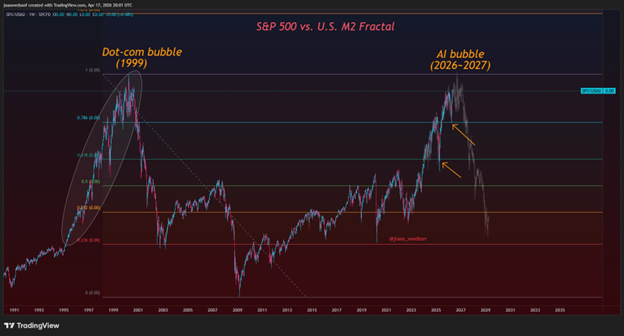
Dividing the S&P 500 by the M2 money supply gives a clearer picture of how late the market is in the AI boom/bust cycle. (Source: Joao Wedson)
Analyst João Wedson stripped out the rise of M2 money supply to see how far equity prices have run relative to the pool of dollars available in the system.
Adjusting the S&P 500 Index’s price relative to M2 growth, we’re in the final inning or two of the AI boom on Wall Street.
Stock prices on the S&P 500 have outpaced the growth in money supply. Without inflation, the S&P 500 continues to track the cycle last seen during the telecom buildout in the 1990s.
Of course, “this time is different,” Right?
We heard the same in the late 1990s. It’s a “new paradigm.” The “internet will change everything.” That turned out to be true. It just didn’t happen on the timetable that is convenient for individual investors.
The dot-com crash arrived while the network was still being built.
Alphabet (GOOGL) and YouTube wouldn’t catch investors’ attention until 2006. Mobile apps that let you skip the line at Starbucks until the 2010s. Netflix (NFLX), PayPal (PYPL), Tesla (TSLA)… today’s stock market darlings were all founded after the dot-com bust.
AI systems are improving. The demand is rising. Companies are experimenting with deployment. At the same time, the market is assigning value today based on outcomes that may take years to fully materialize.
“Crack up booms” – inflation-driven stock market Melt Ups — add another layer.
Extended periods of 20% annual returns in the stock market have occurred before. They tend to cluster near the later stages of a cycle, when participation broadens and expectations stretch.
Today’s chart will not tell you when the market will bust. But it should give you serious pause. For an interesting way to trade today’s Ripple Effect, see: Shadow Stocks.
~ Addison
P.S. Last week on Grey Swan Live!, we showcased our latest research on Shadow Stocks – volatile stocks that move rapidly up and down beneath the surface of the calm indexes.

Earnings season is a ripe time for cherry-picking stocks. Along with the research, we are launching an upgrade to your Grey Swan forecast emails that will include up to five stock or trade recommendations a week.
To kick it off, we’re going to give you three stocks free of charge. Gratis. On the house. The research is excellent, and the upgraded Grey Swan Pro will be worth your time to consider. Take a look here.