GSI Banner
  • Free Access
  • Contributors
  • Membership Levels
  • Video
  • Origins
  • Sponsors
  • My Account
  • Sign In
  • Join Now

  • Free Access
  • Contributors
  • Membership Levels
  • Video
  • Origins
  • Sponsors
  • Contact

© 2025 Grey Swan Investment Fraternity

  • Cookie Policy
  • Privacy Policy
  • Terms & Conditions
  • Do Not Sell or Share My Personal Information
  • Whitelist Us
Ripple Effect

Retail Investors Keep Buying as Insiders Keep Selling

Loading ...Addison Wiggin

June 18, 2025 • 1 minute, 52 second read

Insider Tradingretail investors

Retail Investors Keep Buying as Insiders Keep Selling

Thanks to inflation, a penny stock today is considered any stock trading under $5 per share. That’s also the price where institutional investors are cut off from owning a stock – it’s just too low a price and it’s too easy for big money to buy shares.

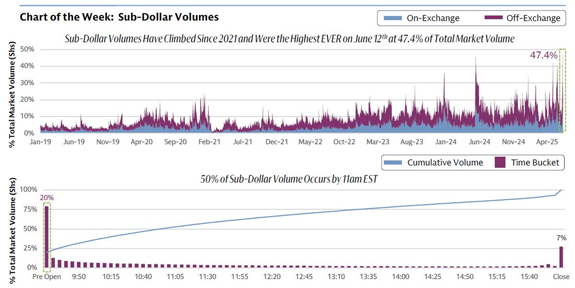
But that isn’t stopping retail investors from buying sub-$5 stocks – and now, true penny stocks trading under $1.00.

Today, a whopping 47% of all market volume is in sub-$1 stocks:
Turn Your Images On

As mentioned in this morning’s Swan Dive, Regencell Bioscience started the year as a penny stock, trading as low as $0.09, split-adjusted.

It’s now been the best market performer year-to-date – even without any positive corporate developments to point out – just pure retail buying. (We also strongly urged you not to buy the stock.)

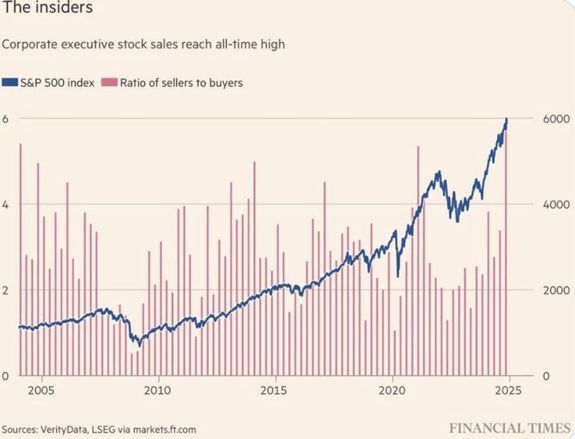
In the meantime, company insiders are now picking up the pace of their sales:
Turn Your Images On

Of course, insiders have many reasons to sell, from putting a kid through college, paying for a messy divorce – or just the good old-fashioned opinion that their shares are overvalued.

These two trends suggest that retail investors are getting ebullient, while the insiders who know their company’s value inside and out are hitting the cash register.

~ Addison

Good News for Stocks

50-year Wall Street veteran, Marc Chaikin is stepping forward to share why history gives him 90% historical confidence that stocks will end 2025 up. However, he also has bad news: the same data also tells him the REAL market crash will likely arrive in 2026. Click here to see the month and day he estimates it will begin.

P.S.: Looking for small-cap companies that are driven by fundamentals and not just retail sentiment?

Consider joining our Portfolio Director Andrew Packer at the Rule Investment Symposium in Boca Raton on July 7-11, 2025. Click here to attend and meet your future cutting-edge resource investments face-to-face.

And for paid-up members: Be sure to join us for Grey Swan Live! tomorrow, June 19, 2025. It’ll be Juneteenth, and we’ll be discussing international investing, value investing, and how to find massive stock winners over time with Chris Mayer. Chris is always a good conversation.

As always, your reader feedback is welcome: feedback@greyswanfraternity.com (We read all emails. Thanks in advance for your contribution.)


2025: The Lens We Used — Fire, Transition, and What’s Next… The Boom!

December 22, 2025 • Addison Wiggin

Back in April, when we published what we called the Trump Great Reset Strategy, we described the grand realignment we believed President Trump and his acolytes were embarking on in three phases.

At the time, it read like a conceptual map. As the months passed, it began to feel like a set of operating instructions written in advance of turbulence.

As you can expect, any grandiose plan would get all kinds of blowback… but this year exhibited all manner of Trump Derangement Syndrome on top of the difficulty of steering a sclerotic empire clear of the rocky shores.

The “phases” were never about optimism or pessimism. They were about sequencing — how stress surfaces, how systems adapt, and what must hold before confidence can regenerate. And in the end, what do we do with our money?!

2025: The Lens We Used — Fire, Transition, and What’s Next… The Boom!
Dan Amoss: Squanderville Is Running Out Of Quick Fixes

December 19, 2025 • Addison Wiggin

Relative to GDP, the net international investment claim on the U.S. economy was 20% in 2003. It had swollen to 65% by 2023. Practically every type of American company, bond, or real estate asset now has some degree of foreign ownership.

But it’s even worse than that. As the federal deficit has pumped up the GDP figures, and made a larger share of the economy dependent on government spending, the quality and sustainability of GDP have deteriorated. So, foreigners, to the extent they are paying attention, are accumulating claims on an economy that has been eroded by inefficient, government-directed spending and “investments.” Why should foreign creditors maintain confidence in the integrity of these paper claims? Only to the extent that their economies are even worse off. And in the case of China, that’s probably true.

Dan Amoss: Squanderville Is Running Out Of Quick Fixes
Debt Is the Message, 2026

December 19, 2025 • Addison Wiggin

As global government interest expense climbed, gold quietly followed it higher. The IIF estimates that interest costs on government debt now run at nearly $4.9 trillion annually. Over the same span, gold prices have tracked that burden almost one-for-one.

Silver has recently gone along for the ride, with even more enthusiasm.

Since early 2023, Japan’s 10-year government bond yield has risen roughly 150 basis points, touching levels not seen since the 1990s.

Over that same period, gold prices have surged about 135%, while silver is up roughly 175%. Zoom out two years, and the divergence becomes starker still: gold up 114%, silver up 178%, while the S&P 500 gained 44%.

Debt Is the Message, 2026
Mind Your Allocation In 2026

December 19, 2025 • Addison Wiggin

According to the American Association of Individual Investors, the average retail investor has about a 70% allocation to stocks. That’s well over the traditional 60/40 split between stocks and bonds. Even a 60/40 allocation ignores real estate, gold, collectibles, and private assets.

A pullback in the 10% range – which is likely in any given year – will prompt investors to scream as if it’s the end of the world.

Our “panic now, avoid the rush” strategy is simple.

Take tech profits off the table, raise some cash, and focus on industry-leading companies that pay dividends. Roll those dividends up and use compounding to your overall portfolio’s advantage.

Mind Your Allocation In 2026