
“You don’t see something until you have the right metaphor to let you perceive it.”
–James Gleick, Chaos
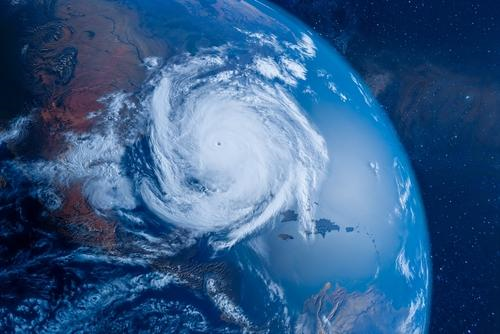
Hurricanes can undergo rapid intensification, just like financial markets
October 8, 2024 – We have a long history with The Republic of Florida, including satellite offices in Delray Beach.
It’s usually pleasant to visit, especially when the incessant dreary days of a Northeast winter start causing undue negativity in our economic commentary. It’s hard to find someone who doesn’t have a friend or family member living in the Sunshine State.
Right now, the entire midriff of the great peninsula is under siege by nature. As recently as Saturday, models in the Gulf of Mexico suggested a low pressure system would dump considerable rain on South Florida.
We blinked and it’s now Hurricane Milton headed straight for Tampa and our neighbor’s Baltimore Ravens-inspired beach bar in Passe-a-Grille, south St. Pete’s beach.
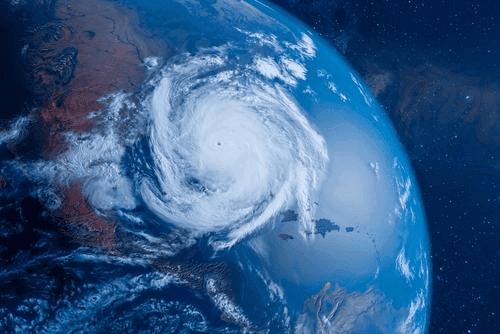
Yesterday, the storm grew to a Category 5, the maximum on record, with winds of 185 miles per hour, and gusts of 200+. The speed of this process, one of the fastest on record, is called “rapid intensification.”
Conditions in the Gulf were just right for this perfect storm — exceptionally warm water, the right wind trends, and little interaction with land.
Although the eye of Milton is about four miles across – a baby compared to Helene earlier this year, it will still hit the Tampa area later this week as a strong Category 3 storm, and send wind and rain across most of the state.
Unfortunately, rapid intensification isn’t limited to hurricanes. As mankind is part of nature, human endeavors also undergo rapid intensification. We wrote a series on how negative feedback loops impact market collapses and demand side – “pull” – inflation during last hurricane season a year ago.
When Bear Stearns collapsed in early 2008, it took until September of that year for Lehman Brothers to go down. Once that happened, the rest of the Wall Street banks became just days away from having their own “Lehman moment.”
In financial markets today, nearly all-time highs suggest calm, cloudless skies. The cliche “calm before the storm” has literal meaning when the metaphor fits.
If climatologists look at elevated surface temperature in the Gulf of Mexico as the prime mover for rapid intensification of tropical storms, economists today can equally evaluate the ripe conditions posed by elevated levels of debt at all levels of society.
Lau Vegys, writing in Doug Casey’s Crisis Investing, suggests just that. When a crisis begins on Wall Street, America’s debt problem could also undergo rapid intensification. Perhaps in the not-too-distant future. Enjoy ~~ Addison
America’s Ballooning Fiscal Gap Threatens to Blow Up Its Future
Lau Vegys, Doug Casey’s Crisis Investing
Today’s chart shows the path of U.S. government spending and revenues from 1989 to now, along with projections for the next 31 years.
See that gap between the lines? That’s where our debt comes from. Every year, when spending outpaces revenue, it’s like putting the difference on the national credit card.
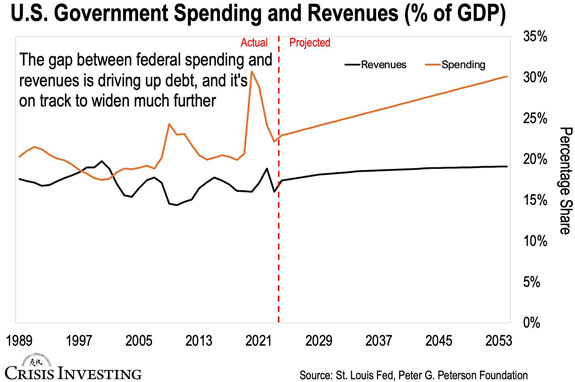
If you take a closer look, the late ’90s and early 2000s were the only time the government’s books weren’t a total mess. Revenues were up, spending was under control. We even toyed with the idea of paying off the national debt. Seems like a fairy tale now, doesn’t it?
But then the 2000s rolled in, and things took a turn. Wars, bailouts, you name it. The gap between what the government was taking in and what it was spending started to widen alarmingly. And just when we thought we’d seen it all, 2020 hit us like a freight train. COVID, lockdowns, stimulus checks galore. Government spending skyrocketed to 30% of GDP.
That was a recipe for a debt explosion, and that’s exactly what happened.
To put it in numbers, our national debt jumped from about $23 trillion at the start of 2020 to over $27 trillion by the end of the year. That’s a staggering $4.5 trillion increase in just one year! For perspective, it took the U.S. over 200 years to accumulate its first $4 trillion in debt.
At writing, we’re staring at $35.67 trillion and counting in national debt, with interest payments exceeding $1 trillion for the first time in history.
That’s grim, but the future doesn’t look any brighter. See that orange line stretching into the distance? That’s government spending, and it’s on an upward trajectory with no signs of slowing down. Meanwhile, the black line – that’s revenue – is barely budging. We’re looking at a gap that’s widening year after year, with no end in sight.
By 2054, we’re looking at spending levels above 30% of GDP with revenues hovering under 20%. This means we’ll be adding trillions to the national debt every single year, and that’s probably a best-case scenario. ~~ Lau Vegys, Doug Casey’s Crisis Investing
So it goes,

Addison Wiggin,
Grey Swan
P.S. Hurricane Milton intensified even more rapidly than Helene, its hellacious predecessor from two weeks ago. If you’re in his path (ahem, Andrew Packer) stay safe.
Our unpaid correspondent Robert from Houston shares these thoughts from last week’s essays on the path to World War III:
Gents, Please consider the neocons (MICCIMATT) enjoyed the Cold War too much to let it die.
Bating Russia is a 200 year established habit. Currently, they desperately need escalation in the Ukraine to cover the US Elections.
So they bait Putin. He knows this, and also knows the only way he loses in the Ukraine is by using a nuke which would alienate the Global South. Fortunately, there is no way Zelinsky could assemble a nuke-worthy target. So Putin’s hardliners aren’t even tempted.
The US continues to threaten longer-range missiles which Putin does not fear but can deftly portray as direct US involvement. Setting up justification for retaliatory strikes on one or more of the 2-3 16B$ Keyhole spy satellites. The Global South would cheer. A Kazan BRICS surprise would be best timing.
With Fauci as the competence-highpoint of the US government, it is not clear they understand any of this nor can wait past Kazan.
We also recall the 2012 presidential debates, when Barack Obama scolded Mitt Romney for warning that Russia was a geopolitical foe, saying, “the 1980s called, they want their foreign policy back.”
One thing Reagan and today’s Democrats have in common, neither mind running up the national credit card to fight wars all over the planet.
Thank you if you have also written in. Keep your ideas flowing, here: addison@greyswanfraternity.com