“At dawn on Sunday,” Shanaka Anslem Perera writes, “the Suezmax tanker OTIS arrived in Tokyo Bay carrying 910,000 barrels of Texas light crude.”
The cargo left Houston on March 22, transited the Panama Canal and was pumped into Cosmo Oil’s Chiba refinery, a plant built around Middle Eastern supply.
It was the first U.S. crude shipment to Japan since the Iran war began on February 28.
The cargo on OTIS covers roughly half a day of Japan’s consumption.
Now hold that thought for a moment.
And allow us to dramatize what’s at stake in President Donald Trump’s gamble with Iran in the Persian Gulf…
📊 Presidents lose House seats in midterms
Since 1946, the president’s party has lost House seats in 18 of 20 midterm elections, averaging about 28 seats. When approval ratings fall below 50%, those losses tend to follow.
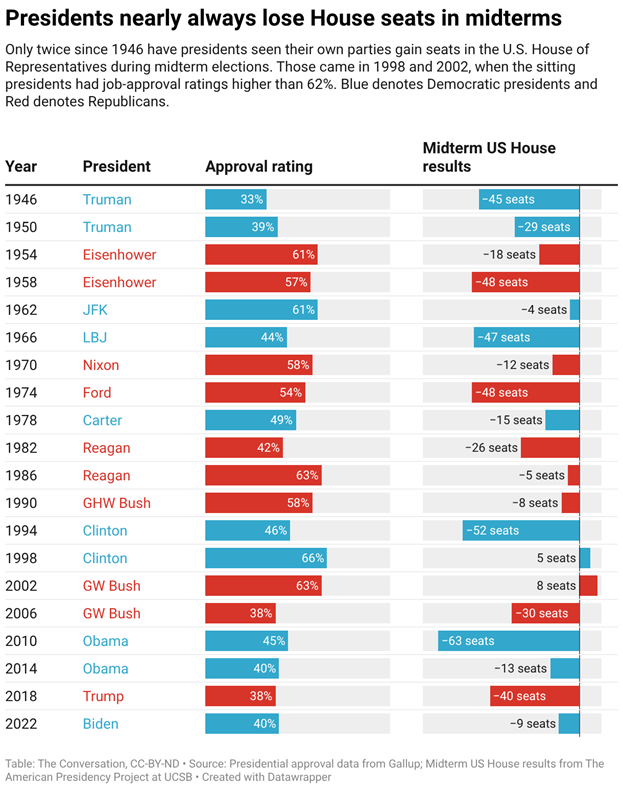
On January 6, 2026, President Trump warned House Republicans that if they did not win the 2026 midterms, he would be impeached again. He stated, “You got to win the midterms, because, if we don’t win the midterms, it’s just going to be — I mean, they will find a reason to impeach me. I will get impeached”. (Source: PBS, Gallup, Datawrapper)
Depending on who you ask, Trump’s approval rating this morning is somewhere between 33% and 41%. He’s entering the 2026 midterm campaign season below the 50% threshold, putting him roughly in the same pattern that wiped out House majorities for Bill Clinton in 1994 and Barack Obama in 2010.
Holding the House requires outcomes that show up long before voters check a box on November 3. Several key factors in the “affordability” index need to swing big in the President’s favor.
Fuel supply and prices need to stabilize after the disruption in the Strait of Hormuz is over. After-tax income needs to rise under the 2025 tax law. And borrowing costs for homes, education and health care need to improve dramatically. Plus, we’re awaiting whether Trump’s Federal Reserve chairman nominee Kevin Warsh shifts rate policy at the Federal Reserve.
🏛️ The Project 2026 Campaign Strategy
President Trump has said he intends to “turn it around” and is pushing for changes in election procedures, focusing on voter ID rules and local administration in cities such as Detroit and Philadelphia.
Republican campaigns are preparing a confrontational approach against Democratic candidates while working with narrow House margins.
At the same time, the White House is advancing three policy tracks tied to November: expanding domestic energy production and exports, implementing tax cuts and tariff refunds already written into law and confirming Warsh as chairman of the Fed to influence interest rates.
Each track addresses a different pressure point — fuel costs, take-home pay and credit conditions — while the campaign builds around election rules and messaging.
🌍 Japan funded U.S. Energy Projects and Defense
Back to Japan.
At the March 19 Trump-Takaichi summit, Japanese officials committed $40 billion to GE Vernova (GEV) small modular reactor projects and $33 billion to U.S. natural gas infrastructure. Japan holds about $1.239 trillion in U.S. Treasurys that finance federal spending.
Japan increased defense spending to 2% of GDP in fiscal 2025 and approved a ¥9.04 trillion budget for fiscal 2026, including stand-off missile systems and coastal drone networks. Those commitments sit alongside long-term Treasury holdings and new energy investments in the United States.
 In their most recent White House meeting on March 19, 2026, President Trump and Japanese Prime Minister Sanae Takaichi announced a major energy and investment deal. This agreement includes a second tranche of Japanese investments totaling approximately $73 billion in U.S. energy infrastructure. That’s on top of the grand bargain President Trump struck with Saudi Crown Prince Mohammed bin Salman at the White House on November 18, 2025. (Source: TheWhiteHouse.gov)
Japan sourced more than 94% of its crude from the Middle East as recently as February. Within 55 days, refiners began rearranging supply chains that had been stable for decades.
Texas crude runs lighter and cleaner than the Saudi supply. Running it through equipment designed for heavier barrels changes what comes out of the system. Gasoline output rises. Diesel and jet fuel fall. Japan’s transport system depends on diesel and jet fuel, so refiners are reducing throughput when they cannot secure crude that yields the fuels they need.
Three additional U.S. tankers are scheduled for delivery in May.
U.S. crude exports to Asia are expected to reach 3.29 million barrels per day, up from 1.1 million before the war. Panama Canal auction premiums to move crude have reached about $4 million per slot.
The supply chains for global energy output and delivery are getting reworked regardless of the outcome of the stalemate between the U.S. and Iran over safe passage. (See: Today’s Ripple Effect, for details on the ceasefire negotiation and a trade likely to skyrocket regardless of the outcome in the Gulf.)
🪖 Maduro Capture Reset the Western Hemisphere Playbook
In early January, U.S. forces carried out a coordinated raid in Caracas and captured Nicolás Maduro, flying him to New York to face narcotics charges. The operation involved months of intelligence work and a large-scale military strike authorized by Trump, who framed it as a law-enforcement action tied to drug trafficking and national security.
The move did more than remove a regime.
It put U.S. control over Venezuelan oil infrastructure back on the table and signaled a willingness to use force inside the Western Hemisphere, a posture officials linked to countering both cartel networks and Chinese influence in the region.
That gives Trump a visible foreign-policy result to point to going into November, alongside the Saudi relationship that anchors oil supply and pricing.
⚖️ Foreign Wins Tie Directly Into the Midterm Math
The midterm calendar does not care about foreign policy victories on its own. Since 1946, the president’s party has lost House seats in 18 of 20 midterms, and that pattern has held when approval ratings sit below 50%. Trump’s path runs through three pieces that connect these overseas moves back to voters at home.
First, energy: Venezuelan oil and Saudi coordination need to translate into stable or lower fuel costs. Second, income: tax cuts and tariff refunds have to reach paychecks and balance sheets before November. Third, rates: confirming Warsh needs to translate into lower borrowing costs that households and businesses can see.
The risk sits in the same place as the opportunity. A short, decisive action like the Maduro operation can be presented as a strength. A prolonged engagement that ties up resources and spending can push isolation-minded voters the other direction.
💰 Tax law sets 2026 income levels
On April 15, we were treated to a White House conference featuring Treasury Secretary Scott Bessent and Small Business Administrator Kelly Loeffler. Together, they chose Tax Day to extol the benefits to U.S. citizens of the One Big Beautiful Bill Act.
In many more words than were needed, the pair demonstrated that the top income tax rate of 37% remains unchanged and that the standard deduction is raised to $32,200 for joint filers, $24,150 for heads of household and $16,100 for single filers.
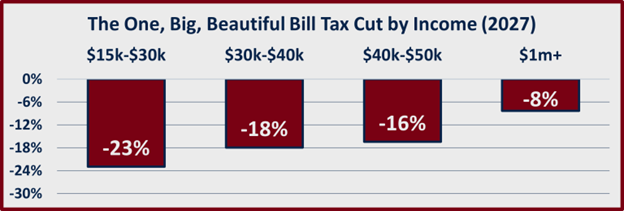
On April 15, 2026, at a Whit House press briefing, Treasury Secretary Scott Bessent highlighted the success of President Trump’s “Working Families Tax Cuts” (enacted via the “One Big Beautiful Bill Act”), stating that 45% of filers had already claimed at least one of the new tax benefits. (Source: CNBC and White House archives.)
Workers can deduct up to $25,000 in tips and $12,500 in overtime pay through 2028, subject to income limits. Individuals aged 65 and older receive an additional $6,000 deduction.
The child tax credit rises to $2,200, and the SALT deduction cap increases to $40,400 for qualifying households.
Businesses can expense capital investments immediately and deduct research and development costs. Analysts estimate after-tax income increases of about 5.4% on average in 2026.
At the same time…
📦 Tariff Refunds Moved Through the CAPE portal
U.S. Customs and Border Protection opened the CAPE portal on April 20 to process refunds of more than $166 billion in tariffs collected under emergency powers.
Companies that acted as importers of record are filing claims. Estimates suggest Walmart (WMT) could receive up to $10 billion, Target (TGT) about $2 billion and Nike (NKE) around $1 billion.
More than 56,000 importers have begun the process. Shipping companies such as FedEx (FDX) and United Parcel Service (UPS) said they may pass along some savings, though most funds are expected to remain on corporate balance sheets.
To round out the trifecta of policy initiatives…
🏛️ Warsh Senate Vote And Earnings Later This Week
Warsh is now on track for a confirmation vote before mid-May, following Sen. Thom Tillis’s withdrawal of opposition. During hearings, Warsh said he would maintain independence while arguing for changes to the Federal Reserve’s approach to inflation.
Treasury bill issuance now represents more than one-fifth of outstanding debt. Money market funds hold about $7.5 trillion in assets. Stablecoin reserves and tokenized Treasury products continue to expand. Banks, funds and digital platforms are absorbing short-term government debt across multiple channels.
The Senate Banking Committee votes on Warsh’s nomination at 10 a.m. Eastern time on April 29.
Later that day, Microsoft (MSFT), Alphabet (GOOGL), Meta Platforms (META) and Amazon (AMZN) report earnings, including capital expenditure tied to data centers and energy demand.
Tick, tock. Tick, tock… the midterms are a comin’…
~ Addison
P.S. If you missed Grey Swan Live! last week with Zoltan Istvan, we got a whirlwind view of the future, Zoltan-style, which we dubbed “Robots, UBI, and Wine”…

In one stirring anecdote, Mr. Istvan described a recent letter he wrote to his wife. After three decades of buying, trading and developing real estate using the credit markets, they are planning for a “black swan” deflationary environment by deleveraging their real estate, something he’s never done with his own money…
I tried to persuade him to use the term “grey swan” instead, since it’s a trend he can see comin’. We’ll see if he comes around.
One curious story, while he’s planting more vines in his vineyard in Napa, he knows several other grape growers who are ripping their vines out of the ground, because it’s cheaper to let the land lie fallow than pay to deal with California’s onerous regulatory environment. Another sign of things to come?
Perhaps. Check out Zoltan’s interesting and very unique perspective on AI, the acceleration of change, and the future of value in the markets… stocks, bonds, real estate and tech. All very thought-provoking and worth a listen.