
GSI Banner
  • Free Access
  • Contributors
  • Membership Levels
  • Grey Swan Forecasts
  • Video
  • Origins
  • Sponsors
  • My Account
  • Sign In
  • Join Now

  • Free Access
  • Contributors
  • Membership Levels
  • Grey Swan Forecasts
  • Video
  • Origins
  • Sponsors
  • Contact

© 2026 Grey Swan Investment Fraternity

  • Cookie Policy
  • Privacy Policy
  • Terms & Conditions
  • Do Not Sell or Share My Personal Information
  • Whitelist Us
Ripple Effect

Private Credit’s Implosion

Andrew PackerAndrew Packer

April 2, 2026 • 1 minute, 42 second read


BanksDonald Trumpiran warprivate credit

Private Credit’s Implosion

President Donald Trump’s speech last night about Iran did little to change the current market dynamic.

That will change in time. But the real challenge to market indexes goes beyond rising oil prices. In the background, the festering pool of bad private credit deals remains.

This morning, private credit giant Blue Owl noted that it had redemption requests totaling 22% of its income fund, and a staggering 41% in its software fund. The problem? The company is capping redemptions at 5%.

Traders are hitting the eject button on private credit as quickly as they can:
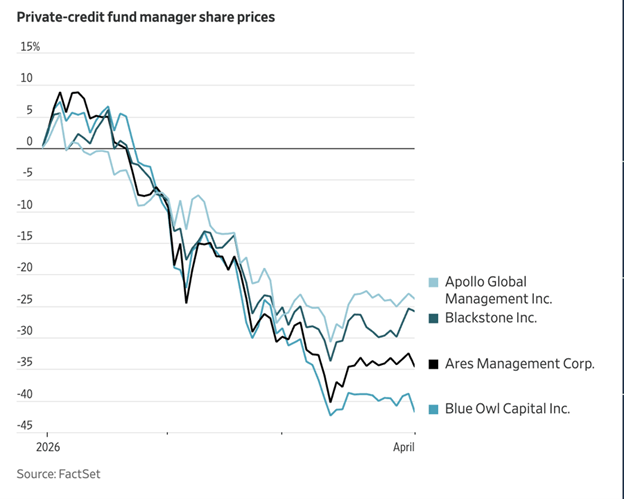
Companies in the private credit space have tanked as redemption requests have soared. (Source: FactSet)

The trouble with private credit:  investors are lured in by the promise of higher returns. But to get them, they have to surrender liquidity. At the first sign of trouble, liquidity is exactly what they want. Shares of private credit giants trading on public markets are selling off hard. 

Given that private credit deals have infected the entire financial system – backed by major banks, insurance companies and pension funds – the contagion is proving as hard to “contain” as subprime mortgages in 2007.

~ Andrew

P.S. Grey Swan Live! returns this week with Ian King, today at 2 p.m. ET. to help us sort the wheat from the chaff.



Ian’s been out front on the crypto revolution for a decade. The rumor mill out of Washington is hot with breakthrough news of a deal between the banking lobby and digital asset innovators. We could hear details on the wording of the Clarity Act as early as today.

This afternoon, we’ll dig into Clarity and cover its implications on everything from tokenization to Defi and get an update on all of our “Dollar 2.0” ideas while lawmakers allow tech to modernize the U.S. dollar and financial system. 

This is easily one of the most disruptive trends in the history of global financial markets. 

Which means, it’s prime Grey Swan event territory! You don’t want to miss today’s chat with Ian King.



Copper’s Clear Signal

August 17, 2026 • Addison Wiggin

Copper and resources are sending us a cleaner market signal than AI stocks.

Channeling Ludwig von Mises, we observe this morning that price is not just a number; it’s information. Price reflects what buyers and sellers collectively believe: demand, scarcity, fear, speculation, disappointment, future expectations and available supply.

When prices rise, and inventories fall at the same time, the message is usually straightforward: buyers need the stuff, and there is not enough of it.

Copper’s Clear Signal
Market Crash Insurance Is Cheap

August 14, 2026 • Addison Wiggin

A low VIX does not predict disaster. It measures complacency. A serial skeptic will read it as the calm before a storm. We shook off that feeling this morning and opted to pursue an opportunity instead.

Here goes:

A VIX reading below 15 means the market is not pricing in much near-term trouble, even though there are obvious risks still sitting in the room: Iran, oil prices, memory chip speculation, circular financing, high valuations, epic high concentrations, spiking long-term interest rates, a regime change at the Fed, a meltdown in Japan and a historic deficit and rising national debt.

Market Crash Insurance Is Cheap
Beware: Financial Innovation In AI

August 13, 2026 • Addison Wiggin

Money is not flowing in a clean, straight line from outside investors to productive businesses. The firms at the top are investing in and buying from each other.

Microsoft and OpenAI are the easiest examples to follow.

Microsoft says OpenAI has contracted to purchase an additional $250 billion in Azure services, while Microsoft continues to account for $13 billion in funding commitments to OpenAI as an investment.

Beware: Financial Innovation In AI
Signs of a Late-Stage Bull Market

August 12, 2026 • Addison Wiggin

At this stage, it’s a stock picker’s market.

We expect space, robotics and some more visible tech startups to remain sources of speculation. After weakness in the first half of 2026, we’re also due for a strong rotation of capital into natural resources, precious metals, critical minerals and energy.

Signs of a Late-Stage Bull Market