“The first panacea for a mismanaged nation is inflation of the currency; the second is war,” Ernest Hemingway infamously wrote. “Both bring a temporary prosperity; both bring a permanent ruin. But both are the refuge of political and economic opportunists.”
This morning, Washington is flirting with both.
A quick anecdote: One of my uncles flew transports in Vietnam, then worked aircraft testing programs with Boeing before the first Gulf War.
Prior to that conflict, he disappeared for several weeks. Years later, he explained he had been mobilized to move Tomahawk systems to U.S. bases in Bahrain, leading up to the liberation of Kuwait from Saddam Hussein’s Republican Guard.
The buildup of weapons and support logistics in the Gulf is remarkably visible again.
Carrier strike groups are positioning in the Mediterranean and Indian Ocean. More than 150 U.S. military cargo flights have transported weapons systems and ammunition to the Middle East.
Another 50 fighter jets — F-35s, F-22s, and F-16s — were repositioned within 24 hours. Oil traded above $64 per barrel on the news.

A widely circulated post on X tracked 25 refueling tankers airborne simultaneously, moving assets toward Europe and the Gulf. Five additional tankers reportedly launched within an hour. Large airlifts are expensive, visible signals. They move fuel, munitions, and leverage. (Source: WarMoniter3 on X)
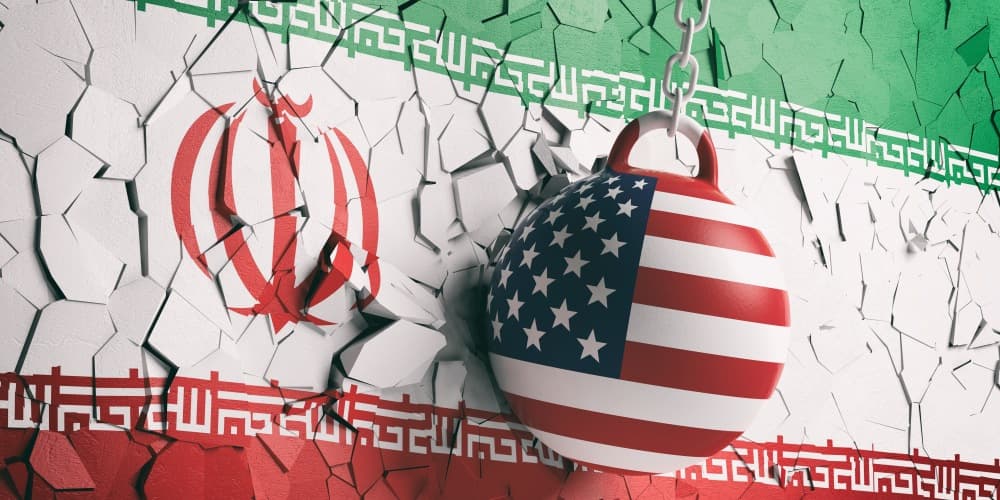
According to a report from the intel group Semafor, indirect talks between the U.S. and Iran in Geneva — mediated by Oman’s foreign minister — have produced limited progress.
Iran’s foreign minister said no deal is imminent and negotiations will resume within two weeks. In the meantime, U.S. aircraft carriers and air defense systems continue arriving in the Gulf. Iran conducted drills that briefly disrupted traffic in the Strait of Hormuz and warned of retaliation for any strike.
Walter Russell Mead described President Trump as “in a sweet spot,” with options ranging from negotiation to regime pressure.
Gulf states worry escalation could pull them into a broader conflict. Brent crude slipped roughly 2% after signs of tentative diplomatic movement, suggesting traders assign non-zero probability to a negotiated outcome.
The military assets are in motion. Oil has spiked 5% this morning.
 Oil, AI, and the Petro-Dollar on Digital Rails
We’ve speculated here in the Dive that back on November 18, 2025, during Mohammed bin Salman’s visit to the White House, a grand bargain was struck between the House of Saud and U.S. President Trump.
The bargain goes something like this: Saudi Arabia would support Trump’s grand realignment strategy and support the 50-year run of the U.S. petrodollar, in exchange for the U.S. manhandling the recalcitrant members of OPEC – Venezuela and Iran – and help the Saudis develop an economy worthy of a global seat at the table in the AI economy.
Under Trump’s plan, the U.S. could plausibly control the global supply of oil and energy assets and keep them out of Russia’s and China’s hands.
Some details leaked this morning support our grand bargain thesis.
Saudi Arabia’s sovereign wealth fund, HUMAIN, committed $3 billion to Elon Musk’s xAI ahead of its merger with SpaceX.
The PIF-backed vehicle converted its holdings into SpaceX equity, becoming what it described as a “significant minority shareholder.” Qatar Investment Authority and Abu Dhabi’s MGX participated in earlier rounds.
The capital supports the development of a 500-megawatt data center in the Kingdom and the deployment of Grok within Saudi Arabia.
Riyadh wants to be an AI champion. Washington wants energy supply aligned with U.S. security interests. Control of oil flows supports the dollar settlement system. The impending digital infrastructure extends that system onto new rails, provided the Senate can settle the scuffle between big banks and digital asset companies and get the wording of the Clarity Act right.
Rare earths, supply chains, and semiconductor dependencies fit inside the same matrix. The grand bargain controls chokepoints, secures pricing power, and protects the dollar’s reserve currency status.
As we said, it’s plausible.
 Gold and the Global Monetary Reset
After 1971, central banks reduced gold reserves to reinforce confidence in fiat convertibility. Since the 2008 financial crisis, the trend has reversed.

Gold now represents roughly 28% of global foreign exchange reserves, up from 16% a decade ago. The U.S. dollar’s share declined to approximately 40%, the lowest in at least 25 years, down from roughly 58% ten years ago. Gold holdings now exceed the combined reserves of the euro, yen, and pound.
The Bank of America survey conducted February 6-11 shows U.S. dollar net exposure at –35, the lowest reading in at least 14 years. In early 2025, that reading stood at +30.

Eighty-seven percent of surveyed fund managers expect central banks to continue reducing dollar allocations.
“A global monetary crisis is sneaking up on us,” our old friend Jim Rickards told Michelle Makori yesterday, “and people really don’t understand it.”
Central banks buy gold through sovereign balance sheets. Institutional investors reduce dollar exposure through portfolio reweighting. Those are observable reallocations.
Reserve composition changes slowly. When it shifts, it does so in large increments.
 Jeremy Grantham and the IPO Supply Question
Jeremy Grantham, co-founder of GMO, argued that an overheated IPO calendar could pressure U.S. equities later this year.
“My prediction is that 2026 is going to see a level of IPO excitement that we haven’t seen in a while,” he said during a recent outlook event. “At least two of the private giants — OpenAI, Anthropic, SpaceX — will go public.”
GMO calculates that historically, a 1% increase in total U.S. market capitalization driven by IPO issuance corresponds with a 7.5% decline in the subsequent 12-month return. With U.S. market capitalization near $50 trillion, a 1% supply shock implies roughly $500 billion in new issuance.
Large AI firms could approach that threshold depending on valuation and float.
Scott Galloway recently remarked that “OpenAI could get pulled,” reflecting cooler sentiment in the technology sector.
If megacap IPOs materialize, supply expands. If they do not, that particular supply pressure does not enter the system. As you may be aware, we’re going to dig into the IPO pipeline with precise details, focusing on the SpaceX IPO tomorrow with our go-to private equity expert, Matt Milner, on Grey Swan Live!
The scuttlebutt is that Matt has a ticker symbol for a backdoor way into the SpaceX IPO. We’ll get the whole story tomorrow, see details for Grey Swan Live! below.
 Inflation and War as Capital Channels
Hemingway drove ambulances on the Italian front in 1918. Shrapnel tore into his legs before he turned twenty. Two decades later, he reported from Spain while artillery walked across dry hillsides outside Madrid. He wrote about men who drank, fished, fought, and lost things they could not get back. He kept the sentences short.
The consequences were not.
Without exaggeration, one of my favorite all-time novels is The Sun Also Rises. It’s written to precision. And ends on a gut-wrenching final sentence.
But it’s the non-fiction observation that sticks with me: inflation and war are ravages of the human condition and a complete failure of our ability to live in a civil society.
This morning, as we take inventory, more than 150 cargo flights are carrying equipment into the Gulf. Two carriers sit within range.
Central banks hold roughly 40% of reserves in dollars, down from nearly 60% a decade ago.
Gold accounts for nearly 28% of global reserves, the highest share since the 1990s.
Bank of America’s survey shows U.S. dollar exposure at –35, the lowest reading in at least 14 years.
The AI economy remains an unknown and undiscovered territory.
My uncle might have wistfully remarked (while teeing up on a golf course) that when you fly heavy over open water, you do not argue with the weather. You check fuel burn, engine temperature, and airspeed.
You keep an eye on the horizon.
~ Addison
P.S. War is in the air.
Yet, when we tried to use OpenAI’s ChatGPT to round up some precise details this morning, it flashed a warning that it cannot provide the requested information.
That sent me to the model page for constructing chats to modify my requests. Reports circulating on X were much more helpful. It just shows that no matter how complex AI gets, a human touch will still be invaluable.
Meanwhile, this week on Grey Swan Live, we turn to a corner of the capital markets usually reserved for well-connected investors: the pre-IPO space. Companies like SpaceX and Anduril have caught our attention as investments, but they’re not officially publicly traded.
Our friend Matt Milner from Private Market Profits has created a way to get access to these companies before they go public – and at the valuations where institutional investors are able to invest today.

So mark your calendar for tomorrow, Thursday at 12 p.m. ET.