
The stakes are high for the country that prints the world’s reserve currency and chooses to go to war. Perhaps, an unwinnable one against a Mosaic Defense.
Today is day 18 for Operation Epic Fury waged by the U.S. and Israel — designed to degrade Iran’s military, nuclear, and leadership structure.
The division of labor is clear. Israel targets leadership and immediate threats. The United States applies deep-penetration strikes against hardened infrastructure.
Iran’s air defenses have been “suppressed.” The U.S. Air Force operates with near-total air dominance.
The opening phase focused on decapitation. Ayatollah Ali Khamenei was killed on the first day.
In the last 24 hours, Iran confirmed the deaths of intelligence minister Esmail Khatib, security chief Ali Larijani, and Basij head Gholamreza Soleimani.
The targets match the doctrine. Remove leadership. Collapse the system. End the war quickly.
Iran built a system designed to absorb the anticipated.
🧩 Decapitation Meet Mosaic
Iran is organized into 31 provincial commands, each with standing authority to act. Orders do not bottleneck in Tehran. They cannot any longer, anyway. With leadership removed, Iran continues to lash out at its neighbors.
Overnight strikes reflect that structure. Missiles hit Tel Aviv, killing two. Drones crossed into the Gulf. Attacks landed across the UAE, Saudi Arabia, and Kuwait. Al Jazeera reported “fresh waves of missiles and drones” across multiple fronts in a single cycle.
John Robb’s work on network warfare anticipated this structure. “Kinetic decapitation” works against centralized hierarchies. It does not shut down a distributed network. Iran’s design turns the state into a web. Nodes operate independently. Remove one, others continue.
The system remains operational.
🧩 A War That Extends Itself
The Islamic Revolutionary Guard Corps and Basij operate as a distributed system reinforced by proxies in Lebanon, Iraq, and Yemen.
Israeli airstrikes continued overnight in Beirut and the Bekaa Valley, targeting Hezbollah infrastructure and personnel. At least 10 were reported killed in central Beirut, including a media figure tied to Al-Manar TV.
Palestine Chronicle writers described Iran’s structure as “resilience through redundancy.” Drones and missiles launch in volume. Defensive systems respond at a higher cost. Interceptors are spent. Infrastructure is repaired. Insurance reprices exposure.
A Tomahawk cruise missile runs about $2 million. A Patriot interceptor costs roughly $4 million. THAAD interceptors range from $12 million to $15 million. Naval systems such as the SM-3 can exceed $25 million per shot.
A $50,000 drone meets a $4 million interceptor. One side spends in thousands, the other in millions. The exchange rate approaches 1 to 80 in some cases.
The daily burn rate reflects that imbalance. Estimates place U.S. operational spending between $900 million and $1 billion per day. In the first week alone, more than $3.1 billion went toward replenishing munitions inventories.
Federal auditors and analysts call it “punishing math.” No pun intended.
The Mosaic Defense structure favors duration. Duration raises costs to the U.S. and Israel.
🚢 The Strait Writes the Terms
The Strait of Hormuz is ground zero for the conflict.
Despite U.S. air and naval suppression, 90 vessels—including roughly a dozen oil tankers—have managed to pass through the Strait since the bombing excursion began, but the traffic tells you more about control than openness.
Most of these crossings are part of the so-called “shadow fleet,” ships operating without transponders, outside Western insurance systems, and often reflagged or relabeled mid-journey to mask origin.
Despite the war and strikes on infrastructure, Iran has still exported well over 16 million barrels since early March—proof that control of the chokepoint does not stop flows, it decides who gets them and at what price.
Lloyd’s List Intelligence reported that many crossings were “dark” transits evading sanctions and oversight.
China remains the primary buyer, according to Kpler, taking the bulk of these flows, often via ship-to-ship transfers and indirect routing; more than 80% of Iranian crude exports still end up there. Trade risk analyst Ana Subasic described the flows as showing “continued resilience.”
🧪 The Second Order Arrives
India and Pakistan are playing a quieter game—negotiating state-to-state passage for specific cargoes, including LPG and crude, rather than relying on formal coalition protection. Russia increased sales in India.
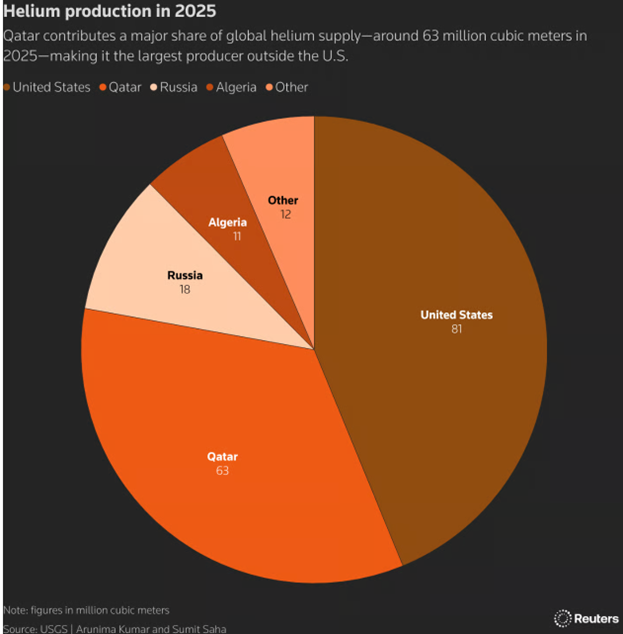
AI’s Achilles Heel in this battle: Helium provides a major cooling factor in chip manufacture and function. (Source: Reuters)
Strikes disrupted Qatar’s Ras Laffan facility, the world’s largest LNG export complex. Helium production fell with it. The market lost about 5.2 million cubic meters per month, roughly a third of global supply.
Prices for helium rose by more than 100%. AKAP Energy projected levels above $2,000 per thousand cubic feet if disruptions persist. Helium has no substitute in semiconductor manufacturing, MRI systems, fiber optics, or space systems.
South Korea sourced about 64% of its helium from Qatar.
Buyers began calling alternative suppliers. Samsung and SK Hynix hold about six months of inventory.
The result of Epic Fury is a two-tier market: Western-aligned shipping largely frozen out, while politically aligned or opportunistic buyers continue to move barrels.
Brent Crude – the price Europeans are left to pay – traded above $110 overnight. West Texas Intermediate (WTI) – what the U.S. pays – stayed below $100. The difference reflects U.S. energy independence and domestic oil supply.
Moody’s chief economist Mark Zandi wrote that a recession is “once again a serious threat,” placing the probability near 49% over the next 12 months.
🎭 Policy Signals Enter the Price
The President, angry that no Western militaries have joined Epic Fury posted this morning that the United States could step back from securing the Strait and leave responsibility to countries that depend on it.
Germany, France, Japan, Australia, and India had declined to send ships. Argentina pledged naval units.
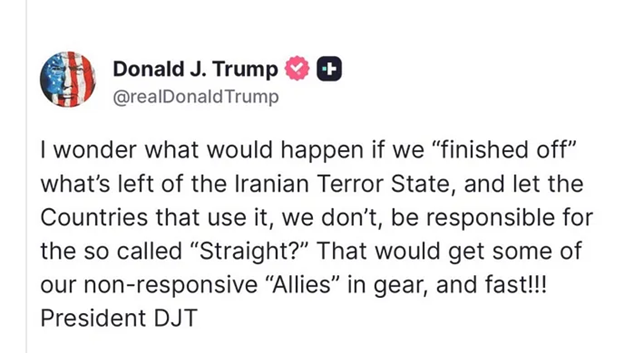
Brent crude rose further after the statement. Insurance terms began to adjust within hours. Then, EU governments reopened discussions on participation in escort operations. It’s a very fluid situation…
🧭 The Trade of the Decade
Early in 2024, in our efforts to build a library of investment ideas for Grey Swan Investment Fraternity members, we published a report called The Big Long.
The idea centered around the “Trade of the Decade” concept, which my writing partner at the time, Bill Bonner, introduced in the first edition of Financial Reckoning Day.
In 2000, with a simple pair: sell dollars, buy gold at roughly $280 an ounce. He drew on Marc Faber’s long-cycle work and Richard Russell’s primary trend.
The method starts with identifying the direction of the primary trend. Then it looks for extremes—assets priced well above or below their historical range. The trade pairs what is crowded with what is neglected. The final step is time. The position sits for years before it resolves.
The position we suggested in the Big Long? “Buy oil, it’s historically cheap.” The report is still a good read and worth a membership to the Grey Swan!
📉 Rates, Debt, and the Setup
Bond traders have all but unwound expectations for rate cuts this year. The Federal Reserve meets today with no change expected. Inflation ran elevated before the conflict. Rising energy prices are adding pressure to an already beleaguered Fed.
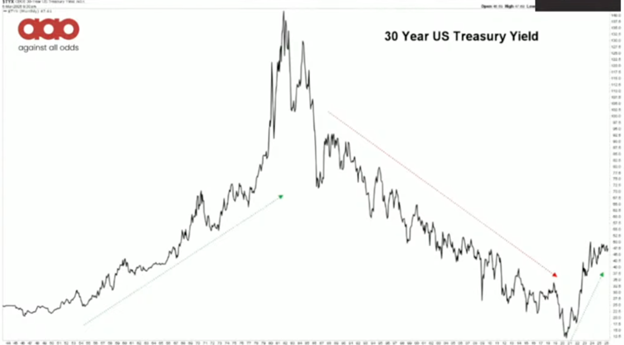
From 1980 through 2021, falling interest rates supported higher valuations, longer duration, and leverage across the system. That environment shaped how capital was allocated.
Fast forward a few years, and the primary has been reversing since the high inflation years during the pandemic and the Biden administration.
Rates are going up, despite the Fed’s overnight rate.
That’s causing a few rashes in Washington, D.C.
The United States now carries more than $36 trillion in public debt, above 120% of GDP. Annual interest expense exceeds $1 trillion. As yields move higher, that cost increases… by the day.
Even without a war in the Middle East.
🌍 The Larger Cycle
Reserve currency status places the United States at the center of Western global finance. Less so than a decade ago, but still, near 60% of global assets are priced in the U.S. dollar.
These historical cycles matter. Especially for the country who prints the world’s reserve currency.
Spain defaulted repeatedly in the late 1500s after military spending exceeded revenue. The Dutch system strained under the burden of war finance. Britain’s debt rose toward 250% of GDP by the end of World War II before leadership shifted.
Ray Dalio posted on LinkedIn yesterday that “it all comes down to who controls the Strait of Hormuz,” referring, of course, to the U.S. status as the purveyor of the modern world’s reserve currency. Control of that critical chokepoint has the ability to undermine confidence in both U.S. debt and its currency.
Dalio:
When the world’s dominant power that has the world’s reserve currency is overextended financially, and it reveals its weakness by losing both military and financial control, watch out for allies and creditors losing confidence, the loss of its reserve currency status, the selling of its debt assets, and the weakening of its currency, especially relative to gold.
🐎 Picks, Shovels, and a Route West
Alas, the U.S. was born and has thrived on the anxiety of booms and busts.
On March 18, 1852, Henry Wells and William G. Fargo formed a company in New York to move value across a continent pulled west by gold.
The miners took the risk. Wells Fargo built the routes.
The company contracted with stagecoach operators to carry gold dust, legal documents, and parcels between the East Coast and California mining camps. It bought gold, issued drafts, and extended credit to merchants supplying tools, food, and equipment. For a premium, riders carried messages across terrain where roads were unreliable and security depended on the man in the saddle.
In 1857, it organized the Overland Mail Company—the Butterfield Line—to run scheduled service. In 1866, it consolidated competing express lines and became the primary carrier across the West. When the transcontinental railroad opened in 1869, it shifted freight to rail and expanded its network.
By 1910, it connected roughly 6,000 locations.
During World War I, the federal government absorbed its shipping routes. The banking operation continued. In 1906, the San Francisco earthquake destroyed the headquarters. The vaults held. Business resumed.
The firm supplied the movement, the credit, and the clearing that allowed the gold boom to function.
~ Addison
P.S. Tomorrow, Thursday, March 18, 2026, Grey Swan Live! returns to its regular slot at 2 p.m. ET / 11 a.m. PST.

This Thursday, we’ll be joined by our natural-resources specialist, Shad Marquitz, for a look at volatility and opportunity across oil, energy, rare earths, and precious metals following the Iran conflict.
We’re in the middle of an active shooting war in the Persian Gulf …Oil has surged … Year to date, gold and silver have each tacked on roughly 20% … Gasoline and diesel prices are spiking…
And yet, the stock market is barely reacting. We’ll unpack what’s going on and the opportunities for investors today.