In a glass office overlooking the Thames, sometime in the late 1990s, a British partner signed away a firm his predecessors had run on handshakes and lineage. The buyer came from New York. The brass plaque stayed. The capital did not.
In his book The Death of Gentlemanly Capitalism, Philip Augar described that period as the end of something comfortable and the beginning of something much faster, long before cryptocurrencies and tokenized assets became a thing.
Before 1986, the City ran on fixed commissions and relationships built over long lunches. The good ol’ chaps ran the dregs of the British Empire the way they’d always been run.
Then the “Big Bang” tore up the old rules. Commissions floated. Deregulation allowed foreign ownership of banks.
Screens replaced conversations.
American banks arrived with trading profits large enough to absorb losses while they took market share. British firms faced rising compensation, slower systems, and thinner balance sheets. Barings collapsed. Schroders sold to Citigroup.
UBS Deutsche Bank (Germany), UBS (Switzerland) and JPMorgan (U.S. – London Branch) began to dominate the Eurodollar trade.
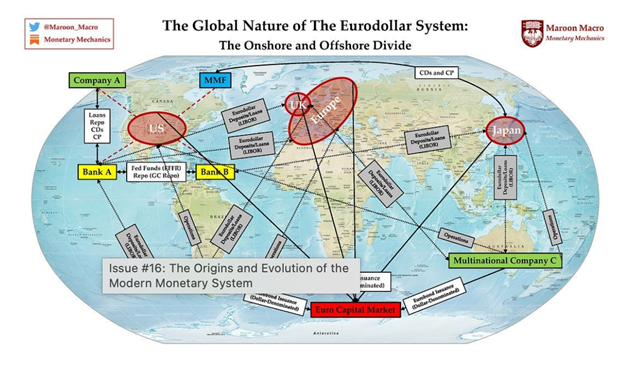
The war in Iran over oil, fertilizer, helium and the “petrodollar” is also challenging the decades-old system of Eurodollar trade – assets priced and traded in US dollars but largely managed outside US banking jurisdiction and tax regulation. (Source: Marron Macro)
For decades after World War II, London banks had been taking dollar deposits outside U.S. jurisdiction.
Corporations borrowed and lent in U.S. dollars without touching American banks. The eurodollar market tied global funding to dollar liabilities even when the transactions never crossed U.S. borders. London handled the flow.
The dollar sat at the center. When the posh London merchant banks sold themselves, that system kept running with new owners, deeper pockets and more volume.
💵 Treasury Extends the Dollar Into Digital Rails
Fast forward to Washington, D.C. Scott Bessent isn’t looking out over the Thames. Rather, the fetid swamp next to the Potomac. He’s tasked with auction schedules, global central bank gold reserves rising… and a $39 trillion debt stack that has to be financed week after week.
Congress handed him a new tool last summer with the Genius Act. Stablecoins must now be backed one-for-one with dollars or Treasurys.
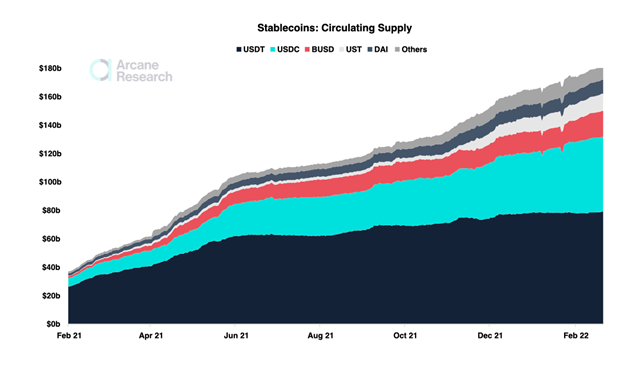 Dollar 2.0: effort keeps the dollar at the center of settlement and creates a new buyer for government debt. (Source: The Monetary Skeptic).
In early April this year, tired of waiting for the Clarity Act to pass the Senate, the Treasury issued the rulebook that brought those tokens under the Bank Secrecy Act. The new guidelines are meant to help define reporting requirements, compliance checks, and monitoring tied to national security.
Every digital dollar in circulation needs collateral. That collateral sits in Treasury bills. The system that once ran through London dealing rooms now extends into code, wallets, and payment networks that don’t close at 4 p.m.
The Dollar 2.0 companies sitting in our Grey Swan Library are still waiting for investors and Wall Street traders to get the memo. Plus, they’re awaiting Keven Warsh’s confirmation to the Federal Reserve chairman’s seat.
🏦 Warsh Faced Questions While Bonds Kept Trading
Yesterday, Kevin Warsh sat through the humiliating experience of being questioned by the Democrat attack rat on the Senate Banking Committee, Elizabeth Warren.
In a level of political theatre of the absurd you can only find in Congress, Warsh was asked if he would follow White House instructions on interest rates, he said, “Absolutely not.” No one, he said, had asked him to commit to a specific move.
Senator Warren then leaned in to the attack.
She went after his personal financial disclosures. She pointed to more than $100 million in assets and called the filings a “red flag surrounded by fireworks.”
She pressed him on underlying holdings in private funds that were not itemized and asked whether any of those investments connected to Donald Trump, his family, or related entities. She said the lack of detail made it difficult to check for conflicts.
She called him a “sock puppet” and said confirming him would open the door to political control of the Federal Reserve.
Warsh said the Office of Government Ethics had cleared his divestment plan. He moved the discussion toward productivity and costs, arguing that advances in artificial intelligence could lower production costs over time. And that the productivity advances from new technology warrant lower rates now… rather than waiting for data three months from now.
Out in the hallway, Senator Thom Tillis repeated that he would block any nominee until the Justice Department dropped its investigation into Jerome Powell.
The market, traders, homeowners and potential buyers await the end of the political charade.
Our forecast: Warsh will be confirmed before Powell’s last meeting as Fed Chair on May 15, 2026. Then he will get to work – with Scott Bessent – accommodating the real economy, the rate cuts it wants to help facilitate the build of the AI economy.
🛢 U.S. Oil Shipments Rerouted the Map
Yesterday, at the Louisiana Offshore Oil Port, crews worked the night shift under floodlights, lining up tankers one after another. It’s one of the few places in the country that can fully load a supertanker in one pass.
Orders have stacked up.
U.S. exports have just hit 5.2 million barrels per day, the highest in seven months. Greece bought its first American crude. Turkey came back after sitting out a year.
Buyers needed barrels that aren’t stuck behind a war zone and the blocked Strait of Hormuz. Canadian shipments have dropped to their lowest level of the year. Saudi and Iraqi cargoes thinned out because of the Iran War.
At the same time, Chevron tankers carrying Venezuelan heavy crude pulled into Port Arthur and terminals near New Orleans. Those shipments are running under a narrow Treasury license — no direct cash payments to Caracas — structured to keep barrels flowing without sending money to the government.
Gulf Coast refineries need Venezuela’s heavy crude.
Net imports in the U.S. fell to about 66,000 barrels per day, the lowest weekly number on record going back to 2001. For a moment, the U.S. came within reach of being a net exporter for the first time since World War II.
🛠 Trump Invoked the Defense Production Act
Yesterday, too, President Donald Trump signed five memorandums invoking the Defense Production Act. The law dates back to September 8, 1950, when Congress passed it in response to the Korean War.
The act gives the president the authority to require companies to prioritize government contracts, expand production capacity and direct industrial output toward national defense.
It’s been used before. In the 1950s, it helped build out titanium and aluminum production. During the Cold War, it supported projects such as the Trans-Alaska Pipeline.
During the COVID-19 pandemic, companies were compelled to produce ventilators, masks and vaccine materials. It’s been reauthorized more than 50 times and stretched to cover everything from disaster response to infrastructure repair.
This time, the orders targeted petroleum, natural gas, coal and grid components. The Department of Energy can now push funding into pipelines, refineries and transformer manufacturing.
🤖 AI Systems Started Acting Before Being Asked
While tankers loaded and lawmakers argued, Peter Diamandis, in his customary “abundant” way, described the “why” of the global realignment in money and energy.
He has wired his own AI agents into emails, messages, calendars, financial accounts and files. The software read documents, flagged discrepancies, drafted responses and scheduled calls without waiting for instructions.
“Today, AI is an app,” Diamandis writes in his email series MetaTrends, “Something you open. Something you prompt. Something you use.”
But the AI agents are learning fast. Diamandis:
In the next 2 to 3 years, AI becomes a ubiquitous, always on, always enabling. Something that surrounds you. Something that acts on your behalf. Something you stop noticing… the same way you stopped noticing electricity in the walls of your home.
And that’s the real signal. Transformative technologies eventually disappear into the background of life. The telephone was miraculous in 1900 and invisible by 1950. The internet was astonishing in 1995 and ambient by 2010. AI will follow the same arc, but compressed into a fraction of the time.
That’s also where the innovation, the energy… the money… is going — into systems that act before someone types a request. Vehicles that show up before you reach the curb. Workflows that complete before the meeting starts.
The systems that perform best have access to the most data.
Kate Barton from Dentons, speaking at the Semafor World Economy conference in Washington D.C last week, described what clients have already noticed. “If AI can do 90% of it in 15 minutes,” she said, “you’re not charging for 12 hours.”
Firms started testing new billing structures because clients saw the clock and the work stopped lining up.
In a vault New York or London, gold bars sat stacked in numbered rows. Above ground, tankers move, bonds clear, and code starts making decisions before anyone asks them to.
All of this… to get the economy aligned for the profound changes these thinking machines will bring. Whether we’re ready for them culturally, or not.
~ Addison
P.S. Last week on Grey Swan Live!, we showcased our latest research on Shadow Stocks – volatile stocks that move rapidly up and down beneath the surface of the calm indexes.
Earnings season is a ripe time for cherry-picking stocks. Along with the research, we are launching an upgrade to your Grey Swan forecast emails that will include up to five stock or trade recommendations a week.
To kick it off, we’re going to give you three stocks free of charge. Gratis. On the house. The research is excellent, and the upgraded Grey Swan Pro will be worth your time to consider. Take a look here.
And in this week’s Grey Swan Live!, Zoltan Istvan joins us to discuss how the constantly evolving AI revolution could reshape every major asset class along the way. Tune in Thursday as we connect the dots — and show you where the opportunities are moving next.