Beneath the Surface
James Hickman: “Zeus” Just Made the Most Predictable Crisis in History Even Worse

July 1, 2025 • 6 minute, 23 second read

“We must keep our budget balanced for each year. That is the cornerstone of our national credit, the trifling price we pay to command the lowest rate of interest of any great power in the world.”
– Calvin Coolidge
July 1, 2025 — It was September 29, 2021— nearly four years ago— that then House Speaker Nancy Pelosi held a press conference about their $3.5 trillion “Build Back Better” spending bonanza.
Despite the outrageously high price tag, Pelosi told reporters at the presser, “the dollar amount [of the Build Back Better bill], as the President said, is zero.”
She then made a little circle with her right thumb and index finger to emphasize her point, pivoting to all the cameras from left to right as if to insist that there was no cost to her $3.5 trillion legislation.
Yet despite defying every arithmetical and logical postulate known to man, the Left went on to repeat this idiotic lie.
“My Build Back Better Agenda costs zero dollars,” tweeted Joe Biden. The bill “will cost zero dollars” said Press Secretary (now MSNBC host) Jen Psaki.
Those on the political Right justifiably lost their minds over such intellectual dishonesty. So it’s ironic that they’re now doing the same thing with their own multi-trillion dollar “One Big Beautiful Bill”.
The Congressional Budget Office’s analysis shows that the One Big Beautiful Bill will add $3 trillion to the national debt over the next decade—on top of the other ~ $22 trillion that they already expect to be added to the national debt between now and 2034.
Well, the Senate’s current rules state that any legislation which adds $3 trillion to the national debt must automatically be subject to more onerous voting requirements.
And these stricter voting requirement will make it almost impossible to advance the legislation through the Senate.
As a result, the Right has decided to do what the Left did in 2021—make up a new form of mathematics to pretend that the bill costs nothing.
Senate Budget Committee chairman Lindsey Graham is in charge of the faux-math: “I’m the king of the numbers,” he declared to reporters. “I’m Zeus, the budget king.”
Something tells me that ‘Zeus’ won’t be awarded the Fields Medal anytime soon for his mythological mathematics.
Now, don’t get me wrong— I like tax cuts. They’re almost always great for growth, which the US economy desperately needs.
But tax cuts alone don’t get the job done unless there are commensurate spending cuts too. Otherwise the deficits will continue to grow, and America’s fiscal crisis will become ever closer.
We’re written about this a LOT: the United States is headed for a serious crisis— which we project will take place in 2033 at the latest.
Irresponsible, reckless spending is the primary reason why. The US already has a $36 trillion national debt (that is set to explode higher this summer). Even today, the interest bill on the US national debt costs $1+ trillion per year, more than 20% of tax revenue.
Continued Below…
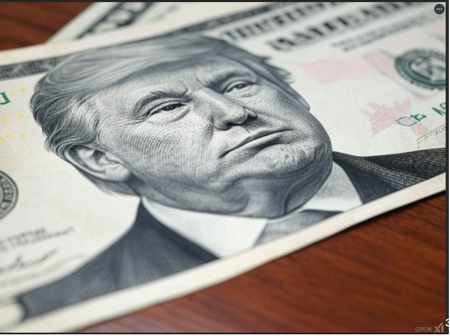
Congress to feature Trump on $100 Bill?
A shocking new plan was just introduced in Washington. The idea is to celebrate Trump’s new “golden age” by placing him on the $100 bill. As you’ll see, it has little to do with the new Crypto Reserve… Or Trump’s ambitious plan for Artificial Intelligence… Former Presidential Advisor, Jim Rickards says, “Trump’s crowning achievement will be much, much bigger.” In the months ahead, he predicts, the government will release a massive multi-trillion-dollar asset which it has held back for more than a century. And this will give ordinary investors a chance to strike it rich. |
By 2033, the government itself projects that the national debt will be at least $55 trillion. At that point, based on their own forecasts, the Treasury Department could spend >40% of tax revenue just to pay interest on the debt.
Oh, and that same year— 2033— Social Security’s biggest trust fund will run out of money, causing an immediate and permanent cut to benefits.
The government will have one way out at that point: pressure the Federal Reserve to expand the monetary base, i.e. to “print” tens of trillions of dollars in order to fund government and prop up Social Security… resulting in a crippling level of inflation.
This is one of the most predictable yet preventable crises in human history. But Congress is not only doing nothing about it, they’re making it worse.
There is another way— one that is conceptually simple.
For starters, Congress could actually do its job and spend responsibly. It’s not like there isn’t a mountain of waste to cut.
They also need to pass much-needed reforms to both Social Security and immigration; the country would be better off if there were an efficient way for smart, talented, law-abiding, hard-working people to become legal residents.
The executive branch, meanwhile, would need to undo mountains of red tape and regulatory sludge that it dumped onto the economy over the past few decades.
I’ve written about this before— “Liberation Day” should have been the day that countless pages of useless, job-killing, productivity-killing regulations were eliminated. This can still happen.
Most importantly, the entire federal government needs to stop its make-believe accounting and show the world (plus American voters) that they are trusted, serious professionals.
It’s bad enough that the US has to sell $2 trillion worth of additional debt each year to fund its annual deficits.
But that’s not even close to the real requirement.
Over the next twelve months, roughly $9 trillion worth of existing US debt securities will mature; this was money that the government borrowed years ago… and will soon come due.
In theory the government has to pay that money back. Naturally they don’t have the funds to do so… so instead they’ll borrow new money to pay back the old loans… essentially refinancing $9 trillion worth of the national debt over the next twelve months.
So realistically they must sell ~$11 trillion in debt over the next twelve months: $9 trillion to refinance existing debt, plus another $2 trillion to cover this year’s budget deficit.
$11 trillion is an enormous amount of money… which means they’ll need every investor possible ready and willing to buy US government bonds.
And that’s a problem. Because right now, foreigners (which own a HUGE chunk of the debt) are aggressively backing away from US government bonds.
That’s a big part of why gold keeps going up—foreign governments and central banks are dumping their US government bonds and buying gold instead.
And who can blame them? It’s hard to take a guy seriously who refers to himself as Zeus and makes up his own arithmetic.
Would you lend money to someone who doesn’t know the difference between ‘free’ and a $2 trillion deficit?
If Washington wants to attract capital and stabilize the economy, they have to start acting like grown-ups. Demonstrate to the world that they can tackle hard problems, cut spending, and govern responsibly.
And right now, they aren’t doing any of that.
James Hickman
Schiff Sovereign & Grey Swan
P.S. from Addison: This week, Andrew and I will take stock of the first half of the year this Thursday, July 3rd at 11 AM on Grey Swan Live!. If you’re serious about joining live, please set a placeholder in your calendar.
During this week’s Live! we’ll review the model portfolio comprehensively and the big trends that have impacted stock prices and the economy during the dizzying first months of the second Trump administration. Stay tuned…
Your thoughts? Please send them here: addison@greyswanfraternity.com