Beneath the Surface
It Turns Out Our Gold Analysis Is Conservative…

March 21, 2025 • 6 minute, 27 second read
“Money is by nature gold and silver.”
– Karl Marx
March 21, 2025 — As we look through the winners and losers of the MAGA economy this week, gold has been re-asserting its role as the antidote to uncertainty and volatility.
The metal has hit a few new historic highs, and — as is its wont when that happens — it has goosed the mainstream news cycle in a few unique ways.
Since the start of the year, President Trump and the new media darling, first buddy Elon Musk, have openly fantasized about taking a trip to Fort Knox to see America’s gold stockpile.
Scott Bessent, Secretary of the Treasury, has suggested that revaluing the gold in Fort Knox would help him in an effort to balance the nation’s books. Or some such creative financing at the federal level…
Even in the Grey Swan community, there are whispers of specific hard asset financiers whom we know who would be tasked with helping the Treasury with the revaluation effort.
“The News” also reports that vast amounts of physical gold have been transported from vaults in London to vaults in New York so that big Wall Street banks can hedge their bets on the SPDR Gold Shares ETF GLD.
In fact, according to the reports, so much gold has moved stateside in recent months that it’s showing up in America’s import/export numbers, causing algorithms to sell off stocks for fear of a shifting economy.
Last year, well before the idea of auditing Fort Knox was ever floated, we followed some macroeconomic trends and released research suggesting that gold prices could be in for a massive move higher, potentially over $20,000 per ounce.
The number seemed ridiculous at first glance. We had to do the calculations and recheck our premises several times.
Consider this.
Gold went from $42 per ounce set by the U.S. government in 1971 to over $800 by the end of that tumultuous decade, by market forces alone.
That’s what investors call a 20-bagger.
Today, a 20-bagger would put gold closer to $60,000, triple our conservative estimates from October.
With that in mind, if you’ll allow us to continue to entertain ourselves with speculation, we turn today to Grey Swan contributor Lau Vegas. Enjoy. ~~Addison
The Great Revaluation: Why the U.S. Could Be Quietly Returning to Gold
Lau Vegys, Doug Casey’s Crisis Investing and Grey Swan
Earlier this week, I wrote about gold breaking past $3,000 per ounce — a new all-time high.
But what if I told you the U.S. government still values its gold at just $42.22 per ounce?
That’s not a typo. The official book value of America’s gold reserves hasn’t changed since 1973.
That price was set under the Par Value Modification Act, a relic of the Bretton Woods system, and has remained frozen for accounting purposes—even as gold’s market price has skyrocketed.
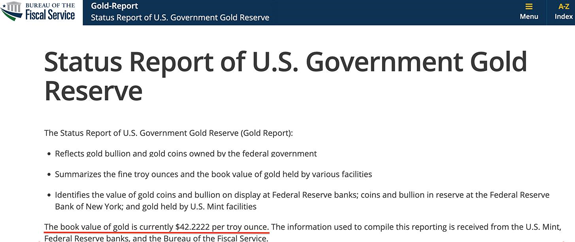
The result? The 261.5 million ounces of gold the U.S. (supposedly) holds are officially valued at just $11 billion. At market prices, they’d be worth nearly $785 billion.
That’s a textbook example of America undervaluing its assets if I ever saw one. Not a problem in regular times, but a serious oversight in an era of nearly $37 trillion in debt, out-of-control deficits, and accelerating de-dollarization.
We believe revaluing U.S. gold holdings could be the first major move in Team Trump’s grand strategy.
Simply marking these reserves to market prices would strengthen the nation’s balance sheet and give the government more leverage in devaluing the dollar—a key piece in Trump’s broader economic reset.
Pegging the dollar to gold at a much higher price post-devaluation would also drastically reduce the real burden of U.S. debt.
Doug Casey: The dollar started out as a receipt for a specific amount of physical gold, 1/20th of an ounce. Is it possible Trump will raise the price of gold to a level where the dollar is again redeemable? I’d say yes. It would be part of the solution to the $37 trillion national debt.
Why?
Think about it—if gold were revalued from $3,000 to $10,000 per ounce, the U.S. government’s gold reserves would suddenly be worth more than three times their current value. That increase in balance sheet value could be leveraged to retire debt—yes, either directly or through gold-backed bonds—but also to stabilize the dollar post-devaluation (or help fund Trump’s broader re-industrialization agenda).
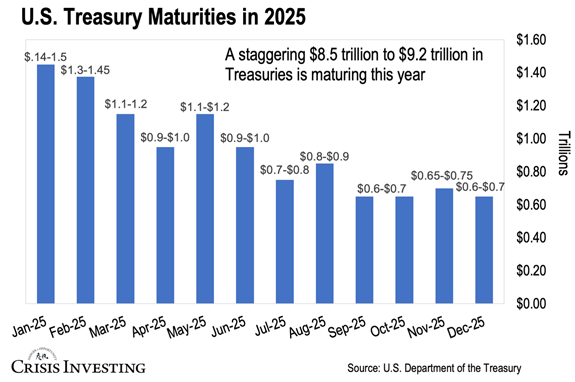
And keep in mind—the U.S. faces $8.5–9.2 trillion in maturing debt in 2025 alone. Under current conditions, that’s not going to be easy to refinance without spiking interest rates or shaking confidence in Treasuries.
The bottom line is that Trump’s Reset could be the most significant shift in the monetary system since August 15, 1971—the day Nixon cut the dollar’s last tie to gold.
And if you look at what’s happening in the markets right now, the signs suggest the U.S. is already laying the groundwork.
For example, since December 2024, COMEX has imported around 674 metric tons of physical gold—a hefty amount on its own. But when you factor in non-COMEX imports, the total goes up to 2,000 tons—64 million ounces—brought into the U.S. between December and February. That’s nearly a quarter of all the gold the U.S. government officially claims in its reserves.
That’s not normal market behavior. Someone with deep pockets—likely the Treasury or the Fed—is aggressively stockpiling physical gold with no concern for price.
Gold at $22,000?
Now, in case you missed it, Doug’s quote above contains a key word: redeemable.
That doesn’t mean we’re banking on a full return to the gold standard right away, but I can easily see the U.S. taking incremental steps to stabilize the system and rebuild confidence in a devalued dollar by gradually moving back toward gold.
And guess what? Even partial backing would send gold soaring. Take a look at the chart below—it shows the gold price needed to back different U.S. money supplies, from M0 (physical cash) to M1 and M2, which also include savings accounts and time deposits.
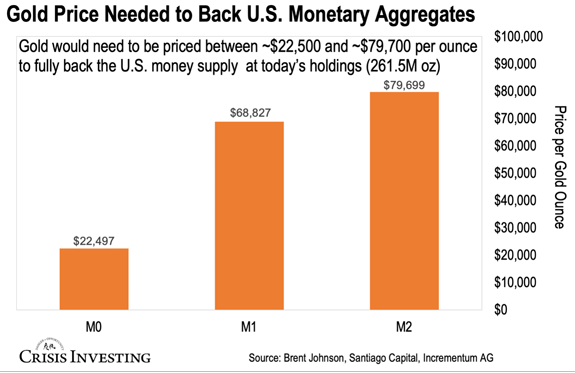
As you can see, backing just M0—the narrowest measure of money, which includes physical cash in circulation and reserves held by banks at the Fed—could push gold past $22,000 per ounce. M1 would require $68,827, and M2 a staggering $79,699.
This just goes to show that while the final long-term price would depend on the level of backing (e.g., 20% vs. 100%), even if the U.S. government chooses to only partially restore monetary credibility, gold prices will skyrocket.
Sounds great, right? Well, sure—if you already own gold. But it comes with a massive dollar devaluation.
And, yes, this also means that anyone not holding gold and other “real stuff”—like silver, natural resources, and commodities—is going to see a dramatic drop in their standard of living.
Regards,
Lau Vegys, Doug Casey’s Crisis Investing and Grey Swan
P.S. from Addison: Meanwhile, our latest research on the real, unique, story behind the border crisis with Mexico is available to view here. Paid-up Fraternity members can immediately access our Library of Special Reports.
And it’s not too late to review our research from last year on the best places to benefit from today’s rising gold prices. After all, there’s now a strong chance that our prediction is wrong… at least in the sense that it is far too conservative given events unfolding in the gold market.
If you like to speculate a little yourself, please send your thoughts on what a gold revaluation would look like and what it would do to your long-term gold investing plans to addison@greyswanfraternity.com