

The problems in private credit aren’t going away – they’re compounding. According to a Fitch report released this morning, defaults hit 9.2% in 2025.
And yet, the market shrugs. Why? Because there are plenty of ways to default on a loan without appearing to default.
The number of private credit deals where income has been earned, but not collected, is rising:
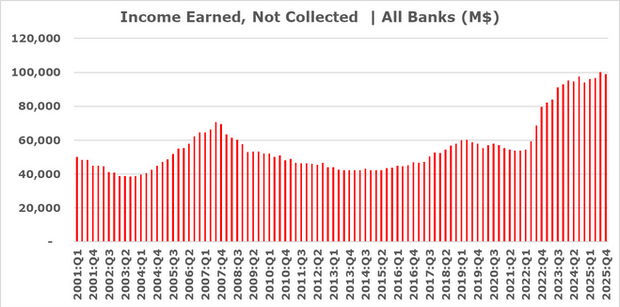 Banks are owed income on loans, but are not collecting it. (Source: R.C. Whalen)
One of the most insidious ways to “stealth default” is to replace a cash payment with a payment in kind (PIK).
Nutshell: Alternative payments in the credit space often include another loan, which, in turn, extends and deepens the debt. The practice is the opposite of being risk-averse.
In effect, the bank is assuming the capital risks of a failing business. And not collecting revenue for its own balance sheet.
“One of the most insidious loans during the housing boom was the negative-amortization mortgage,” notes our Portfolio Director and private credit skeptic Andrew Packer. “Each month, borrowers would make a payment, but would end up owing more on their loan, in the expectation that housing prices would rise faster.”
The parallels in private credit today are a huge warning flag for any sensible person who lived through the 2008 financial crisis.
The market’s distraction du jour is oil, fertilizer and the Strait of Hormuz. In private credit, the cockroaches multiply.
Beware: What happens in credit markets… rarely stays in credit markets.
~ Addison
P.S. This week in Grey Swan Live!, we have another two-fer. The recording from Panama City during The Gathering with Ronan McMahon will be posted soon.
In the interview, Ronan and I explore the Ipanema and Caracol briefings in the context of infrastructure, canal exposure, jurisdiction and long-term capital allocation.
You’ll also get a great overview of why we include the deals from Real Estate Trend Alert (RETA) in our resources available to Grey Swan Investment Fraternity.
Not only do they offer international diversification for your portfolio, but Ronan also insists that most RETA members are even more enthusiastic about the lifestyle choices they offer.
Then, Thursday, March 16, 2026, Grey Swan Live! will return to its regular time slot at 2 p.m. ET/11 a.m. PST.
This Thursday, we’ll be joined by our natural-resources specialist, Shad Marquitz, for a prescient look at volatility and opportunity in oil, energy, rare earths and precious metals following the Iran bombing excursion.