Beneath the Surface
How Bitcoin is Becoming a Cornerstone of American Economic Policy

June 4, 2025 • 5 minute, 29 second read
“Bitcoin is a hedge against the traditional financial system and a beacon of hope for economic empowerment.”
–Tyler Winklevoss
June 4, 2025 — “We want our fellow Americans to know that crypto and digital assets, particularly Bitcoin, are part of the mainstream economy and are here to stay.”
That was the message Vice President JD Vance delivered to a packed audience at last week’s Bitcoin Conference 2025 in Las Vegas. It’s a message that has clearly taken root. What began as a movement of early adopters—many of them twentysomethings dressed in hoodies—has matured into a full-blown national economic priority, embraced by leaders at the highest levels of government and finance.
Last summer, if you recall, then-candidate Donald Trump made headlines as the first former U.S. president to speak at a Bitcoin conference. He pledged to lower the regulatory hurdles of the Biden administration, to kill Operation Choke Point 2.0, and to position the U.S. as the global leader in Bitcoin.
Less than a year later, and a little over 100 days into Trump’s second administration, that vision is rapidly becoming reality.
The Las Vegas conference was the largest in Bitcoin’s history, with over 35,000 attendees. The speaker list read like a who’s who of power players: sitting senators and representatives, big-name executives and the president’s own sons. It was more than a convention for crypto enthusiasts. It was a policy summit.
Continued Below…
Nvidia, Amazon and Apple Doomed? Trump’s MAGA policies have put 50 “Safe” stocks at high-risk. Click here to learn how to see the full list. |
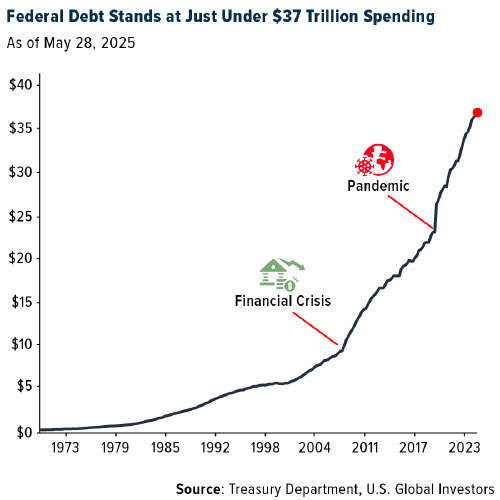
One of the most salient points of discussion was the BITCOIN Act of 2025. The proposed legislation calls for the U.S. government to acquire 1 million bitcoins over a five-year period and hold them in custody. The goal is to create a Strategic Bitcoin Reserve, modeled after the existing reserves for petroleum and gold. Wyoming Senator Cynthia Lummis pointed out that holding even 4 million Bitcoins over a 20-year period could theoretically draw down the national debt, which currently stands at just under $37 trillion.
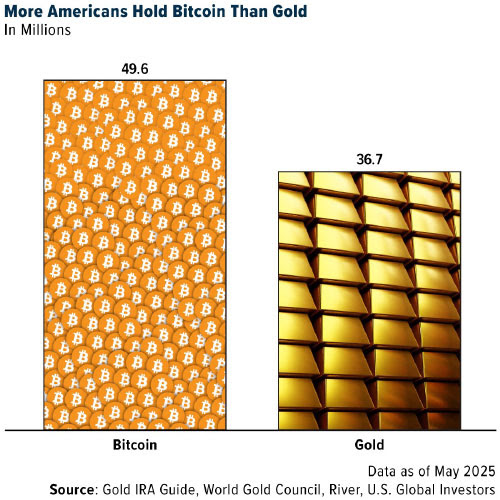
This isn’t the sort of talk you’d expect to hear about an asset that, just a few years ago, was derided by many as a vehicle for crime and terrorism. How times have changed! Today, some 50 million Americans own Bitcoin, compared with just under 37 million who own gold, according to new research by Bitcoin financial firm River. For the first time in history, Bitcoin has overtaken its analog cousin in retail ownership in the U.S.
The U.S. Leads the World in Every Bitcoin Metric That Matters
Indeed, the U.S. dominates in every measurable category of Bitcoin leadership, according to River’s research. Approximately 40% of the world’s mined Bitcoin is held by Americans. Publicly traded U.S. companies account for almost 95% of global corporate Bitcoin holdings. America also holds the majority of Bitcoin in ETFs, venture funding and national stockpiles. As of today, the U.S. government owns more than twice the global market share of Bitcoin as it does of gold.
I don’t believe any of this happened by accident. It happened because our country’s entrepreneurs, technology experts, futurists and policymakers saw an opportunity and ran with it.

Gold Preserves Wealth, Bitcoin Builds It
None of this is to say that gold is going away anytime soon. As I told a roomful of YPO attendees last week, I still believe deeply in gold as a store of value. Unlike Bitcoin, the yellow metal is a tangible asset, used in jewelry, electronics and much more.
Countless households have relied upon gold for centuries.
When families fled Vietnam and, more recently, Syria, many did so thanks to the universal acceptance of precious metal, which also later helped them rebuild their lives. Gold preserves wealth in times of fear.
Bitcoin, on the other hand, is about growth. It’s about creating wealth, not just preserving it. Bitcoin is programmable. It operates 24 hours a day, seven days a week, and it doesn’t recognize borders or gatekeepers. It’s scarce in a way that few assets are.
This is why companies, ETFs and whole governments are looking to add Bitcoin to their balance sheets. As Eric Trump told the audience, everyone wants to add Bitcoin right now; no one wants to sell. That’s true in every corner of the earth, from the Americas to Africa, from the Middle East to Asia.
I believe the logic is simple. As the world goes digital and decentralizes, Bitcoin offers a new form of reserve asset that combines scarcity with transparency and portability. It’s a hedge against economic uncertainty and bad policymaking.
Next year is the United States’ 250th anniversary, and I can think of no better symbol of economic independence than Bitcoin. It represents the very values Americans hold dear: individual responsibility, innovation and freedom from centralized control. Fiat currencies can be printed without limit, but Bitcoin is capped at 21 million. It requires work and energy to produce.
Several speakers at the Vegas conference likened Bitcoin to the early days of the internet. You probably remember the dial-up modems and clunky browsers. A lot of people back then dismissed the internet as a novelty. In 1998, Nobel Prize-winning economist Paul Krugman famously (and hilariously) wrote that the internet was a disappointment and would eventually prove itself to be as economically impactful as the fax machine.
As we all know, the internet is the backbone of today’s global economy. The same arc of adoption is playing out in real-time with Bitcoin.
I agree wholeheartedly with VP Vance: Bitcoin isn’t going away, and it’s only going to grow stronger with America leading the charge.
Frank Holmes
U.S. Global Investors & Grey Swan
P.S. from Addison: Frank will share deeper insights into bitcoin and the rise of digital assets on tomorrow’s Grey Swan Live! and bring us up to speed on his HIVE data center project.
Frank is a longtime associate of mine. He’s the CEO of U.S. Global Investors, and his background stretches back decades in the hard asset space, from gold to the digital realm with bitcoin mining.
In addition to Frank’s views on bitcoin and digital assets, we’ll also be looking under the hood of two intriguing ETFs he launched – JETS and WAR. It’ll be worth your time to tune in and hear Frank’s perspective.
If you’re a paid member, please join us at Grey Swan Live! tomorrow, June 5, at 11am Eastern.
Your thoughts? Please send them here: addison@greyswanfraternity.com