Beneath the Surface
Election Update: The Vibe Meets the Tribe

October 16, 2024 • 7 minute, 54 second read
“The individual has always had to struggle to keep from being overwhelmed by the tribe. If you try it, you will be lonely often, and sometimes frightened. But no price is too high to pay for the privilege of owning yourself.”
– Rudyard Kipling
Election Update: The Vibe Meets the Tribe
October 16, 2024 – On Monday, we released our latest analysis on what we expect will be an unsettling time for AI stocks on the broader indexes.
Right on cue, markets saw their first big stumble in over a week yesterday. The reason? A “glitch” that caused Dutch equipment manufacturer ASML to post its earnings on its website early.
That report also provided tepid forward guidance, reflecting the ultimate reality that demand for AI isn’t infinite.
We recall a similar earnings release “glitch” involving Google over a decade ago. The result was the same: a big drop in the share price.
Unlike Google, however, when one chipmaker falls, the entire sector stumbles. Across the board, this little “glitch” cost investors about $420 billion.
Oops!
On the plus side, the glitch “only” set back markets by about a day, thanks to Monday’s sharp rally.
This is but a bitter foretaste of what will happen when the AI growth trend is no longer “to the moon.”
At some point, the AI trend will slow, just as the internet trend slowed in the 1990s, hitting the “Cisco moment” where everyone who needed a modem already had one.
Meanwhile, in another market, the political betting one, Donald Trump is gaining momentum. Here’s the latest data from Polymarket, which looks at several betting sites, polling data, and other factors to determine the odds:
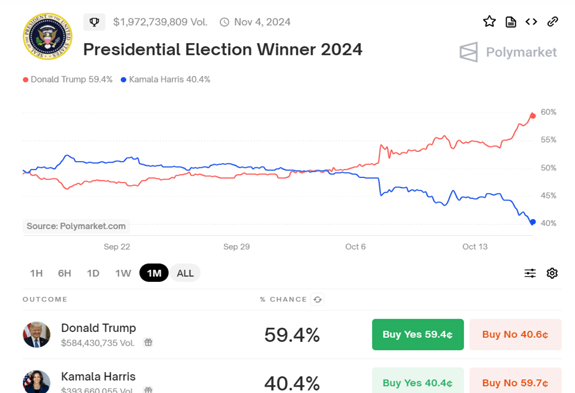
Trump has led since the start of October, and appears to be taking off. We’ll see if this trend holds true to election day (or however many days later it takes to count all the votes).
We note that both Trump and Harris will pursue easy-money policies, which should help juice financial markets and help weaken the dollar. Harris would likely let the existing tax cuts, passed by Trump during his (first?) term, expire at the end of 2025. Trump would likely keep the tax cuts.
Meanwhile, the latest polling data indicates that the GOP may flip control of the Senate, although Senator Ted Cruz of Texas appears to be in a considerably tight re-election campaign.
If the House stays in narrow GOP control, which the polling data also suggests, we won’t see any big legislation — essentially keeping the “rules of the game” the same. Financial markets love that outcome. You may have your political tribe, but gridlock means Wall Street gets to call the shots.
The shifting polling data indicates that the shine on Harris may have worn off, following her awkward performance on 60 Minutes. But while the media’s attempt to create a “vibe” around her has faded, she remains the party standard-bearer and is the de-facto leader of one of America’s two major tribes.
Below, Grey Swan contributing member John Robb weighs in on how this is shaping up to be a tribal election, and what it means for America’s future. Enjoy. ~~ Addison
The Tribal Election
John Robb, Global Guerrillas
“Political tribalism really does break people’s brains” – Elon Musk
“A feeling I’ve been keeping mostly to myself: this doesn’t seem like an election year to me. I just don’t see 2024 as a presidential election. I really don’t know what this is, and lack the language to describe it. Anyone else feeling like you don’t know what we’re watching?” – Eric Weinstein
America’s 2024 election is the first presidential election dominated by networked tribes.
- People aren’t choosing candidates; they’re selecting a tribe.
- People aren’t voting for their tribe; they are voting against the other tribe (both candidates/parties/tribes have higher negatives than positives).
- People aren’t debating competing policies and programs; they’re talking past each other about the threat posed by the opposing tribe.
There’s a lot at work here. Let’s dig into it, one step at a time.
Networked Politics
As a refresher, networks haven’t just changed how we communicate (see the GG Report; Packetized Media for more detail);
- Exposure to networks has rewired our brains. We process information differently now. Specifically, we scan torrential information flows instead of reading or watching long-form books and broadcasts to uncover new, novel, or interesting information.
- We use pattern matching to make sense of the packets of information we find through scanning. We can do this independently (few people) or rely on popular podcasters, X accounts, or YouTube personalities to pattern match for us (many people).
- Overwhelmingly, people have opted to join large (tribal) networks engaged in collaborative pattern matching since it simplifies processing torrents of online information. Due to this adoption, collaborative networks are now in the process of rewiring our politics and our society.
Networked Tribalism
Inevitably, the most successful collaborative pattern-matching networks to emerge over the last eight years (when I started writing about this shift) organize tribally.
- Traditionally, tribal organizations use stories (why we came together, what we have successfully endured, why we are better together) and rituals to create a fictive kinship that can bind people together as if they were blood relations.
- Network tribalism uses the opposite approach. It binds people together in their opposition to a common threat. Tribal networks use collaborative pattern matching to create patterns of behavior that can indicate a person or an organization is a threat.
- Networked tribes go to war by mobilizing their tribe to defeat the threat they manufacture. They win when the enemy is defeated, and the entire network, at both the human and system levels (from algorithms to AIs), is aligned with their pattern to suppress the enemy completely.
Tribal Elections
Open Source Dynamics
Tribal networks don’t have organizational hierarchies. They are open-source networks where anybody can join and contribute. Let’s explore this;
- Leadership is conditional. It’s earned by damaging, defeating, and vanquishing tribal enemies. If a leader begins to delve into the policies, agendas, platforms, and narratives of traditional politics, they will quickly find they are not leaders anymore.
- Open source networks are also multi-cephalic (with many potential heads), meaning that any participating individual, group, or organization can become a leader (head) if they move the tribe forward. As a result, if a currently successful leader is removed (assassinated, banned, or jailed), another person will quickly take their place.
- They are innovative. They are constantly finding new ways to damage the enemy, and network connectivity amplifies and accelerates their ability to share those methods, targets, and support.
Opposing Tribal Orientations
The two great tribal networks at war in the US, the tribes that have completely consumed the US political system, are based on competing national decision-making orientations (see the GG Report; “What went wrong with America?” for more details on these decision-making orientations).
NOTE: Orientation sets the direction for decision-making at the individual and national levels. It sets you on the decision-making path towards the goals you want to achieve. If your orientation is wrong, every decision you make advances you toward disaster, defeat, and crisis.
- Anti-Globalist Tribe: This tribe is at war with the post-Cold War globalist orientation. Since opposition to this ruling orientation was structurally repressed (marginalized by bureaucratic institutions, traditional media, and the dominant political class), the anti-globalist tribe emerged as a network insurgency in 2016 (which explains why the efforts to defeat and oppose it became so frantic).
- Anti-Nationalist Tribe: The dominant orientation within the institutional, media (broadcast), and government establishments. It became aggressively anti-nationalist once it took back power in 2020.
- Anti-orientation. These tribes aren’t proponents of an orientation they support; they are opponents of an orientation they despise. They know what they hate and will see no fault in any policy, program, or leadership that isn’t connected to the enemy tribe’s orientation. This stance makes reform, productive discussion/debate, and holding anyone connected to the tribe in power responsible for failure nearly impossible.
Note the attitudinal shift between this Saturday Night Live skit featuring Trump in November 2015 and the tribal hatred that emerged a year later when it became evident he had adopted a nationalist orientation. ~~ John Robb, Global Guerrillas
So it goes,

Addison Wiggin,
Grey Swan
P.S. Leading up to the election, gold gets more interesting by the day. We anticipate a rally to continue regardless of who wins the White House or what the tech sector does on the indexes.
Leading to next week’s BRICS meeting, Oct. 22nd, central banks have been enjoying the party all year. But, individual investors largely haven’t gotten out of their Ubers to join the party yet.
Meanwhile, on the supply side, there’s been a decline in new, sizeable deposits of the metal. According to data from S&P Global, 2023 marked the first time there were zero such discoveries.
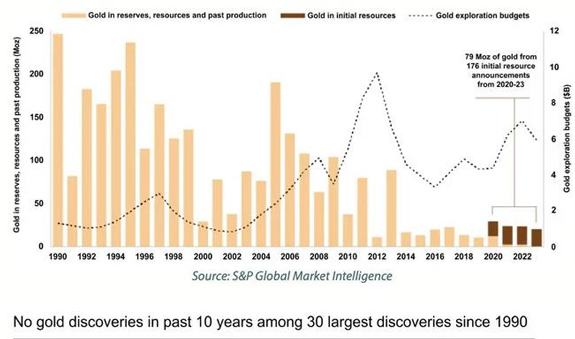
With demand rising, supply tight and new major supplies now non-existent, gold’s rally is likely to continue. But it could also set up for a massive squeeze higher, possibly as soon as 2025.
Will that wake up Washington to its wasteful spending ways? Probably not. But you can, and should, get prepared now. Paid-up Fraternity members already have access to our latest research and reports on gold , including my top play in the gold mining space.
Please send your own comments, reactions, opprobrium, vitriol and praise to: addison@greyswanfraternity.com