GSI Banner
  • Free Access
  • Contributors
  • Membership Levels
  • Video
  • Origins
  • Sponsors
  • My Account
  • Sign In
  • Join Now

  • Free Access
  • Contributors
  • Membership Levels
  • Video
  • Origins
  • Sponsors
  • Contact

© 2025 Grey Swan Investment Fraternity

  • Cookie Policy
  • Privacy Policy
  • Terms & Conditions
  • Do Not Sell or Share My Personal Information
  • Whitelist Us
Ripple Effect

Debt Hangover? Nah…

Loading ...Addison Wiggin

January 5, 2026 • 1 minute, 9 second read


debtGDP

Debt Hangover? Nah…

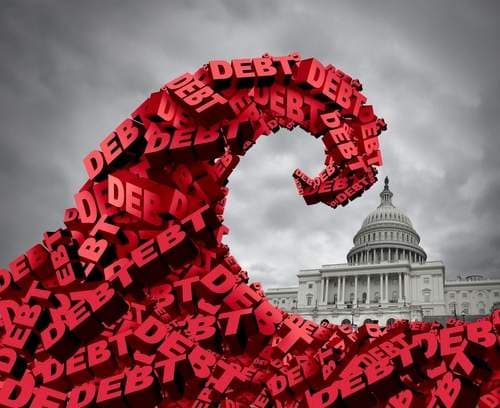
To start the year, the U.S. government didn’t bother with a hangover, rather it continues to spend so profligately that if we compared it to a drunken sailor, we’d have to apologize to the sailor.

Closing out 2025, America managed to rack up over $38 trillion in “official” debt. Looking at debt relative to GDP, it’s back over 121%:

Turn Your Images On

U.S. debt-to-GDP is back above 121% (Source: FRED)

Magically, too, government spending adds to the nation’s GDP rather than “crowding out”  from the private sector.

Our PSA to start the year:  Countries with debt-to-GDP ratios over 120% tend to be susceptible to a crisis that results in austerity measures, capping future GDP growth.

Historically only countries with high personal  savings rates can avoid crises at these levels.

Alas, we can expect even more profligacy in 2026 as President Trump pushes his global realignment agenda and hands out incentives — like tariff rebates — to voters ahead of the midterms.

~ Addison

P.S. Grey Swan Live! returns from its holiday hiatus this week. Our guest this week will be Matt Smith, publisher at Casey Research. Matt and co-author Doug Casey have just released a new book titled “The Preparation.” Stay tuned, details to come…

Members can access the 2026: Something Wicked This Way Comes episode of Grey Swan Live! with Dan Amoss replay in the members-only archive of the Grey Swan Investment Fraternity site here.

The Confidence Paradox

January 6, 2026 • Addison Wiggin

This is the confidence paradox in motion.

The legitimacy of the action remains contested. The legality may be debated for years. Yet capital immediately priced the outcome as useful.

Pundits on Fox Business immediately began explaining the complexities of processing “heavy, sour” crude oil that the refineries in Texas and Louisiana used to be tooled up for, versus the “light, sweet” variety the shale boom gushed forth. 

The Confidence Paradox
A Tale of Two Countries

January 6, 2026 • Addison Wiggin

History is clear. The “warmth of collectivism,” as New York City Mayor Mamdani wants you to believe, doesn’t come from a healthy economy. Maybe from, burning books and buildings… but not from building a prosperous society.

A Tale of Two Countries
Seven Grey Swans, One Investment Strategy

January 5, 2026 • Addison Wiggin

The entire process of reviewing forecasts and then issuing new ones has made us more intensely focused on our purpose. We’re not actually trying to “predict the future” to parody the disdain with which so many lazy media pundits would dismiss our approach.

Rather, we’re examining trends in the news cycle and trying to separate the wheat from the chaff. What signals are coming through stronger than the nauseating cacophony of  Washington and Wall Street, amplified by legacy and social media alike?

There are years when markets feel confusing because they are volatile. And there are years when they feel confused because the old explanations no longer work.

Seven Grey Swans, One Investment Strategy
Grey Swan #1: The Age of Intelligence: Rise of the Network State

January 2, 2026 • Addison Wiggin

The Grey Swan is not the invention of artificial intelligence. It is the moment the public understands that incentives have changed.

Network economics reward different behaviors than factory economics. Platform states operate by different rules than welfare states. Coordination outruns legislation. Culture lags technology. Conflict follows the gap.

In Financial Reckoning Day, we described how systems adapt when fiscal choices narrow. The Age of Intelligence represents that adaptation in software and silicon.

By the end of 2026, most people will recognize that machines now think alongside humans in logistics, finance, and planning. Some jobs disappear. Others appear. Output improves faster than consensus expects. Politics argues. Markets enforce discipline.

Grey Swan #1: The Age of Intelligence: Rise of the Network State