Yesterday, markets opened the day on a sugar high thanks to a “handshake for a framework” deal between the U.S. and China.
President Trump announced a 55% tariff on Chinese goods and a 10% counter from Beijing, in exchange for a loosening of rare earth exports and a return of Chinese exchange students to American universities.
It’s not a treaty. It’s not even a contract. It is a post on Truth Social. But in today’s markets, that’s enough to move trillions.
By midafternoon, traders started asking real questions: How long will this hold? Will the courts overturn the tariffs? Can China be trusted on rare earths? Can the U.S. be trusted on anything?
The rally fizzled as fast as it began.
 Stocks Retreat, Bonds Catch a Bid, Platinum Shines
The 10-year Treasury yield dropped after CPI came in softer than expected. The Treasury’s auction of new bonds was met with robust demand — the kind that says: “We don’t trust equities at these levels, thank you.”
On the metals front, platinum is going vertical — hitting a four-year high. And the junior miners? They’re suddenly acting like it’s 2003.
“Something most unusual is happening in financial markets,” notes Dominic Frisby.“Junior mining companies are behaving well. Silver is going up. Platinum is going up. It feels like a proper bull market. These things have been utter dogs for years… I never thought I’d see a bull market in these things again in my lifetime.”
Platinum is up nearly 40% in two months. Dominic notes that long-abused names like Tharisa (THS.L) are clawing their way back. Silver is teasing its resistance line at $37. If it breaks? Frisby sees $44, then $50.
We are cautiously optimistic that the market is signalling the beginning of a precious metals surge. Our Shad Marquitz, whom you’ll recognize from his stellar Grey Swan Live! episode, gives us the finer details in the June Grey Swan Monthly Bulletin – which is about to hit the mailboxes of our paid-up members.
That said, base metals remain stagnant. We’ve yet to get a reading on industrial demand that accurately accounts for new tariffs. That part of the commodity market may face more pain ahead.
 Funny How The Media Perceived the CPI Yesterday
“May’s inflation print was soft,” was the consensus view. Maybe with good reason:
- CPI rose 0.1% month-over-month (vs. 0.2% expected)
- Annual inflation now at 2.4%, slightly higher than April’s 2.3%
- Core CPI (ex-food and energy) came in at 0.1% monthly, 2.8% annually
Shelter remains the main driver of price growth, climbing nearly 4% year over year. Egg prices fell 2.7% for the month — welcome news for breakfast lovers — but are still up over 40% from a year ago. Duh.
Strategists are already warning: don’t celebrate too soon. Seema Shah of Principal Asset Management calls the data “reassuring — but only to a point.” Gregory Daco at EY-Parthenon says the real inflation wave from tariffs could show up midsummer.
President Donald Trump: “Crypto Will Skyrocket Like Never Before… Even Beyond Your Expectations”
BlackRock CEO Larry Fink – who controls $11.5 TRILLION in assets – is now predicting Bitcoin to hit $700,000 per coin…
$65 Trillion in Wall Street banks – JPMorgan, Goldman Sachs, Bank of America, and more – just secured approval to hold crypto for their clients, unleashing a potential multi-trillion-dollar flood in crypto…
Mastercard’s Global Rollout- Mastercard is deploying a new payment system giving its 3 BILLION customers direct access to crypto – one of the largest adoption events in history…
But as astonishing as these developments are – they’re just the setup for something MUCH bigger.
 No Cut, No Change, Just the Waiting Game
Despite political pressure, most notably from VP JD Vance, who called the Fed’s inaction “monetary malpractice” yesterday, the U.S.’s third central bank is standing firm.
The CME FedWatch tool pegs the chance of a June rate cut at less than 1%. There are actually higher odds for a rate hike, of all things – although that’s also near zero.
Rick Rieder at BlackRock expects no movement until September, and only if the labor market starts to soften. Our consensus is also “no cut”, “no bueno” for Trump’s Great Reset plan… yet.
As we also pointed out yesterday, the rumors are flying around DC parlors that Bessent will be tapped to replace Powell as soon as legally possible by the Trump clan – although Bessent is denying those rumors for now.
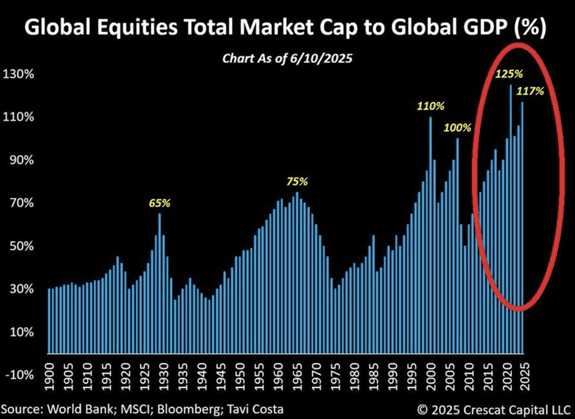
117%: The Number That Should Make You Go “Hmn…”
Thanks to the rebounding market, global stock market capitalization now equals 117% of global GDP.
That’s higher than the peak of the Dot-Com bubble. It’s also the kind of spike higher that should tell you to take some profits off the table.
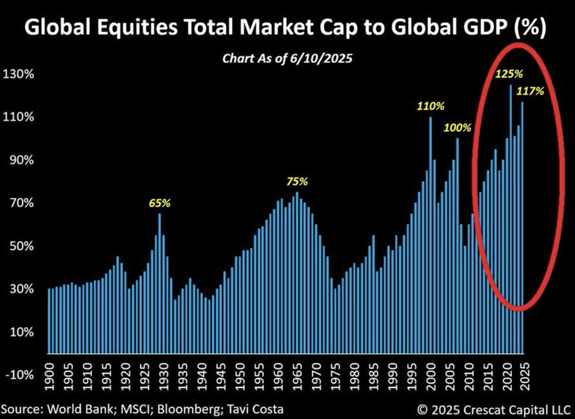
It means, globally, the market is priced for perfection — low rates, tame inflation, stable geopolitics — with no room for error.
Fair warning, when assets float this far above fundamentals, even small tremors can spark avalanches.
 Banks Are Still Sitting on 400 Billion in Unrealized Losses
With consumer credit balances hitting historic highs, regional banks are not yet counting their chickens. Because there aren’t enough to count.

The first quarter marked the 14th consecutive quarter of paper losses for U.S. banks. That matches the streak that began in 2006 and ended in collapse. No one’s sounding the alarm — yet. But the parallel is there. And it’s loud.
The above two charts should give you pause. Global debt is also at historic highs. And much of that debt money is sitting in historically high brokerage accounts, globally.
A $1.365 Trillion Deficit… and Counting
The U.S. government has already racked up $1.365 trillion in red ink this fiscal year — the third-largest in history. The tariff “solution” has generated more headlines than revenue. And the bill is growing.
 MicroStrategy’s Bitcoin Yields, For Now
We’ve been suggesting that Strategy –formerly MicroStrategy, before its market cap went from $1 billion to $100 billion thanks to its aggressive bitcoin buys – is one proxy for owning bitcoin outright.
Again, we’re cautiously optimistic here.
Saylor and associates rolled out their Series A preferred shares (STRD) with an 11.75% yield. It raised $980 million, bringing its total haul for the year to nearly $3 billion — all earmarked to buy more bitcoin.
The dividend is great, but it is not a guaranteed amount. No obligation to pay. No penalties if skipped. No make-ups if missed. A correction in bitcoin will likely vaporize the return, too.
Still, you’d still own the shares if you, like our own Mark Jeftovic has done with his data business, want to go along with Saylor for the bitcoin- as-operating-capital ride.
During today’s Grey Swan Live! we’ll be digging into AI packet-tized media and technology-driven strategic adjustments in modern warfare with Grey Swan contributor John Robb.
Seems like a good day for it. The market wants a soft landing in the economy. A meandering summer trend higher. A trade truce. A rate cut. A pause in inflation. A calm summer.
But the signals are contradictory:
- CPI says inflation is easing… but shelter is still climbing.
- The handshake deal boosts confidence… but there’s no signed agreement. (You could, as we prefer to do, ignore the trade headlines until an actual signed agreement with China and a host of other countries, including the EU trade bloc.)
- Stocks rally… while bonds signal caution and precious metals explode higher.
And now, global market valuations sit above 117% of GDP. Higher than 2000. Higher than 2007. Higher than any sane person should feel comfortable with.
Historically, market dislocations don’t resolve in tidy boxes. They end with sudden repricing — quietly at first, then all at once.
~ Addison
P.S.  Grey Swan Live! today features a no-holds-barred conversation with strategist and former special forces intelligence operator John Robb. We’ll dig into Ukraine’s drone strikes on Russian soil — not just the headlines, but what they reveal about the future of warfare.
We’ll also explore how AI-driven media is fueling mistrust, tribal narratives, and protest networks like those now erupting in LA. Robb calls it “packetized truth” — a world where each of us assembles reality to match our own bias.
The big question: how do you invest in a world like that? Paid-up Fraternity members can join us at 11 a.m. ET today — and find out. Your invitation will arrive in your inbox, just prior.
Your thoughts? Please send them here: addison@greyswanfraternity.com