

“We should take nothing for granted. Only an alert and knowledgeable citizenry can compel the proper meshing of the huge industrial and military machinery of defense with our peaceful methods and goals, so that security and liberty may prosper together.”
– President Dwight D. Eisenhower
June 25, 2025 — The US is creating its own ‘Devil’s Island.’ USA Today:
In Florida, an ICE detention facility in the middle of the Everglades
“Alligator Alcatraz” expected to house up to 1,000 immigrants
Empires usually end their lives with a heady cocktail of too much spending and too much violence. Often, keeping people under control — at home and abroad — becomes the major expense. An empire is fundamentally a protection racket; what Eisenhower called the ‘military-industrial complex’ is its major beneficiary.
On both scores — money and war — Washington seems to be following the script history provides. But as Michael Brenner tells us, each decaying empire dies in its own ditch.
Continued Below…
This THIRD WAVE from Texas
|

In the US, 2025, the budget debate shows no sign of ending the deficits that are ruining the US. Instead, progress — towards a fiscal crisis — continues unmolested. USA Today:
Trump’s ‘big, beautiful bill’ is shrinking in the Senate
And the latest bombing of Iran suggests that while a rise in politics and violence may be common to all failing empires, each has its curiosities. Bloomberg reports that Iran’s nuclear research centers may not have been obliterated after all:
US Strikes Inflicted Limited Damage to Iran’s Nuclear Sites, Pentagon Says
A report said the bombing likely didn’t cripple the core components of Iran’s program below ground.
As you recall, the bond market hit an all-time high in July 2020. Since then, it has been downhill for the full faith and credit of the US government. Its debt has sold off more than at any time in history. Bond prices have generally been in retreat for five years. The longest bond ETF – $ZROZ — has lost 60% of its value. The dollar has dropped by 10% this year alone, and foreign stocks have outrun US competitors, 16% to 2%. Foreign buyers of US stocks or bonds have suffered a double hit.
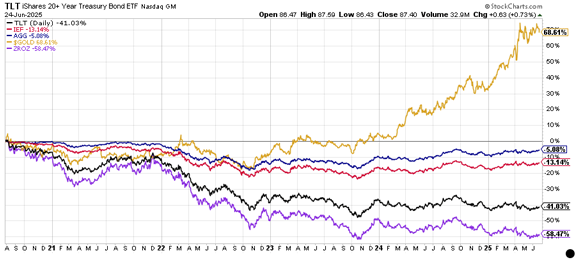
Gold quietly soared past government & corporate bonds
over the last five years.
The great bull market in debt, 1982-2020 is well and truly over. And since bond market trends last for a very long time, we should expect rising interest rates for the rest of our lives.
Back in 2020, the Brookings Institute looked ahead and saw “trillion dollar deficits as far as the eye can see.”
Then in 2023, the Fiscal Times looked out and saw “crisis-sized deficits, as far as the eye can see.”
This year, Pacific Research sees “deficits as far as the eye can see.”
Apparently, only blind people are buying Treasuries.
Deficit gaps need to be filled with borrowed money. The trouble is, a society only has so much in ‘capital’ — savings. It can use it to build more factories, add more infrastructure and fund more innovations. Or, it can be taken by the feds and squandered on budget busters.
Already, as Prof. Stephen Hanke showed us, federal borrowing is ‘crowding out’ private borrowing…which means, more and more of America’s precious savings is being diverted to unproductive ‘investments’ — such as bunker busting bombs.
Which of course, brings us to the second part of the empire-destroying formula. The bunker busters may or may not destroy the bunkers in which the Iranians may or may not be making nuclear bombs. But they definitely help bust the budget of the world’s richest country.
They also help convince foreign countries that they should get together and gun-up to protect themselves. Enemies proliferate…and eventually find a way to bust our own bunkers.
But at least for now, as State Department spokesperson Tammy Bruce put it: “The US is still the greatest country on Earth, next to Israel.”
Regards,
Bill Bonner
Bonner Private Research& Grey Swan
P.S. from Addison: “I just read Empire of Debt,” writes reader Brian Q. “and today’s report about the debt crossing $37 trillion. It’s frightening. This debt will never be paid. What trick the government has up it sleeves for reneging on the debt?”
Brian continues with the wonder of a child encountering a rabid dog in his back yard:
What if we just don’t pay it back, especially to the foreign countries? What what are they gonna do repossess our car? Foreclose on our house?
In the book Empire of debt it was stated countries like Spain and France reneged on their debt several times and guess what they’re still countries today. so while these statistics are quite astounding, I think at this point we need to start addressing what the solutions are instead of reeling off these unimaginable numbers. There must be some trick up the sleeve. Do you have any idea what that might be?
“After reading Empire of Debt, I started asking well what are the solutions but I don’t hear solutions. It seems to me, you should be instructing everyone on how to use put options or how to sell short the dollar.”
You’re right to be concerned, Brian. And I think you’ll find you’re in good company here at The Grey Swan Investment Fraternity. The solution sets we recommend are collected in the 47 special reports we’ve published for paying members since we opened doors last fall. And 15 long-term, dividend paying stocks, 5 short to mid-term speculative plays you’ll find in the Grey Swan Model Portfolio.
We reserve those solution sets for paying members and update them quarterly or more frequently, given the policy by Truth Social environment we’ve passed into during this second term of President Trump.
One thing I will suggest is that you shouldn’t be trading options – puts or calls – on the dollar index, or anything else for that matter, if you don’t have the rest of your financial house in order. You can win big when you get a trade right. But you can also lose. Big.
As to your question about tricks up the government’s proverbial sleeve, we’ll be discussing the most recent one tomorrow at 11 am ET on Grey Swan Live! (Thursday, June 26 at 11 a.m. ET.) We’ll be joined by cryptocurrency expert and tech wizard Ian King a rousing discussion on the GENIUS Act passed last Tuesday through the Senate; Circles meteoric 800% gain in the past 18 trading days… and how Treasury Secretary Scott Bessent believes stablecoins may become a backdoor lifeline for the U.S. Treasury. You’ll want to hear this one… another perk of being a fully paid up member of the fraternity.
Your thoughts? Please send them here: addison@greyswanfraternity.com