GSI Banner
  • Free Access
  • Contributors
  • Membership Levels
  • Grey Swan Forecasts
  • Video
  • Origins
  • Sponsors
  • My Account
  • Sign In
  • Join Now

  • Free Access
  • Contributors
  • Membership Levels
  • Grey Swan Forecasts
  • Video
  • Origins
  • Sponsors
  • Contact

© 2026 Grey Swan Investment Fraternity

  • Cookie Policy
  • Privacy Policy
  • Terms & Conditions
  • Do Not Sell or Share My Personal Information
  • Whitelist Us
Ripple Effect

A Tale of Two Asset Classes

Loading ...Addison Wiggin

May 21, 2025 • 56 second read


A Tale of Two Asset Classes

Five years ago, during the pandemic, the bond market hit record-low yields. At one point, the 10-year U.S. Treasury bond paid a scant 0.318% yield.

Today’s 10-year bond buyers? 4.51%.

For $10,000, that’s a more than ten-fold difference between getting paid $31.80 in annual interest versus $451.

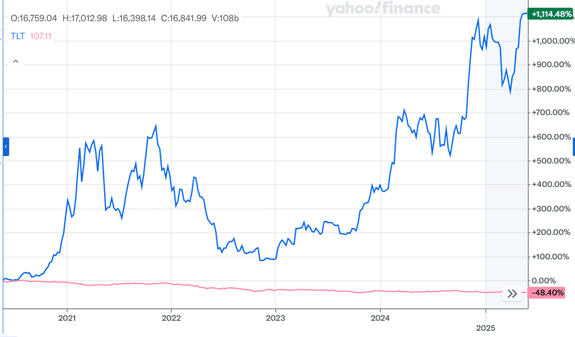
Bonds have been a poor asset, especially longer-dated ones. The iShares 20+ Year Treasury Bond ETF, TLT, is down over 50% since 2020.

Let’s contrast that return with bitcoin.

Over the past five years, whether interest rates have been low or high, whether central banks have been flooding the system or not – bitcoin has soared over 1,100%.

Turn Your Images On

This week, soon-to-retire JPMorgan Chase CEO Jamie Dimon graciously announced that the bank would allow its customers to buy crypto.

That’s after a 1,100% move. And after bonds, which the bank is more than happy to deal in, have been cut in half.

When it comes to crypto, asking a bank about it is like asking a taxi driver what they think of Uber.

There’s a monetary regime change underway. And bitcoin could allow investors to come out ahead – whatever happens – and whoever ends up on top.

~ Addison

The Hindenburg Five

February 24, 2026 • Addison Wiggin

The stock market “rebalancing” is a polite way to put it. Energy and health care are getting a healthy boost. But tech hardware and software makers are still getting dressed down and have been asked to report to the principal’s office.

The great rotation underway has triggered a series of “Hindenburg Omens.” Five have occurred in recent weeks.

The Hindenburg Five
Piercing The Veil

February 23, 2026 • Addison Wiggin

The S&P 500 has traded in a 3.7% range over the past two months — less than half the 20-year median of 8.6%. One of the tightest ranges in modern history.

In trader parlance, the indexes are “flat,” a setup that often materializes before a sell-off at the top after a multi-year bull market.

Goldman Sachs told its own traders to be aware that institutional trading activity resembles a VIX reading near 35. Rather than a reading of 20, where the VIX has been trading over that same 2-month period.

The U.S. software ETF, IGV, tested its April 2025 lows last week and trades roughly 35% below its peak. The “SaaS-pocalypse” in software companies reflects the fear of Citrini’s 2028 scenario happening in real time.   That divergence now exceeds the spread seen at the peak of the Great Financial Crisis.

Under the surface, the “great rotation” we wrote about last week is threatening to widen.

Piercing The Veil
Oh. Canada

February 23, 2026 • Addison Wiggin

Despite its overly-educated 40-million-plus population, on a GDP per capita basis Canada is null. Collectively, the Great White North would rank as America’s second-lowest state, coming in above Mississippi, but below Alabama.

Oh. Canada
Matt Milner: SpaceX + xAI: What It Means for You

February 20, 2026 • Addison Wiggin

SpaceX is the most valuable private startup in history — and if its success continues, it might become the most valuable public company in history.

After all, as Musk famously said in 2023, “I have never lost money for those who invest in me and I am not starting now.”

For investors, SpaceX has been a wild, joyful ride — and now the journey continues!

Matt Milner: SpaceX + xAI: What It Means for You