
After President Donald Trump’s Truth Social post this morning indicating the U.S. will not target the Iranian electricity grid, oil fell $10.
The whipsaw from the war has traders on edge.
Inflation charts circulating over the weekend show an alarming trend. We’re sitting uncomfortably close to the 1968 to 1980 “stagflationary” environment.
Back then, the money supply ran hot first. Oil hit second. Prices exploded after.
In the 1970s, M2 grew above 10% a year before inflation ripped. Washington, D.C. spent. The Fed accommodated. Energy shocks poured gasoline on a monetary fire that was already burning.
When too many dollars chase the same goods, prices move. When oil rises at the same time, the move accelerates. Groceries. Freight. Diesel. It spreads fast.
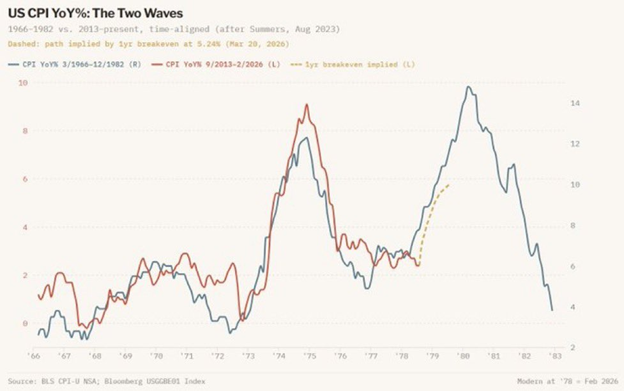
Let’s not have a repeat of the 1970s? Trump’s nominee to replace Jerome Powell at the Fed is zeroed in on this chart and failures of the Fed in the 1970s stagflationary economy. (Source: Carl Quintanilla via X)
Today, the Fed is sitting on a historic $6.6 trillion in pandemic-crisis-acquired assets. It cannot afford to play the same games as Arthur Burns, chairman of the Federal Reserve 1970 to 1978.
Trump’s nominee for the same job, Kevin Warsh, looks at the energy crisis in the 1970s and says the mistake was made before the oil embargo, not after.
Warsh points the finger squarely at the Burns Fed for letting money growth run loose and then scrambling once inflation embedded itself. Fed governors and politicians of the day chased wages and jawboned expectations – but kept the money spigot flowing.
Ultimately, Paul Volcker had to step in and chase rates to 18% to slay runaway inflation.
“Let’s not do that again,” Warsh would say.
Warsh wants to slow the money before it spills over. Shrink the $6.6 trillion balance sheet. Stop using the Fed as a preemptive bailout tool for bad decisions in Washington, D.C. and on Wall Street.
Let supply of energy and technology do the work — more oil in the ground, more output per worker through AI — instead of smashing demand with late, panicked rate hikes.
Think of it this way: if your bathtub is overflowing, you turn off the tap before you start mopping the floor.
In the 1970s, they mopped first.
Warsh wants to reach for the faucet.
~ Addison
P.S. For an analysis of where gold and silver are likely to go if the Fed is unable to deal with spiking energy costs and Congress continues to spend with abandon, see our report here: $22,227 Gold in 24 Months
Last week on Grey Swan Live!, our natural-resources specialist, Shad Marquitz, provided a prescient look at gold and oil price volatility; the “whack-a-mole” trading environment set in motion by the war in Iran.
Shad systematically covered the mosaic of natural resource opportunities in oil, liquefied natural gas, antimony, tungsten and precious metals following the Iran bombing excursion.
If you’re looking for more than just a further investment in gold, look no further – Shad shared a list of smaller-cap companies that look promising across the commodity space now.
Click here to sign up for the Grey Swan Investment Fraternity if you’re not a member yet to get this latest insight – the replay is up on our site now. And catch Shad’s article in our recently-released March issue, looking at merger & acquisition activity in the gold miner space.