Readers of Swan Dive will be relieved — profoundly relieved — to learn that the war is over, the scoreboard is settled – and Iran has won.
How do we know? We read it on the internet.
“Iran Emerges as a Global Power,” one headline tells us. Another purports to show “How Tehran Forced a Trans-national Owned Superpower To Retreat and Reshaped the Global Economy.”
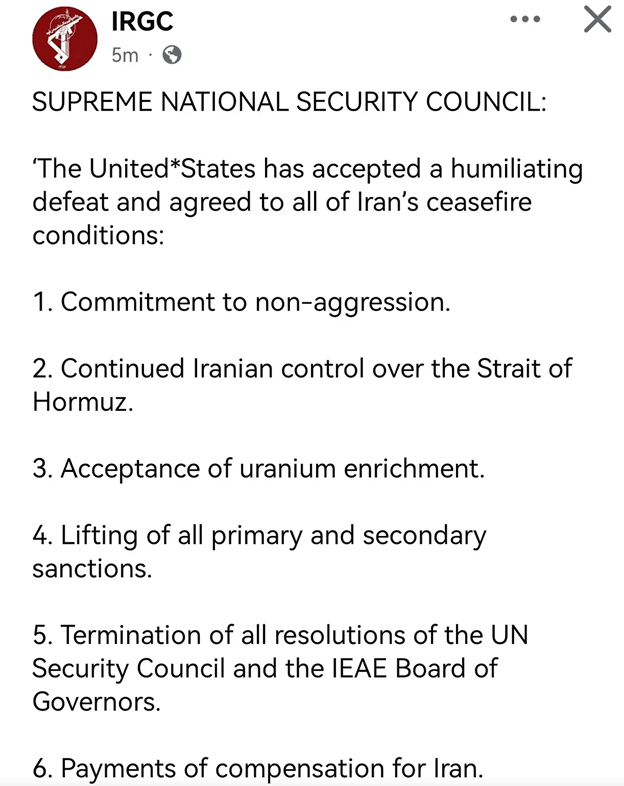 (Source: X)
According to the Supreme Council of the Iranian Republican Guard, Washington, D.C. accepted conditions it had rejected for four decades — sanctions, enrichment, regional posture, maritime control — not through negotiation, but because it ran out of escalation options.
Iran heroically absorbed the blows, preserved its command structure, retained its retaliatory capability and emerged from the conflict with its position intact.
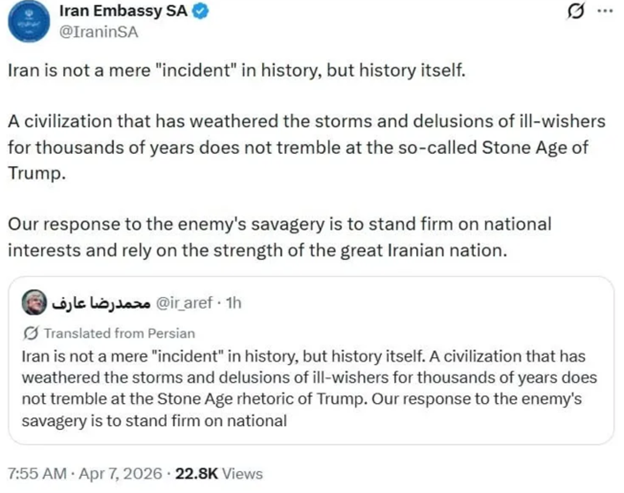
There has been no confirmation from Washington. Although mainstream media like CNN seem to agree.
Oh well.
After a fit of existential dread, we went about our business for the day, which had previously started with a lengthy post from Ray Dalio on LinkedIn.
🌍 What Is History, Anyway
“As a global macro investor for over 50 years who has needed to study all things that affected markets over the last 500 years to know how to deal with what’s coming at me,” Ray Dalio had excerpted from his book How Countries Go Broke.
Dalio has recently stepped down as CEO of Bridgewater Associates, which he also founded. Bridgewater is widely considered the most successful hedge fund ever to grace Wall Street.
Dalio’s book is itself drawn from a larger piece of historical analysis of “The Big Debt Cycle”; national debt accumulation, crisis and restructuring, arguing that excessive borrowing and mismanagement lead to economic collapse, as seen in historical examples such asthe U.S., Europe, and China.
Dalio:
“It appears to me that most people tend to focus on and react to the attention-grabbing things that are going on at the time—like what is going on with Iran now—and miss the much bigger, more important, and longer-term-evolving things that are driving what is going on and what is likely to happen. For today, that is most importantly that the US-Israel-Iran war is just part of a world war that we are in and that isn’t going to end anytime soon.
We have grabbed another piece of Dalio’s LinkedIn post because it helps frame the Israel-U.S. confrontation with Iran as part of a larger, emerging multipolar world order as the world readies itself for a future dominated by AI technologies.
In the multipolar world, China is aligned with Russia, and Russia is aligned with Iran, North Korea and Cuba. The United States, Ukraine (which is aligned with most European countries), Israel, the GCC states, Japan and Australia make up the other power bloc.
Calculations by world leaders are part of a classic sequence of steps leading to major wars that have repeatedly taken place and are now happening. Looking at today’s events and knowing this classic international world order/conflict cycle.
Here is the classic sequence of steps, historically speaking:
- The economic and military strengths of the dominant world power(s) fall relative to those of the rising world power(s), leading them to become roughly comparable powers and to begin challenging each other in economic and military conflicts over their disagreements.
- Big increases in economic wars take the form of economic sanctions and trade blockages.
- Economic, military, and ideological alliances form.
- Proxy wars increase.
- Financial stress, deficits, and debts increase, especially for the leading powers that are most overextended financially.
- Critical industries and supply chains are increasingly controlled by governments.
- Trade chokepoints become weaponized.
- Powerful new technologies for war are built.
- Multi-theater conflicts increasingly happen simultaneously.
- Within countries, loyal support for the country’s leadership is demanded and opposition to the war and other policies is squashed, because as Lincoln quoted from the Bible, “A house divided against itself cannot stand,” especially when it is at war.
- Direct military combat between major powers occurs.
- There are big increases in taxes, debt issuance, money creation, FX controls, capital controls, and financial repression to finance the wars. In some cases, markets are shut down. (Read Chapter 7 in Principles for Dealing with the Changing World Order for a more complete explanation of investing during war.)
- Eventually, one side beats the other and gains indisputable control of the new order, which is designed by the winning side.
(Source: Ray Dalio’s Principles)
In Dalio’s view, the sequence that leads to war does not depend on the outcome of any single engagement, such as the latest detente between Iran and the U.S.
War is part of a broader political struggle that advances step by step, regardless of who claims the latest headline.
📉 The Market That Isn’t
That the latest headlines also determine day-to-day trading is also eye-opening for individuals trying to make sense of the outbreak of violence in the Gulf.
This morning on an invite-only Slack channel among Grey Swan researchers, writers and marketers there was a healthy discussion over the so-called “TACO Tuesday” trade (Trump Always Chickens Out).
 The Kobeissi Letter posted it this way on X: “Tonight’s situation is proof that X has become the primary source for world-changing news, developments, and analysis.”
The algorithms programmed to follow price movements adjust to the prices in real time. Those not on the platform receive information after prices have already begun to move.
“Following the right accounts on X is quite literally a source of alpha in 2026.”
We admit, today’s Dive presents a dizzying array of ideas if you let them be dizzying. Still, we have to invest our money wisely, so this morning we suggest three ways to look at the markets…
🏛️ Follow The Politics
The political response to the AI economy is already manifesting in ways difficult to ignore.
In Indianapolis, 13bullets were fired into the home of city councilor Ron Gibson after he voted in favor of a data center project in his district. A note left at the scene read “No Data Centers.” No one was physically harmed, but the signal was clear enough.
At the state level, similar pressures are moving through legislative channels. Maine is expected to pass a moratorium on data centers consuming more than 20 megawatts, targeting the scale required to support large AI infrastructure.
Nine states are considering similar restrictions, with Pennsylvania expected to join them.
In Ohio, activists are gathering signatures to place a statewide ban on the ballot. South Dakota and Wisconsin have rejected comparable proposals, while municipalities such as Port Washington are holding local votes to determine whether development should proceed.
The objections are tied to measurable effects. A study cited by the Wall Street Journal reports that large data centers can create heat islands extending several miles, contributing to pollution and increased mortality. At the same time, these facilities bring employment, tax revenue and capital investment into the regions that host them.
The argument is not being resolved in theory. It is being resolved through votes, legislation and, in one instance, gunfire.
🎭 Follow the Entertainment
Another of our favorite billionaires, Bill Ackman, has directed capital from his fund, Pershing Square, toward a different kind of asset, one that does not depend on zoning approvals or grid capacity.
His fund is offering approximately $64.4 billion to acquire Universal Music Group, the company behind artists such as Taylor Swift and Bad Bunny. Ackman described the catalog as “world-class,” while arguing that the stock has “languished due to a combination of issues that are unrelated to the performance of its music business.”
If completed, the transaction would merge Universal Music Group with Pershing Square and shift its listing from Euronext Amsterdam to the New York Stock Exchange, placing it within a different investor base and regulatory framework.
As far as public offerings go this year, while not SpaceX exactly (see more below), Ackaman’s Pershing effort will likely get a lot of public attention and scrutiny all the same.
🪨 Follow The Molecules
Beneath the movement of capital and policy, the distribution of physical inputs continues to shape the AI economy in ways that do not respond to narrative.
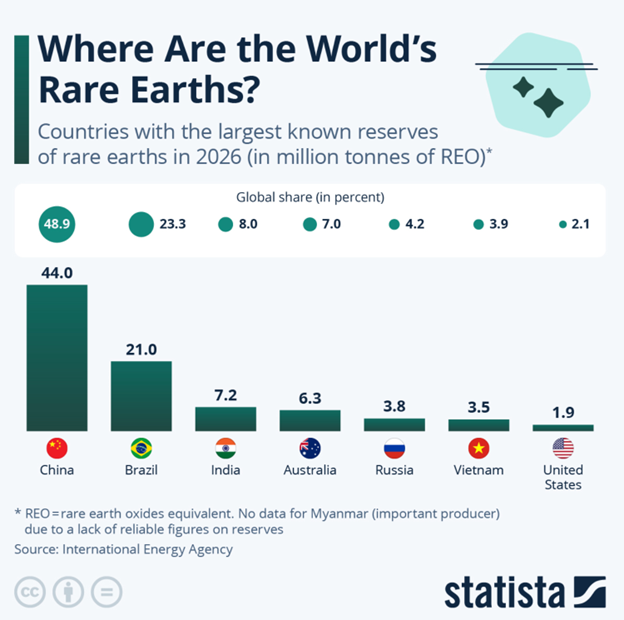
The International Energy Agency’s Rare Earth Elements 2026 report places nearly half of global reserves — approximately 44 million tonnes of rare earth oxide equivalent — in China.
Brazil holds roughly 21 million tonnes.
India accounts for 7.2 million tonnes.
Australia, Russia and Vietnam maintain deposits in the range of 3 to 6 million tonnes, while the United States holds about 2% of the total.
These seven countries account for roughly 97% of known reserves. The concentration becomes more pronounced when processing is considered, as China’s position extends beyond mining into refining and manufacturing capacity.
Recycling contributes less than 1% globally due to the technical and economic difficulty of extracting these materials from finished products. Efforts to build alternative processing capacity are underway in Europe, North America and Japan, but they remain in early stages relative to projected demand from electric mobility and wind power.
China holds roughly 44 million tonnes of rare earth reserves and controls a large share of the processing capacity that turns those materials into magnets, motors and electronics. Brazil holds about 21 million tonnes compared with about 7.2 million for India, but neither country operates refining at the same scale.
Manufacturers building wind turbines, electric vehicle drivetrains and defense systems place orders where processing exists, not where deposits are mapped.
That keeps supply chains anchored to Chinese facilities even when the raw materials sit elsewhere.
More to come…
~ Addison
P.S. This week on Grey Swan Live!, legendary economist Dr. Mark Skousen joined us to step back from the noise and look at the bigger picture.
And this is one you’ll want to catch up on…
With the macroeconomic picture casting a cloud over the markets, we teamed up to break down what’s really driving this market resilience, what to make of fading war-driven volatility and where the best opportunities may be right now.