A seemingly innocuous $2 billion Treasury announcement… economic warfare in Iran… and boom! A $1.3 trillion move in gold and silver.
Let’s dig in.
On Tuesday, August 19, Secretary Scott Bessent announced that Treasury is raising the maximum for long-end liquidity-support buybacks from $2 billion to at least $4 billion per operation, effective September 9. You might remember we called it “a rounding error on a bag of small potatoes in a forgotten root cellar.”
That is the mechanical part.
The political part we need to understand is Bessent’s language and intention. Bessent’s trying to solve two problems at once.
Bessent, by Reuters interpretations, left the door open for buybacks to increase further after the initial doubling, while Al Jazeera took it as a warning that new U.S. economic measures are intended to “collapse” Iran’s regime.
That gives the story two potential plot twists. The Treasury is not just managing bond-market plumbing. It is trying to run a domestic yield-stabilization operation while also escalating economic warfare abroad.
What appeared this morning, August 21, is the market’s response.
Treasury yields briefly dropped, then skooched back higher – the 10-year Treasury near 4.7% and the 30-year around 5.25% – suggesting the initial bond-market relief did not hold.
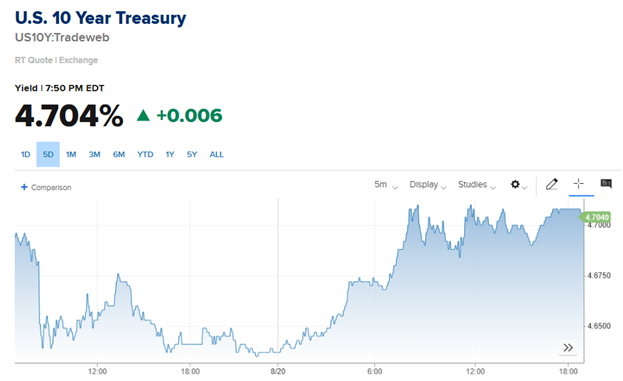
Bessent announced Tuesday that the Treasury will double its buyback program from $2 billion to $4 billion starting September 9, producing the desired dip in bond yields. But the move was short-lived. Practicing yield-curve control at home and economic warfare abroad will be a persistent challenge. And so far, the Treasury’s on its own with no help from the Fed. (Source: Barchart)
So the analysis changes from “Treasury added liquidity” to something more combustible:
In trader speak: Treasury is trying to tell the bond market that current yields are too high, while the bond market is telling Treasury that the debt load, inflation risk, war risk and foreign-creditor risk are not theoretical.
At the same time, Bessent is threatening a more aggressive sanctions campaign against Iran, which could touch oil flows, shadow finance, secondary sanctions and allied trade relationships.
That is not a calm backdrop for suppressing long-term rates.
And… the Japan angle still matters.
If global allies are pushed into an “us or them” sanctions regime, and if foreign holders of Treasurys need dollars to defend their own currencies or economies, then Washington has two problems at once: it needs foreign cooperation to isolate Iran, and it needs foreign confidence to keep absorbing U.S. debt.
That is a difficult posture for a Treasury secretary trying to “grow out” of what is now a rapidly compounding $40 trillion debt burden.
Treasury’s buyback expansion is supposed to be a liquidity operation, not QE. But markets are not trading it that politely.
Once Treasury starts buying long bonds to calm yields, issuing more short bills and talking about a larger toolkit, traders begin to see a Treasury-led version of yield management.
Maybe not yield-curve control in the name. Not yet. But close enough to wake up the debasement crowd.
That is why gold and bitcoin matter in the story.
They are not just “risk-on” trades. They are market votes against the idea that Washington can painlessly manage a bond market, a war-finance problem, an escalation in Iran sanctions, a strong-dollar policy, and a $40 trillion debt stock at the same time.
Where’s the Federal Reserve in all this? Watching and waiting. The Fed, thus far, has resisted buying Treasurys as has been the practice since the Bernanke Fed.
New Fed chair Kevin Warsh says he’s going to make the Fed more independent, and that Treasurys on their own. We’ll see if he can resist stealth quantitative easing (QE) and yield curve control (YCC), as his predecessors had a wont of doing…
The market reaction is important.
Bessent’s buyback announcement for Treasurys has renewed fears of “dollar debasement,” with investors worried that efforts to restrain long-end yields could shift the adjustment toward a weaker dollar.
Gold jumped more than 3%. Together, gold and silver added $1.3 trillion in market cap. Bitcoin jumped 13% after the Treasury “surprise.”
We’ve repeatedly warned that in any monetary uncertainty, gold and silver will catch a bid. This morning, we’re seeing that play out in real time.
With traders seeking alternatives to the top-heavy AI trade, it wouldn’t be crazy to see another run of speculation in precious metals like January.
Since the Basel III accord passed in 2023, classified gold as a “tier one” asset alongside Treasurys and the U.S. Dollar, gold has eclipsed U.S. debt as the reserve asset of choice among foreign central banks.
And with the Treasury signaling that the “debasement trade” is back on, gold is back to $4,500, and bitcoin is up over 20% in the past week. Not too bad. You may recall that here we reasserted our call to buy physical gold on August 7 after noticing a brief dip below $4,000 to $ 3,992 on July 15.
On August 7, we also recommended a gold and silver miner (with a copper and antimony kicker) across several of the Grey Swan portfolios.
It’s also no surprise that some of our recent Grey Swan Pro trades have hit their upside targets, especially trades made back in June and July involving resource trades. That includes a 30% gain in the shipping company Frontline (FRO) and a 25% gain in the precious metals mining company Hecla Mining (HL).
We expect resource stocks to continue to perform well, and for other sectors to join the crack-up boom when the “debasement trade” really takes off.
In the meantime, Today’s Grey Swan Pro recommendation is a financial stock, direct play on Bessent’s ‘s efforts in the bond market.
~ Addison
P.S. Grey Swan Live! returned yesterday with Jennifer Stevens of International Living.
If reviewing our time during the pandemic has driven any idea home, it’s the idea that you also need your own personal bolthole. And that the safest place to bolt may be in a different country.
In our first chat, Jennifer reviewed the top global real estate markets. We’ll take a look at where the best opportunities are, whether you’re looking for a second place to live part-time or full-time, or whether an investment property overseas – which may eventually become a retirement or bolthole – is best for you.

But that’s not all!
And today at 2 p.m., we have a special event – a conversation with our friend Nick Buhelos at Prime Corporate Services. Nick can show you how to best structure your investments to reduce your tax liabilities in the U.S. – a great idea whether you want an intrusive government like the one during the Covid-era or not.