
Decade-high interest rates:
The benchmark 10-year Treasury recently pushed above 5.2% yesterday – its highest level since the pre-crisis year 2007. The 30-year note reached a 24-year high.
At the same time, hyperscalers have issued roughly $247 billion of debt this year, more than 12 times last year’s level.
In total, Treasury and corporate debt will hit $8 trillion in 2026.
While Treasury Secretary Scott Bessent needs investors to finance a federal government carrying more than $40 trillion in debt, Oracle (ORCL) Chairman and Chief Technology Officer Larry Ellison and the rest of the AI “it” crowd need the same investors to finance data centers, chips, power contracts and long-dated infrastructure.
An individual investor might be slightly curious: Where does this orgy of debt lead?
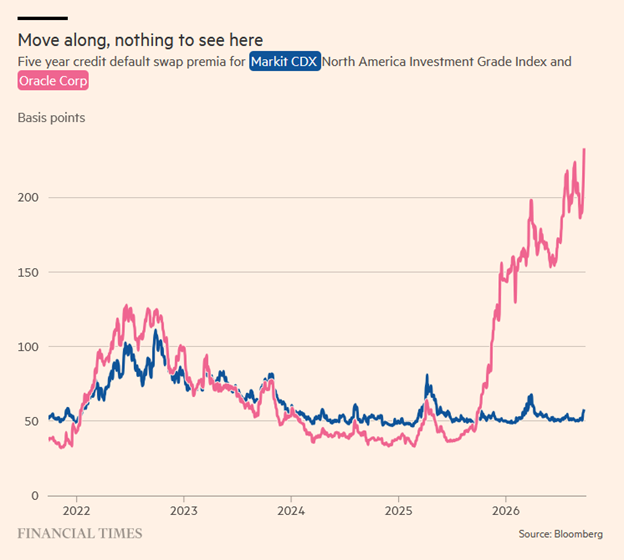
Oracle provides a test case. Credit default swaps – the financial tools that allowed big banks to bet on a collapsing housing market – are back, only this time, in hyperscaler form:
The story Larry Ellison told was simple: Oracle was no longer just an old database and enterprise software company. Oracle had become an AI infrastructure company.
OpenAI, Meta Platforms (META) and even TikTok needed massive cloud capacity. Oracle would borrow, build and lease enough data-center capacity to serve them.
Ellison told investors he was raising capital to meet “contracted demand” from its largest Oracle Cloud Infrastructure customers. The Financial Times reported that Oracle expected cloud growth to accelerate by 64% to 70%, and that investors viewed the company’s growing contract book as evidence that Ellison’s AI buildout was working.
The stock market believed him for a while.
Bond investors are now testing the story.
A 30-year Oracle bond issued in February recently yielded 8.1%. Oracle’s five-year credit default swaps traded around 227 basis points. A company can still call itself investment grade at those levels, but investors are demanding to be paid as if they are taking real risk.
Oracle must build the data centers, secure power, retain customers, manage debt, protect margins and prove that AI revenue arrives fast enough to justify the capital structure.
That promise has to be fulfilled. On time. And with customer satisfaction.
One delayed project, one force majeure notice, one customer wobble, one financing problem, and bond investors start treating Oracle like prophecy for the AI boom, a credit cycle. The pun is entirely coincidental… we think.
It’s a fascinating setup if you think about it: Big Tech and the U.S. government are competing for capital at scale. At stake is some $124 trillion in baby boomer capital (Cerulli Ass.) waiting to change hands to a spouse or heir.
Investors can buy Treasurys near 5% without underwriting AI demand forecasts, data-center construction risk or circular financing.
Andrew’s recommendation doesn’t attempt to solve Oracle’s balance sheet. He is looking at the companies that help issue, arrange, rate, trade and distribute the debt. When Washington and Big Tech compete for capital this aggressively, the debt facilitators are a pure play.
~ Addison
P.S. Last week on the Grey Swan Trading Fraternity, Andrew covered the recent rally in the stock market, why it doesn’t pass the smell test on a fundamental and technical level, and what to buy to stay cautious. Be sure to check it out if you haven’t yet.
We’ll be back with Grey Swan Live! later this week – more details to come. And the Grey Swan Trading Fraternity weekly livestream will be at a special time, this Friday at 3 p.m. ET – just in time to digest all the market swings of the week, and look ahead to what the fourth quarter is likely to bring to markets and investors.