
The most recent Bureau of Labor Statistics (BLS) report reveals a positive trend. The federal government payroll shed -18,000 jobs in March, down to 2.66 million – its lowest number 1966.
This marks the 14th consecutive monthly decline, coinciding with President Donald Trump’s return to the White House:
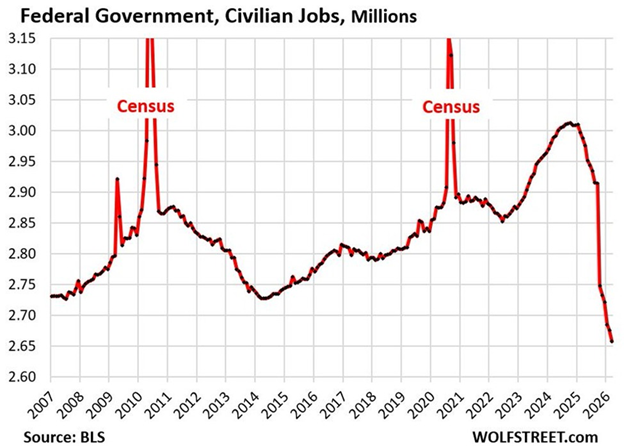
The total number of federal employees is down 12% over the past 14 months. (Source: Wolfstreet)
Private sector job growth, on the other hand, is showing “quiet resilience” in 2026, rather than a downturn, characterized by steady, moderate gains, with a significant concentration in health care and education.
Small businesses – those with fewer than 50 employees – are leading hiring in recent months, suggesting a catch-up phase, while overall labor demand is cooling.
Caveat lector: don’t confuse a shrinking federal payroll with a decrease in government spending. Au contraire. Social Security, Medicare and President Trump’s increase in war spending and interest on the debt are making up the difference in government injections of capital into the economy.
The federal deficit crested $1,005 trillion through the first five months of the 2026 fiscal year. That pace is on par with 2025’s historic $2,774 trillion pace.
~ Addison
P.S. Grey Swan Live! was in top form last week with Ian King. We had attendees from the four corners of the continent, from Seattle to Boca Raton, Ontario to Baton Rouge. Arizona and Alabama. If you’re a Grey Swan member, it’s worth your time to join Grey Swan Live! on Thursdays. It’s one of the primary benefits of your membership!
Ian’s been out front on the crypto revolution for a decade. The K-Street rumor mill is hot in Washington, D.C. this week with breakthrough news of a deal between the banking lobby and digital asset innovators.

Ian explained how and why the banking cartel is trying to defend its monopoly over the nation’s savings, and how the innovators at crypto companies have positioned themselves to benefit their customers when the Clarity Act finally gets sent up to the Oval Office.
The implications on everything from tokenization to Defi are profound. We specifically ran through all of the companies listed in the “Dollar 2.0” recommendations in our digital asset special report in the Grey Swan library.