Trump’s dealing in the desert. The dollar’s drifting like the Sahara dunes. And a monarchy the size of Connecticut is buying influence like it’s Black Friday at the Pentagon.
We’re struck by a common theme threading through a bunch of little news nuggets this morning:
The forced erosion of institutional trust and intentional unraveling of legacy systems — monetary, political, educational, and corporate —under the weight of opportunism, technology, and a new post-war world order.
Systems aren’t breaking so much as they’re being bypassed. Things still function, just not according to the status quo.
If you’re in the Trump administration, you call it “strategic uncertainty.”
If you’re trying to manage your own money, you’re left reading between the lines while the institutions you thought you could rely on quietly get rewritten by AI bots.
Not to worry, we’ve got you covered. Let’s whip through these nuggets quickly…
💸 Operation Influence: Small Country, Big Checkbook
Qatar has been quietly flooding the U.S. with cash for years — billions into universities, think tanks, corporations, and even military partnerships — essentially buying itself a backdoor into the American policy machine.
It’s not espionage, it’s marketing. And it’s working.
A nation with the landmass of a Connecticut suburb is helping to shape the narrative in Washington using natural gas wealth and a knack for institutional sponsorship.
📉 Markets Lose Their Momentum
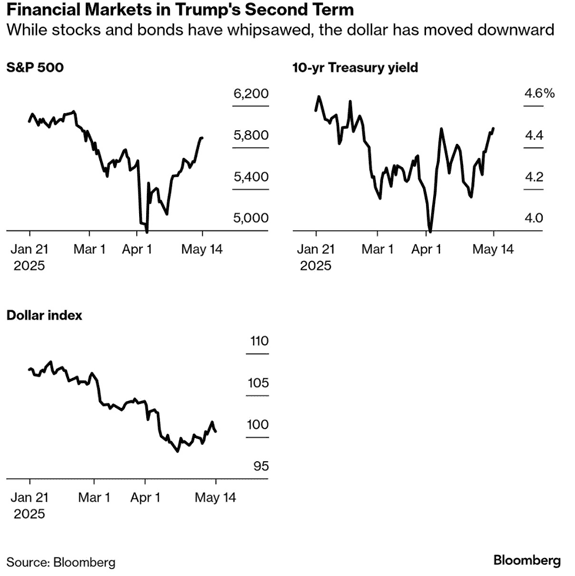
The April tariff tantrum bounce is fading, just as stocks regained their key 200-day moving average.
The S&P 500 barely budged Wednesday, up just 0.1%. Most sectors dipped. The Mag 7 has once again been the lone point of light. That could also be alarming.
💵 The Dollar’s Not Weak by Mistake
Since Trump returned to office, the dollar has been down 8%. A big move for any currency, but for the world’s reserve currency? It’s an earth-shattering move.

But it’s all part of the plan. The goal? Fewer imports, more manufacturing, and yes, a weaker greenback. You don’t have to read the fine print. Markets already have.
The Trump team, judging by their actions at least, see reserve currency status as a “burden” not a benefit. That includes lead economist-turned-adviser Stephen Miran, whose opinions on the subject we’ve noted before.
(As the charts reveal, the second phase of the Trump plan, as was forecast, begins this summer. We’ll have new research on the Trump Reset roadmap next week.)
Meanwhile, Bloomberg reports the White House isn’t formally including currency provisions in trade deals. But FX traders aren’t buying it. They see the policy shift for what it is: if Trump’s vision of a trade-reset world requires a weaker dollar, that’s what they’ll bet on — formal language or not.
🌍 Trump Talks Tariffs, Tim Cook, and… India?
Trump, still on his Middle East circuit, told reporters India offered a no-tariff deal — no documentation, no context, just a soundbite.
Then he told Tim Cook to stop building Apple plants… in India, where Apple moved to diversify away from China.
Yeah.
We’ll have to wait for Trump to return from the Middle East for details…
📉 Recession Warning Light: Yellow, Blinking
Steve Cohen of Point72 says there’s a 45% chance of a recession, and a strong chance the market retests its 2025 lows. Why? Nothing complex. Growth’s slowing.
However, with tariffs still threatening to lift prices, the Fed’s boxed in. They can’t cut without stoking inflation, and they can’t raise without tanking what are already weak mortgage and consumer borrowing markets.
The big “R” call is subject to change next week, of course.
⚖️ UnitedHealth’s Credibility Spiral
Just days after ousting its CEO and freezing earnings guidance, UnitedHealth is now reportedly under criminal investigation for Medicare fraud. The company says it hasn’t heard from the DOJ.
That’s a bold flex for a company whose operations are starting to resemble an HBO miniseries.
In the meantime, UNH, a Dow component, is now down about 50% in a month. Even Boeing, amid all its woes, didn’t get crushed this much, this quickly.
🧳 Cartel Cash Laundered Through the System
Federal agents say a Chinese underground network helped launder $50 million for the Sinaloa cartel — right through L.A. bank tellers and ATMs. No tunnels. No suitcases. Just structured deposits and digital transfers.
The institutions we trust to guard the gates? They didn’t even notice.
So… It’s all still working — markets are open, universities are issuing degrees (using AI bots), corporate earnings are being filed (most of them).
But underneath the facade, the gears are stripped.
The institutions built to uphold confidence and competence are now reacting to incentives, not responsibility. And maybe that’s a good thing.
Either way, that leaves you, the individual investor, relying on instinct, history, and a sharpened sense of timing. Trump is building a new order in real time. Whether it holds is one question. Whether it pays is another.
On a day like today, even finding a common theme among disparate inputs is a challenge. But, why not? Keeping track of the world, even on a seemingly “slow” news day keeps us young, right?
~ Addison