Air Force One touched down in Beijing shortly after 8 p.m. local time on Wednesday evening while television floodlights illuminated the wet tarmac around the aircraft.
Chinese Vice President Han Zheng stood waiting near the foot of the stairway as workers rolled out a long red carpet across the runway.
A military honor guard lined the arrival area beside a brass band dressed in dark ceremonial uniforms while hundreds of Chinese students in white and robin’s-egg blue jackets waved small American and Chinese flags beneath enormous television cranes broadcasting the scene live across the country.
As Donald Trump emerged from the aircraft doorway, the crowd began chanting in English: “Welcome, welcome! Warm welcome!”
Trump paused halfway down the stairs and looked out over the choreography with the unmistakable grin of a man who has spent most of his adult life enjoying large public performances staged in his honor.
“Trump and 12 CEOs worth $20 trillion arrive in Beijing” is not the opening line to a joke…
Behind him came Secretary of State Marco Rubio, Eric Trump, Lara Trump, Elon Musk and Nvidia CEO Jensen Huang, whose presence in the delegation quietly revealed more about the purpose of the trip than the ceremony itself.
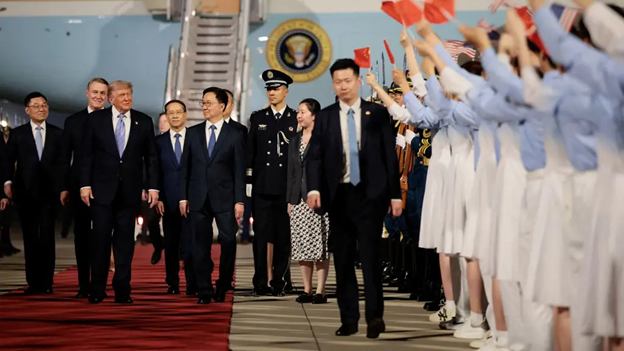 Markets are watching Trump’s China trip closely as tensions over trade, the Iran war and technology remain front and center. (Source: BBC News)
Video from Chinese state broadcaster CCTV spread rapidly across Weibo within hours while commentators on both sides of the Pacific dissected the symbolism surrounding the first American presidential visit to China in nearly nine years.
The spectacle carried a strange historical symmetry because the China welcoming Trump is, in no small part, the China the United States spent two decades financing.
🏗️ China 2005; Back To The Uncertain Future
Back in 2005, China still looked like a cheap-labor story to most Americans, to those who even thought about China at all.
That was the year I published the first edition of Demise of the Dollar.
China occupied a much narrower role in the American imagination. Most Americans encountered the country through discount retailers, container ships and earnings reports celebrating lower manufacturing costs. China produced televisions, toys, microwaves and cheap consumer electronics while American households financed consumption through rising mortgage debt and inexpensive credit.
Wall Street viewed the arrangement as efficient. Washington viewed it as manageable. Consumers viewed it as convenient.
Meanwhile, Beijing viewed it as an opportunity to build industrial capacity at a scale not seen since the United States itself industrialized during the early 20th century. At the time, I wrote:
“Holding US debt gives China economic leverage over the United States in several ways. First, it ensures the continued trade gap favoring China and hurting the US economy. Second, holding this debt enables China to virtually control US buying patterns, interest rates, and economic policy.”
That argument sounded alarmist in 2005 because most economists still believed globalization represented a permanent equilibrium. American corporations would design products and manage finance, while China would remain the workshop economy, assembling goods at lower labor costs.
But Chinese leadership never approached globalization as a permanent arrangement.
Perhaps not coincidentally, Demise of the Dollar sold more copies in Chinese than in English. And on later trips to Beijing, I was treated as a minor celebrity. At one point, my mug was featured on the front page of the China People’s Daily after having had a few sojus with a gaggle of reporters.
📚 Beijing Used Globalization As A War Chest
Rush Doshi later described China’s strategy as a “long game” built around reducing Chinese dependence on the outside world while steadily increasing the world’s dependence on China.
The first phase unfolded quietly during the 1980s, 1990s and early 2000s while Beijing followed Deng Xiaoping’s instruction to “hide capabilities and bide time.” Chinese officials integrated the country into global manufacturing networks while avoiding direct confrontation with the United States. American corporations accelerated the process because moving production into Shenzhen and Guangzhou improved quarterly margins almost immediately.
As export manufacturing expanded, Chinese provincial governments financed ports, highways, freight rail systems and electrical infrastructure capable of supporting rapidly growing industrial zones along the coast. Beijing directed state-backed banks toward long-term infrastructure investment while the United States increasingly directed capital toward consumption, financial services and asset inflation.
The distinction became clearer after the 2008 financial crisis.
Chinese officials watched Lehman Brothers collapse while the Federal Reserve expanded emergency lending facilities and Treasury officials stabilized American banks through extraordinary intervention.
Beijing interpreted the crisis as evidence that the United States had become heavily dependent on debt expansion and financial engineering while China still retained advantages in manufacturing, infrastructure and state-directed investment.
After 2008, China stopped merely participating in the global economy and began shaping it more aggressively.
The Belt and Road Initiative expanded Chinese financing into ports, rail systems and industrial corridors stretching across Asia, Africa and the Middle East. Chinese firms increased investment into semiconductors, electric vehicles, battery systems and telecommunications infrastructure while state planners accelerated construction of high-speed rail and power-generation projects across the country.
The workshop economy evolved into an industrial and technological rival.
⚡ The Huang, Musk and Cook Connection
Jensen Huang did not travel across the Pacific to negotiate over cheap televisions.
NVIDIA (NVDA) now occupies a central position inside the global AI buildout because advanced machine-learning systems require high-end semiconductors, massive data centers and extraordinary amounts of electricity.
Elon Musk’s companies depend heavily on battery systems, industrial metals and Chinese manufacturing capacity. Tim Cook continues operating inside supply chains that Apple spent decades building across China.
Artificial intelligence transformed the old trade relationship into something much more strategic because AI depends on physical infrastructure at every layer of the stack.
Data centers require electrical generation, cooling systems and transmission capacity. Semiconductor fabrication plants require water, advanced manufacturing equipment and billions in financing before producing a single chip. Battery systems require lithium, nickel and rare earth refining capacity. Shipping networks must move all of it continuously without interruption.
The International Energy Agency (IEA) estimates that electricity demand from data centers could more than double before 2030.
China prepared for this industrial shift years ago.
State Grid Corporation invested heavily into transmission infrastructure while Chinese firms expanded domestic semiconductor production, battery manufacturing and electric-vehicle supply chains. Beijing’s objective extended beyond export growth.
Chinese planners wanted to reduce dependence on foreign technology while increasing global dependence on Chinese infrastructure and manufacturing networks.
Meanwhile, American corporations became increasingly dependent on the same systems Washington now describes as strategic vulnerabilities.
🛢️ When China Started Selling Treasurys
The global reserves changed sharply after 2022.
When Washington froze approximately $300 billion in Russian foreign reserves following the invasion of Ukraine, Chinese officials received a direct demonstration of how vulnerable foreign dollar assets could become during geopolitical conflict.
China responded by reducing Treasury exposure and increasing gold purchases.
Chinese Treasury holdings declined from more than $1.1 trillion earlier in the decade toward roughly $775 billion, their lowest level since the 2008 financial crisis.
At the same time, the People’s Bank of China increased gold reserves through an extended buying campaign while Chinese retail investors moved savings toward bullion as domestic real-estate markets weakened.
Simple. The incentives behind the shift remained straightforward.
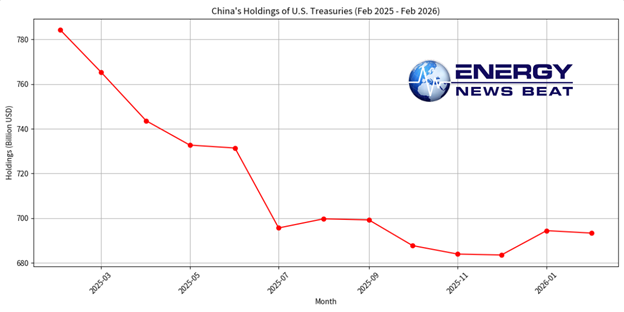
China continues stepping back from U.S. Treasurys, adding another layer of pressure to an already fragile bond market. (Source: Energy News Beat)
Treasurys exposed Beijing to sanction risk.
Physical gold did not.
The broader BRICS bloc also accelerated efforts to settle portions of trade outside the dollar system while central banks increased gold purchases globally.
🛢️ The Iran War Injects Energy and Shipping
“China’s navy,” opens a journal entry published this morning by the U.S. Naval Institute, “is quietly reimagining Mao Zedong’s “People’s War”—a guerrilla strategy for land defense—as a blueprint for global naval conflict.
“Chinese strategists contend its asymmetric logic can be carried to the far seas, transforming a revolutionary idea born in the countryside into guidance for confronting the United States on the world’s oceans.”
We summarize the point being taught to the US Navy’s future leaders: China’s future security lies at sea.2 To defend expanding national interests and deter intervention, the plan must project and sustain combat power in distant oceans.
One presumes Chinese naval power will soon project as far away as the Strait of Hormuz.
Trump arrived in Beijing while energy markets remain under pressure from the Iran conflict.
Brent crude prices climbed sharply through April and May while maritime insurers raised shipping rates across routes tied to oil transport and industrial trade.
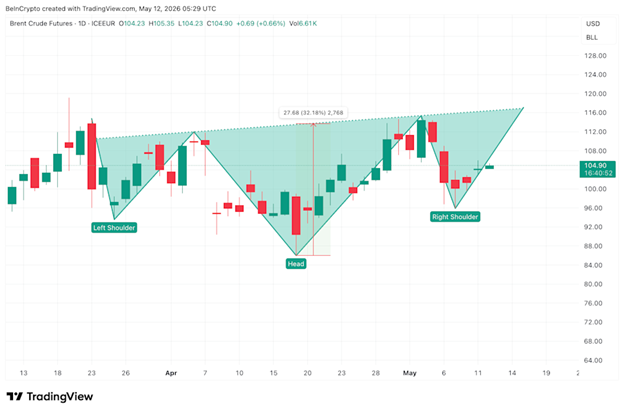
Oil markets are heating up again as Brent crude moves higher on tightening supply and geopolitical uncertainty. (Source: TradingView)
Electricity demand forecasts continued rising alongside AI infrastructure spending, while utilities across the United States delayed planned power-plant retirements because projected demand growth now exceeds replacement generation capacity entering the grid.
China spent years preparing for resource competition and supply-chain instability.
Beijing secured mineral agreements across Africa and Latin America while expanding refining capacity for rare earth elements and battery materials. Chinese naval planning increasingly focused on shipping lanes linked to energy imports and industrial trade routes stretching through the South China Sea and beyond.
The United States spent much of the same period assuming globalization itself would remain stable enough to support perpetual financial expansion.
At least, until the first… and second… Trump administrations.
🏛️ The Cranes Are Moving long after the ceremony ended
Late this evening (tomorrow), construction crews continued working beneath floodlights across western Beijing while Trump’s delegation entered another round of closed-door meetings near Tiananmen Square.
Freight trains arrived steadily from industrial provinces carrying steel, machinery and electrical equipment into logistics hubs surrounding the capital.
Electric buses moved through traffic beneath surveillance cameras mounted above major intersections while cargo vessels continued unloading components at Chinese ports linked directly to battery systems, semiconductors and AI infrastructure projects.
China’s State Grid Corporation invested more than $70 billion into transmission infrastructure last year, while PJM Interconnection warned this month that projected AI-related electricity demand in the United States is rising faster than replacement generation capacity entering the grid.
The story continues…
Heads up: We’re anticipating a series of important announcements and Truth Social posts from the meetings in Beijing.
Andrew and I – and a crack team of researchers – have been busying ourselves with trades that we think will benefit from a shift in tariff policy, a major announcement concerning oil or rare earths agreements or even a major microchip deal… stay tuned. Watch your inbox.
~Addison
P.S. Quick program note: on Friday, May 15, at 2 p.m. EST/11 a.m. PST, we’ll be hosting a live webinar on taxes and trading. Are you making the most of your tax status to save and invest money? Find out on Friday:

P.P.S. Also, this week’s Grey Swan Live! features Jennifer Stevens, publisher and executive editor for one of our favorite publications, International Living. We’ll be chatting it up with Jennifer at 2 p.m. EST/11 a.m. PST tomorrow – Thursday, May 14 – about making those tax savings go farther overseas:
We bumped into and had dinner with Jennifer in Panama City a few weeks back at the beginning of March.
Over some fresh fish and an Argentine Malbec, we started a conversation about what she calls the “value proposition” that those who choose to retire overseas seek. Here’s a snippet of the email conversation that followed our meetup:

What most people don’t realize is that you can have a lifestyle that’s a lot more interesting and affluent than most people realize. The key is to explore your options abroad.
Because outside the US—in the right spots—good living costs quite a bit less than it does in the States.
A couple can live well on as little as $1,700 a month in some places. The trick is to know where to go. And that’s what we show people at IL.
And to be clear: You don’t have to upend your life to take advantage of this “arbitrage.”
- You could buy a place – outside the US, outside the dollar, protect some of that hard-earned money from whatever may be coming down the pike in the US – rent it out for income, watch it appreciate, and you could enjoy it, too.
- You could spend part of the year abroad…
- You could, in fact, up sticks and move…
We invited Jennifer to join us this Thursday, May 14, 2026 at2 p.m. EST. If you’re looking for a way to make your pile stretch further, beat inflation, avoid politics and give you a life with some adventure in it… you’ll want to join us and hear what Jennifer has to say.