Richard Cantillon, writing in the early 18th century, was on the business end of the first modern European experiment in printing paper money.
During the late 1710s and early 1720s, Cantillon, a banker and merchant, speculated in and later helped fund John Law’s Mississippi Company, from which he acquired great wealth.
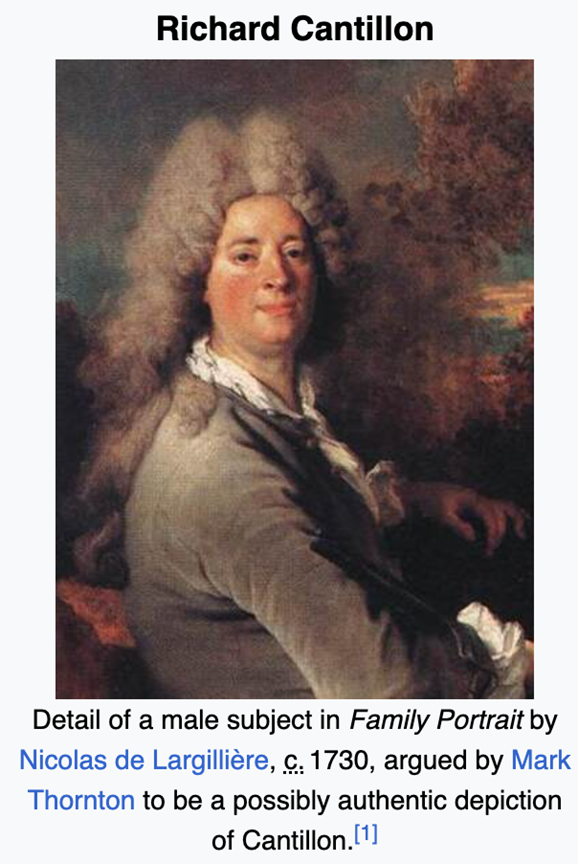
Cantillon’s success, however, came at a cost to his debtors, who pursued him with lawsuits, criminal charges and even murder plots until his death in 1734.
The aftermath of John Law’s monetary experiments in France — paper money, credit expansion, asset speculation and the inevitable unwind led Cantillon to a kind of epiphany and an apologia of sorts.
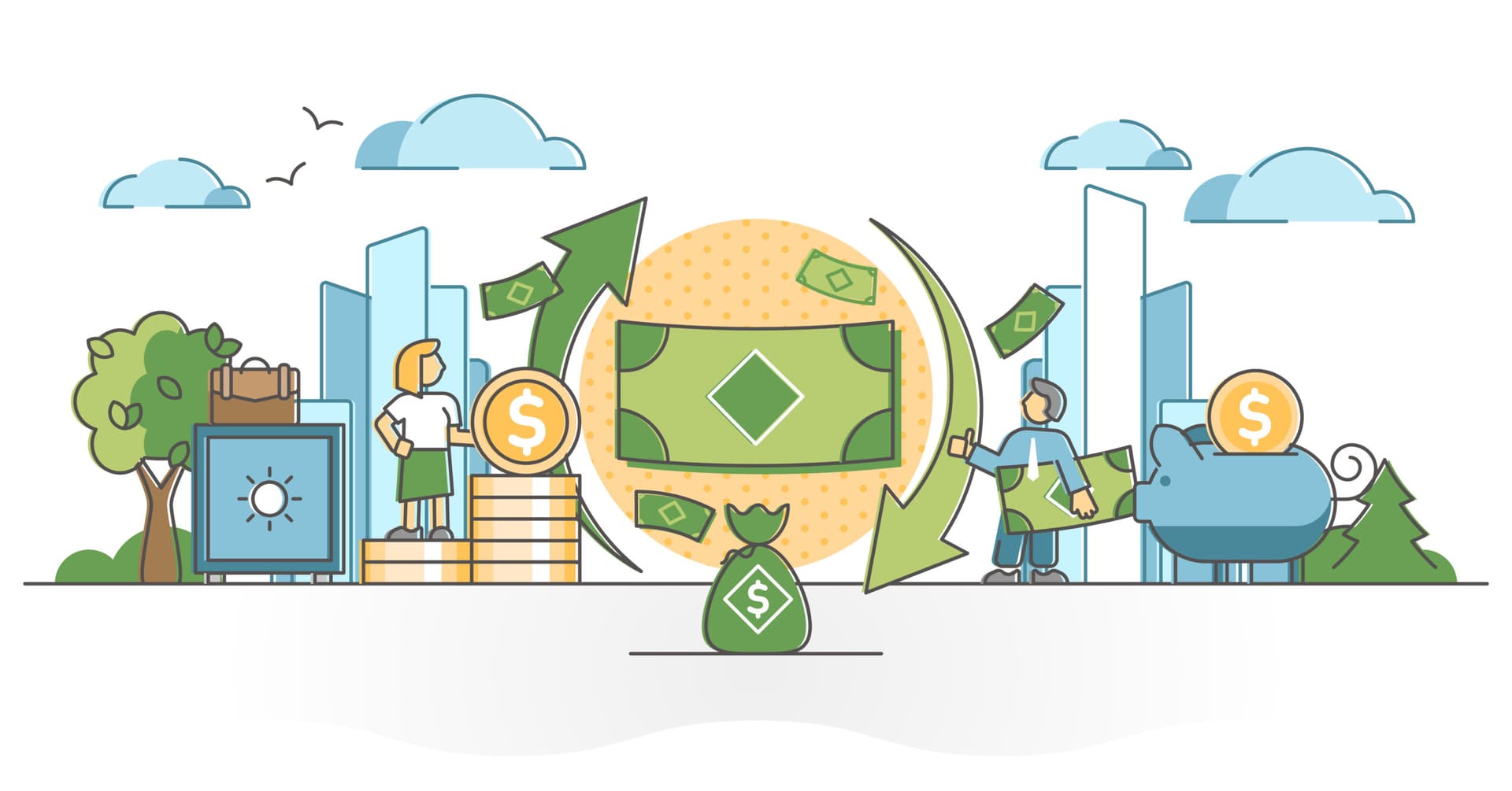
Cantillon noticed that money does not enter an economy evenly. It arrives somewhere first, moves outward and changes prices along the way. Those closest to the creation of money (and policy) benefit first. Those further away pay a lot more for the same goods, later.
That sequence — now called the Cantillon Effect — never required belief. It only required observation.
This morning, after learning “a civilization may die tonight,” we realized we can’t shake the Cantillon Effect when reviewing the news. And there is no use trying.
Inflation, As Experienced vs. Inflation, As Reported
Turn on financial television and inflation appears as a number — CPI, PCE, rounded, revised, debated.
Between 2009 and early 2026, the S&P 500 Index moved from roughly 950 to around 6,700. Housing followed the same path. The Case–Shiller index more than doubled. Over that same period, CPI rose by about 50%.
In response to the 2008 financial crisis, credit expansion flowed through banks, asset purchases and capital markets before reaching wages and consumer goods.
Claudio Borio warned more than a decade ago that economists had “neglected the financial drivers of business cycles.” The markets did not neglect them. They simply priced them into the cost of credit, debt and consumer goods.
Quants and wonks in Washington, D.C. came up with all kinds of measures – hedonic price indexing, the substitution effect, seasonal data – to try to explain away the average consumer’s experience at the checkout line or gas pump.
Wall Street bankers and K-Street lobbyists – those closest to the flow of credit and the policy that supports it – saw prices adjust in their favor first.
🧾 A Budget That Gets Rewritten Midstream
Most egregiously, the federal budget has become a hideous ghost of its former self. The two most electable parties used to take turns being “fiscally responsible.”
That ended in the early 1980s when “Reagan proved deficits don’t matter,” at least according to Dick Cheney.
What used to be the goal – balancing the budget – gave way to stabilizing debt relative to gross domestic product (GDP). Now the conversation has settled on reducing deficits from roughly 6%of GDP toward 3%.
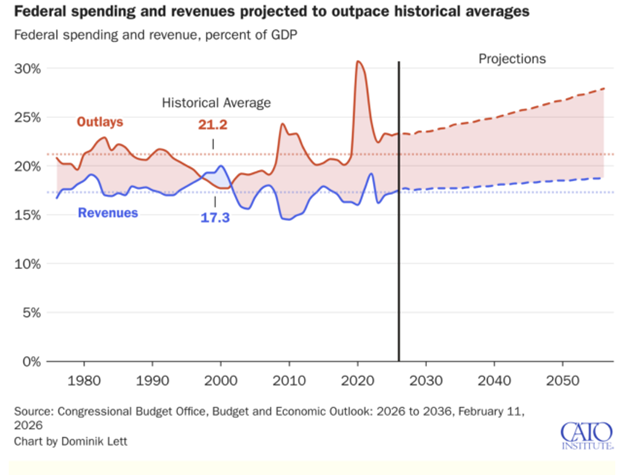
Jodey Arrington, writing in this morning’s Daily Economy, explained the gap:
Reaching a balanced budget would require roughly $18 trillion in adjustments over ten years. The current proposal lowers the target to something that can be approached without forcing that adjustment.
Meanwhile, the cash continues to move. And a policy falls in line to justify it.
The 2025 budget package expanded deficits going into this year. Congress is now preparing another reconciliation bill to fund additional military spending tied to Iran. Interest payments rise as the Treasury rolls over debt at higher yields.
The United States has already been downgraded by all three major credit rating agencies. Interest expense, for a moment before the Iran war, ranked alongside “defense” as one of the three largest categories in the federal budget.
Within a decade, projections show that Social Security, Medicare, Medicaid and interest will absorb nearly all federal revenue.
Everything else – including war spending – will be financed with additional borrowing.
Those closest to the money and the policy benefit first and the most.
⚓ War Aims Defined
The war offers a more in-your-face version of the same pattern.
President Donald Trump warned in a press conference, “A whole civilization will die tonight.” Earlier in the campaign, officials described Iran as effectively defeated. Defense Secretary Pete Hegseth said, “They are toast, and they know it.”
More than 13,000 combat flights. Over 12,000 targets struck. More than 30,000 munitions deployed. Two American aircraft lost within 48 hours. Air superiority is described as partial, expanding in pockets rather than being absolute.
If winning the war includes unmolested travel through the Strait of Hormuz before their civilization meets its demise, the Strait remains under Iranian control.
Gregory Brew told the Wall Street Journal, “Iran will not surrender the strait at this point.” Iran now charges for passage—roughly $1 per barrel, up to $2 million per vessel.
Professor Robert Pape, a top U.S. expert on warfare based at the University of Chicago, says Iran will likely emerge from this terrible war as a superpower.
Pape has run simulations of U.S.-Iran wars for decades and is clear:
Trump made a huge mistake:
…For the moment, the Americans and Israelis are enjoying success after success: killing leaders and school girls, blowing stuff up and so on. “That can be mesmerizing, and cause this illusion of precision control but it is not the same thing as a strategic victory. Iran before the war controlled 4% of the world’s oil. Twenty-six days later they control 20% of the world’s oil.”
As Trita Parsi of the Quincy Institute pointed out this week Denmark charged transit fees for 400 years for vessels to pass through the Øresund Strait into and out of the Baltic. Panama, Egypt and Turkey all charge transit fees.
It’s not clear to anyone, really, what a victory would look like. Unless a consortium of Western nations steps in to police the Strait after Israel and the U.S. stops trying to annihilate Iran’s infrastructure.
🛢️ Saudi Vision 2030 Meets A Shipping Reality
A snapshot of one ambitious ally in the effort to squash the Iranian revolution, Saudi Arabia is also paying a heavy price. Exports have already been reduced to roughly half of normal levels as Hormuz traffic tightens.
Offshore fields have been shut in. One of the world’s largest petrochemical plants has halted operations. The war has cost the kingdom more than $10 billion in lost revenue and expenses.
Major PR events have been canceled. Airlines have suspended routes. The financial in Riyadh was evacuated ahead of tonight’s deadline.
Across Riyadh, construction fencing still advertises Vision 2030 —“an extraordinary new normal,” “redefining livability.”
Behind those signs, projects are being reviewed, scaled back or canceled. A $38 billion mountain development has been shelved. A $5 billion dam sits partially completed.
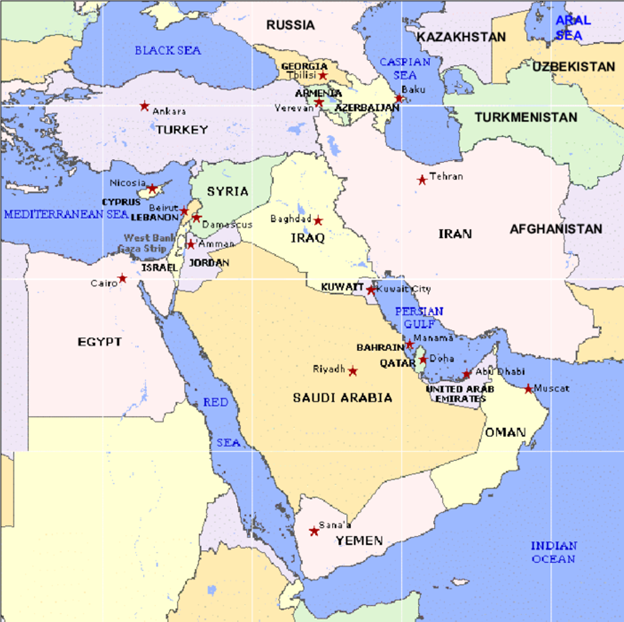 Capital is being diverted to build new pipelines across the arid desert away from the Persian Gulf to reach the Red Sea. Tankers reroute around Africa, adding 10 to 15 days to delivery times. (Source: World Sites Atlas, Madrid, Spain)
In a geographic Cantillon effect, costs accumulate incrementally before ever reaching the end user.
We doubt a civilization will die tonight, exactly. But the disruptions to the global economic infrastructure grow farther from being a quick solution to the Iran problem with every passing minute. And they continue to dominate the news cycle, resembling anything but civil discourse.
🏛️ Another Kind of American Presence
Alas, not all U.S. policies or U.S. presidents have been antagonistic to the Arab civilizations.
On April 7, 1961, John F. Kennedy asked Congress to fund the preservation of ancient temples threatened by the Aswan High Dam. The United States contributed $16 million and sent archaeologists to relocate Abu Simbel and other sites.
Egypt agreed to allow American teams to excavate the surrounding areas. Artifacts, including the Temple of Dendur, were later installed in New York.
~Addison
P.S.: Grey Swan Live! was in top form last week with Ian King. We had attendees from the four corners of the continent, from Seattle to Boca Raton, Ontario to Baton Rouge. Arizona and Alabama. If you’re a Grey Swan member, it’s worth your time to join Grey Swan Live! on Thursdays. It’s one of the primary benefits of your membership!
Ian’s been out front on the crypto revolution for a decade. The K-Street rumor mill is hot in Washington, D.C. this week with breakthrough news of a deal between the banking lobby and digital asset innovators.

Ian explained how and why the banking cartel is trying to defend its monopoly over the nation’s savings, and how the innovators at crypto companies have positioned themselves to benefit their customers when the Clarity Act finally gets sent up to the Oval Office.
The implications on everything from tokenization to Defi are profound. We specifically ran through all of the companies listed in the “Dollar 2.0” recommendations in our digital asset special report in the Grey Swan library.