

GSI Banner
  • Free Access
  • Contributors
  • Membership Levels
  • Grey Swan Forecasts
  • Video
  • Origins
  • Sponsors
  • My Account
  • Sign In
  • Join Now

  • Free Access
  • Contributors
  • Membership Levels
  • Grey Swan Forecasts
  • Video
  • Origins
  • Sponsors
  • Contact

© 2026 Grey Swan Investment Fraternity

  • Cookie Policy
  • Privacy Policy
  • Terms & Conditions
  • Do Not Sell or Share My Personal Information
  • Whitelist Us
Ripple Effect

The AI Story Just Won’t Quit

Andrew PackerAndrew Packer

May 6, 2026 • 1 minute, 45 second read


AIcapexCommoditiesMagnificent 7

The AI Story Just Won’t Quit

We’re not done with earnings season yet. 

But with most of the Mag 7 plays now reporting, we know that the AI story isn’t showing signs of slowing down yet.

Until that happens, the economy should continue to hum along as AI grows and new benefits for the technology filter down into everyday life.

One proxy for this trend? Capital expenditure spending by the big-tech companies, or capex for short. Currently, it’s soared to $700 billion, nearly triple its level in 2024:
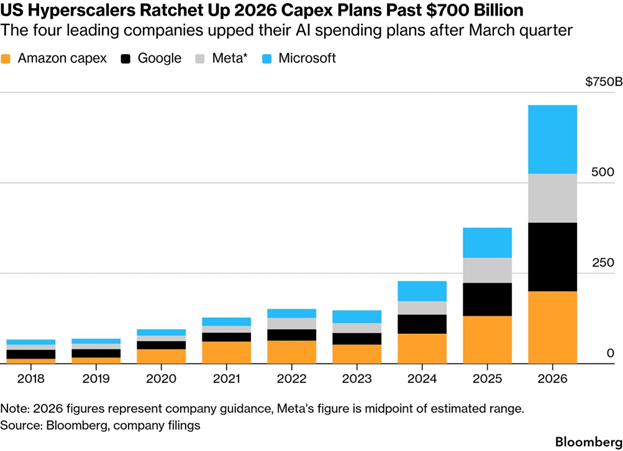
 

Spending on AI capex is now estimated at over $700 billion, providing a significant tailwind to the economy – provided that AI infrastructure can be built out.  (Source: Bloomberg)

Ultimately, this capex growth trend is unsustainable. Markets could be in for a rude awakening when it slows, as investors will conclude that most of the easy money in the market has been made.

But we’re not there yet. It’s full steam ahead. And since October 2022, with the launch of ChatGPT, AI has been a positive Grey Swan event for markets – now one of the largest in total dollar volume.

For now, following surging semiconductor stocks, investors may want to look at other parts of the AI boom, particularly investments related to building out the physical data centers that will make AI possible, such as commodities. 

Those goods can’t be generated by an LLM prompt, and have to be physically discovered, removed from the ground, and refined.

Plus, commodities tend to fare well in inflationary times, so if expectations for AI-driven deflation fail to pan out, there’s a built-in secondary way to profit.

If you’re looking for a company that can play to the current AI buildout, but also has some strong positioning for potential sticky inflation as a commodity play, check out Grey Swan Pro. (See: Shadow Stocks.) 

~ Andrew

P.S. This week, Addison is visiting family out in Maine, and I’m at the Consensus Conference in Miami, learning about all things crypto – ideal timing with the Clarity Act moving forward. 

So no Grey Swan Live! But we’ll be back to our regular schedule next week.


One Sign that Government Spending Is At a Crisis Point

August 7, 2026 • Addison Wiggin

Debts and deficits will eventually cause a crisis. Treasury Secretary Scott Bessent’s effort to help bail out the Japanese Yen this week is entirely motivated by self-preservation. The contagion signal flashing in Japanese bonds since late ‘25 is infecting the BOJ, which may be forced to sell U.S. Treasurys to stabilize its own currency.

One Sign that Government Spending Is At a Crisis Point
“Doc” Copper Tests Positive for Testosterone

August 6, 2026 • Addison Wiggin

The copper price is no doubt benefiting from inflation driven by money printing. But the doc don’t lie. Copper’s new all-time highs, while gold and silver still languish, are a sign the AI growth story is also that of the global economy itself.

“Doc” Copper Tests Positive for Testosterone
Gold Mining Stocks Still Big Winners Amid the Price Pause

August 5, 2026 • Addison Wiggin

Many miners were profitable with gold around $2,000 and silver near $50. At sustained prices closer to $4,000 gold and $60 silver, the arithmetic changes dramatically.

Gold Mining Stocks Still Big Winners Amid the Price Pause
The “Yentervention” Kicks US Markets Into High Gear

August 4, 2026 • Addison Wiggin

The stock market is getting an unexpected boost to kick off August, bucking the historically weak summer session for the U.S. stock market.

What’s happening? The Bank of Japan and the U.S. Treasury are making a coordinated effort to support Japanese yen; a move last attempted nearly 30 years in the height of the Asian Financial contagion (1998).

The “Yentervention” Kicks US Markets Into High Gear