Beneath the Surface
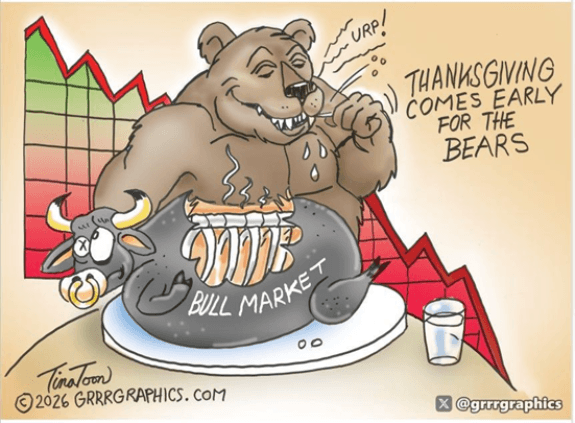
Thanksgiving Comes Early for the Bears

November 21, 2026 • 5 minute, 24 second read
“The bears feast on Thanksgiving and the bulls feast on Christmas.”
~ Dale Pinkert

The bear is enjoying an early Thanksgiving dinner, with the bull market roasted, stuffed, and served on a platter. The red stock chart in the background suggests that Wall Street’s holiday menu has changed from champagne and caviar to antacids and regret. (Source: Malone News)
Note from Addison: A seasons greetings from Dr. Malone.
Wall Street’s daily exercise in legalized panic continues; here’s a quick explanation (with help from an AI – as I am no economist).
A bull market is when stock prices are rising, investors are optimistic, and everyone suddenly believes they’re a financial genius. Traditionally, a bull market means stocks have risen at least 20% from a recent low. The bull charges upward, lifting prices, retirement accounts, and the egos of people who bought Nvidia three years ago.

A bear market is when stock prices fall 20% or more from a recent high. The bear market is a sudden downward swing that takes stock prices, retirement savings, and investor confidence along for the ride. Suddenly, those same financial geniuses are explaining why they’re actually long-term investors.
So, where does that leave the economy today?

The Nasdaq has entered correction territory, the Dow is teetering on the edge, and the S&P 500 has suffered six consecutive losing sessions. None of the three major indexes has officially entered a bear market, but Wall Street’s optimism is looking increasingly battered. And according to many, the AI bubble is about to burst.

And stocks aren’t the only things taking a beating. Gold has plunged from its 52-week high of approximately $5,518 an ounce to $3,586, a staggering 35% decline.
Silver and other precious metals: Silver has joined gold in the recent selloff, reminding investors that precious metals are not immune to market volatility. When investors need cash, even the family silver can end up on the auction block.
And Bitcoin? It closed Thursday near $61,915, down more than 50% from its October 2025 record high. So much for the supposedly bulletproof alternatives to Wall Street.
Apparently, neither the traditional safe haven nor the digital alternative is immune to a good old-fashioned financial panic.

And what about real estate and other assets?
Residential real estate: The housing market is struggling. Existing-home sales fell 5.5% in October and were down 8.8% from a year earlier. The median existing-home price was $416,700, barely 0.4% higher than last year. Meanwhile, 30-year mortgage rates have climbed back to approximately 7.3%. Buyers can’t afford the houses, and sellers don’t want to lower their prices or buy new property when their current mortgage interest rate is less than 2%. So, real estate agents are discovering that low inventory and low demand are not a great way to build a real estate business.
And of course, as immigration was driving new construction, even the trades are being hit.
Farmland: One of the more resilient tangible assets. USDA reports that average American farmland values increased 3.4% in 2026 to $4,500 per acre, although inflation consumed most of that gain. Unlike Bitcoin, farmland can at least grow something useful when the financial markets go haywire.
Cash, CDs, and Treasury bills: Suddenly, boring looks beautiful. Short-term Treasury bills and insured bank deposits offer something increasingly attractive: relatively predictable returns without having to guess which financial bubble will burst next. The downside? Inflation continues to nibble away at the returns of personal savings or retirement accounts. Welcome to the new world – where your money devalues faster than you can save it.
Then there is the “tiny issue” of Inflation: Inflation is still eating away at Americans’ purchasing power. Consumer prices rose another 0.4% in October, following a 0.6% increase in September, when annual inflation reached 3.7%, well above the Federal Reserve’s 2% target. But here’s what those reassuring government statistics don’t tell you: Over the past five years, consumer prices have risen 22%, food prices 24%, housing costs 26.8%, and energy prices a staggering 33.2%. That means a household spending $5,000 a month five years ago would now need approximately $6,100 just to maintain the same standard of living, assuming its expenses followed the overall inflation index. And that’s before accounting for higher borrowing costs. And just because inflation has slowed down a teeny bit doesn’t mean prices are falling. It simply means Americans are being squeezed a little more slowly. Apparently, that’s what passes for good economic news these days.

Inflation: Washington’s Favorite Hidden Tax
Inflation is taxation without legislation. Washington borrows and spends, then benefits as inflation shrinks the real value of its existing debt and pushes taxpayers into higher nominal incomes. Meanwhile, our savings lose purchasing power, and everything costs more. Of course, inflation also makes new government borrowing more expensive, but why worry about tomorrow’s debt when you can quietly devalue today’s dollar? Washington gets to spend the money. Americans get to pay the bill. And Congress doesn’t even have to vote on the tax increase. Just in case you missed the memo, inflation is how the State surreptitiously funds wars and social services. Ever ask yourself why Nixon killed the gold-based dollar? In a nutshell, three words. Viet Nam War.

Notice who is missing in this graphic? Big Ag.
The bottom line: Stocks are wobbling, housing is stagnating, gold and silver are retreating, and Bitcoin has taken a beating. Farmland is holding up better, while cash and short-term government securities are looking increasingly attractive. And inflation still continues to hammer away at all of us – except the government, which long ago realized that inflation is a form of taxation – which pays for both entitlements and wars.
The bulls (and the GOP) are still insisting this is all a temporary setback. The bears, meanwhile, have already set the Thanksgiving table.

The bottom line: The bear hasn’t quite cooked the bull yet, but he’s preheated the oven, sharpened the carving knife, and invited the entire family over for Thanksgiving.
~ Dr. Robert W. Malone
Malone News and Grey Swan
P.S. On Sunday evening, August 15, 1971, President Nixon interrupted regular TV programming to “temporarily” cut the dollar’s link to gold.
Within 48 months, the dollar had lost more than 80% of its purchasing power against gold. Most Americans didn’t see it coming.
This time you’re getting a warning in advance: a new “Federal Reserve” goes public on November 30. But most people won’t hear about it until the biggest moves are behind us.
Click here to learn where to move your money first.