

Overnight, the outstanding US Treasury bill crossed $39 trillion.
Let’s take a moment:
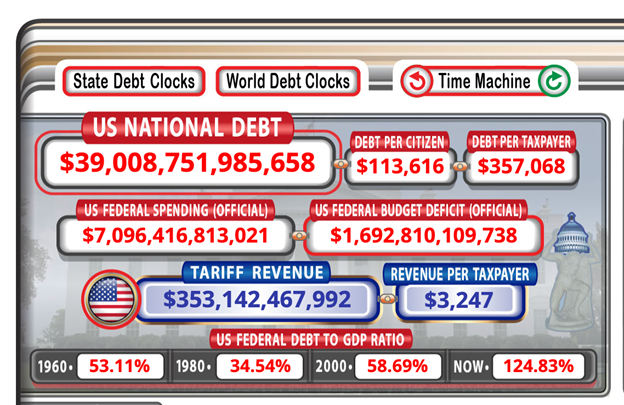
For a live-action tabulation of the public debt, see: US Debt Clock (Source: US Debt.org)
The United States’ outstanding public debt now exceeds the combined economic output of China and the Eurozone.
Debt sits north of 120% of gross domestic product (GDP), a ratio last seen when the United States was demobilizing after World War II.
Only the acquisition speed has changed.
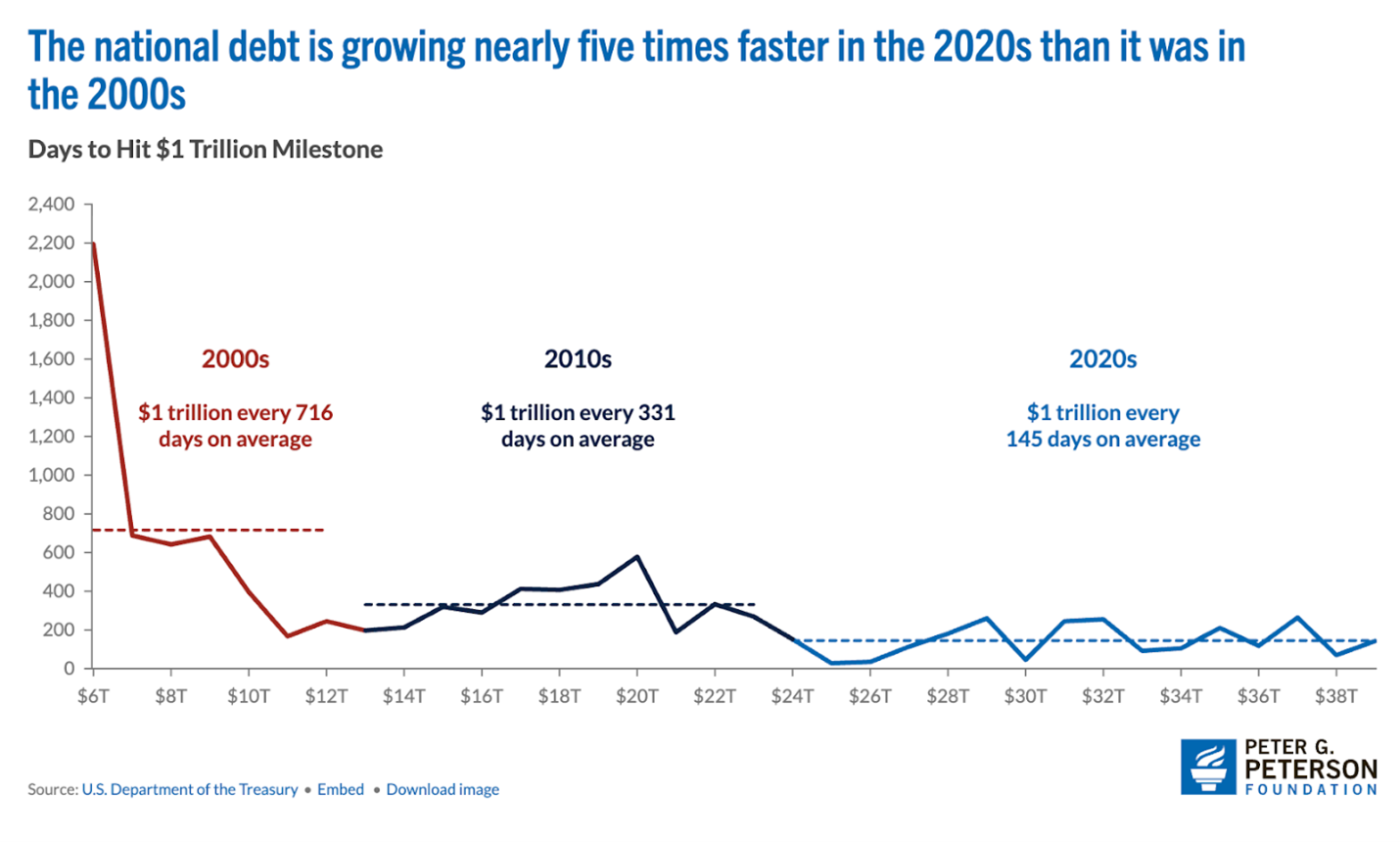
In the 2000s, Washington, D.C. added roughly $1 trillion every 24 months. In the 2010s, it arrived about every 11 months.
In the 2020s, the interval compressed to roughly five months.
Annual interest expense now exceeds $1 trillion. At current yields, every additional trillion dollars in issuance adds tens of billions of dollars in annual servicing costs. Those payments flow through the federal budget before a single dollar reaches Social Security, Medicare, “defense” or infrastructure.
📉 Producer Prices and the Dow’s New Low
In addition to concerns about the Iran war, equities have been laboring since the Bureau of Labor Statistics (BLS) reported that February producer prices rose 0.7% month over month – more than double the 0.3% consensus estimate.
Headline PPI reached 3.4% year over year. Core PPI printed 3.9%. That means inflation was baked into the system at the highest rate since August 2023.
Energy goods led the move. Diesel rose 13.9% and accounted for nearly 30% of the increase in processed goods. Energy materials advanced 6%. Aluminum reached a four-year high.
The Dow sank to a fresh 2026 low after the number was released. The industrial index remains on pace for its worst month since 2022.
Gold fell below $5,000 to a one-month low as traders reduced expectations for near-term rate cuts.
🏦 The Fed Votes 11–1
The Federal Reserve used the cover of inflation creep to keep its target rate at 3.50% to 3.75% for a second consecutive meeting. The vote passed 11–1, with President Donald Trump’s latest appointee, Governor Stephen Miran, dissenting in favor of a 25-basis-point cut.
The post-meeting statement matched January’s language almost word for word, adding a single line noting that “the implications of developments in the Middle East for the U.S. economy are uncertain.”
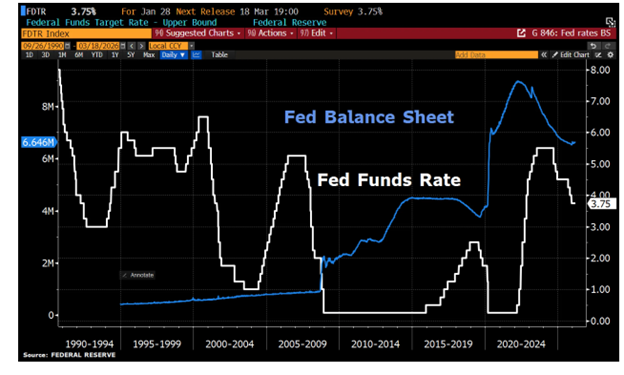
Fed Chairman Jerome Powell said, “The forecast is that we will be making progress on inflation, not as much as we had hoped, but some progress.”
Keep in mind, Powell’s term ends May 15.
And Trump nominated former governor Kevin Warsh back in January.
However, Powell announced he plans to remain in place until a successor is confirmed. He also said he will remain on the Board during a Department of Justice probe into the $4 billion renovation of the Eccles Building, the Fed’s HQ.
Senator Thom Tillis renewed his vow to block Warsh’s confirmation until the Justice Department concludes its investigation.
🛢️ Oil Ticked Briefly Above $11o… Again
Crude approached $111 after Israeli strikes hit an Iranian gas field. Tehran responded by declaring Gulf energy infrastructure legitimate targets and striking a major Qatari fuel hub.
The Strait of Hormuz remains partially obstructed as Iran continues retaliatory actions tied to U.S. and Israeli operations.
Earlier hopes that exports from Iraq and Kurdistan could resume through an overland pipeline faded as new strikes offset expected flows.
The Treasury eased sanctions on Venezuelan state-owned oil companies to increase global crude supply.
Yesterday, Trump issued a 60-day waiver of the Jones Act to allow foreign-flagged vessels to transport fuel between U.S. ports. Vice President JD Vance and other lawmakers met with oil executives to discuss domestic production and logistical constraints.
🪨 Mining Stocks Under Pressure Despite Record Margins
We’ll be talking to Shad Marquitz on Grey Swan Live! today.
Marquitz, in an email to readers yesterday, described a difficult stretch for mining investors, so we’re going to dig into the details with him a bit.
After tax-loss selling in December and a January rally, many gold, silver and copper equities have broken through technical support even as producers report their strongest quarterly revenues and margins on record.
Redemptions accelerated. Stops were triggered. Several stocks gapped lower.
In late January, silver traded between $96 and $102, and gold topped $5,400. Positions were trimmed into strength, raising portfolio cash above 10%. Since then, funds have been redeployed selectively during sharp downdrafts on January 30, February 13, February 17 and again this week as selling intensified.
The selling this month has been broad, including producers experiencing record quarterly average realized prices. More details to follow…
🗓️ Shock and Awe
On this day in 2003, American and coalition forces initiated “shock and awe” operations in Iraq. Roughly 90 minutes after the deadline for Saddam Hussein to leave expired, Tomahawk cruise missiles struck Baghdad from ships and aircraft positioned in the Persian Gulf.
President George W. Bush addressed the nation and described the early stages of military operations to disarm Iraq and defend against grave danger.
Major combat operations were declared complete on May 1, 2003. No weapons of mass destruction were found.
Direct U.S. budgetary spending reached approximately $1.79 trillion. Long-term veterans’ health care and disability benefits are projected to exceed $500 billion through 2050. Interest on borrowed funds exceeds $400 billion. The total cost of post-9/11 wars, including Iraq, Afghanistan and Syria, exceeds $6.4 trillion.
In December 2003, U.S. soldiers located Saddam Hussein near Tikrit in a six-to-eight-foot underground hideout. He did not resist. He was tried, convicted of crimes against humanity and executed on December 30, 2006.
Interest on the debt used to finance the war continued accruing long after the statue in Firdos Square was pulled down.
🌍 World Spirit and the Balance Sheet
The German philosopher Georg Wilhelm Friedrich Hegel rather pompously observed in the 1830s that history tends to advance when one nation exhausts its organizing principle and another steps forward with a fresher one.
Exhaustion doesn’t announce itself with trumpets and flags, but it does show up in ledgers.
Imperial Spain financed continental wars with borrowed silver from the New World. By the mid-1500s, state spending reached roughly 300% of revenue. Sovereign defaults followed in 1557, 1560, 1575, 1596 and 1597. Their credit eventually fractured, and financial gravity shifted north to Amsterdam.
The Dutch Republic built the most sophisticated capital market in Europe, then leveraged it to fund military campaigns and speculative excess.
By the 1690s, the Bank of Amsterdam quietly financed state wars with depositor funds. Maritime pre-eminence faded. London took the baton.
Britain entered the 20th century as banker to the world. Two world wars changed the math.
Debt climbed from roughly 30% of GDP before World War I to near 250% by 1944. Sterling gave way to the dollar at Bretton Woods. The City endured. The crown adjusted.
Now, the United States carries $39 trillion in public debt, above 120% of GDP. Interest payments exceed $1 trillion annually.
The Treasury adds $1 trillion in new debt roughly every five months. Spain had silver. The Dutch had ships. Britain had an empire.
The United States currently prints the world’s reserve currency.
One can only wonder for how long…
~ Addison
P.S. Today, March 19, 2026, Grey Swan Live! returned at 2 p.m. ET / 11 a.m. PST with Shad Marquitz to examine volatility and opportunity across oil, energy, rare earths, and precious metals following the Iran bombing excursion.

We’re in the middle of an active shooting war in the Persian Gulf …Oil has surged … Year to date, gold and silver have each tacked on roughly 20% … Gasoline and diesel prices are spiking…
And yet, the stock market is barely reacting. So, we unpacked what’s going on and the opportunities for investors today.