

GSI Banner
  • Free Access
  • Contributors
  • Membership Levels
  • Grey Swan Forecasts
  • Video
  • Origins
  • Sponsors
  • My Account
  • Sign In
  • Join Now

  • Free Access
  • Contributors
  • Membership Levels
  • Grey Swan Forecasts
  • Video
  • Origins
  • Sponsors
  • Contact

© 2026 Grey Swan Investment Fraternity

  • Cookie Policy
  • Privacy Policy
  • Terms & Conditions
  • Do Not Sell or Share My Personal Information
  • Whitelist Us
Ripple Effect

Record-High Margin Debt, Record-High Indexes

Addison WigginAddison Wiggin

April 23, 2026 • 1 minute, 35 second read


debtEarningsmargin debtstocks

Record-High Margin Debt, Record-High Indexes

During March, as the market sold on Iran fears, U.S. margin debt declined by $32 billion to $1.22 trillion, the lowest since November 2025.

The contraction marked the 2nd consecutive monthly decline in margin debt.

Margin debt is now down by $59 billion year to date:
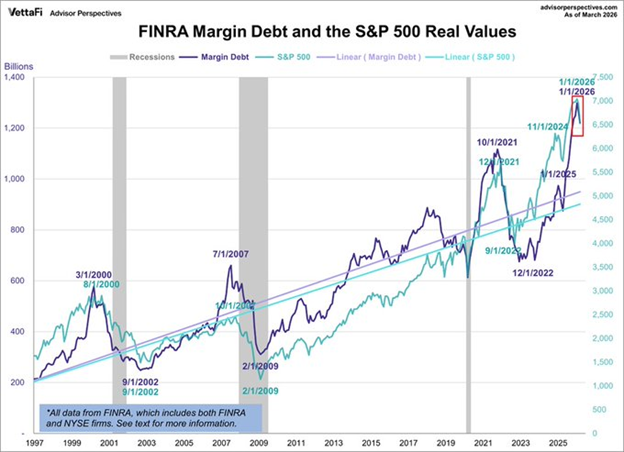
Margin debt declined in February and March, in line with fears over an energy shock and the Iran war,  but is still up 39% year-over-year. (Source: VettaFi)


Despite that drop, margin debt is still up $341 billion year over year – a 39% increase. Speculation is alive and well across all sectors of the market.

The last time margin debt increased at this pace? In 2021, right before the bear market that ravaged the indexes in 2022.

Since the 2022 bear market low in October of that year, margin debt has surged by $570 billion, an 87% increase. And a big reason why, over the same timeframe, the S&P 500 has more than doubled.

Leverage and speculation have driven the market to three years of above-average bull market gains.

Looking below the index averages, individual stocks can – and do – pop in this environment, provided they have decent earnings.

A Grey Swan take:  with many stocks priced to perfection, a hedge against the trend is also warranted. 

For a specific hedge trade right now, check out our Shadow Stock recommendation for paid-up Grey Swan Pro members, right here. 

~ Addison

P.S.  Today on Grey Swan Live!, Zoltan Istvan joins us to discuss how the accelerating pace of change due to AI is already reshaping every major asset class along the way. And, likewise, how you should be thinking about your money.

Tune in later today (2pm EST/11amPST) as we connect the dots — and show you where the opportunities are moving next. 

Zoltan will take time out of his campaign for governor of California to help us dig into…

  • Open-source AI is reshaping business. 
  • And the public is starting to push back on both. 

Copper’s Clear Signal

August 17, 2026 • Addison Wiggin

Copper and resources are sending us a cleaner market signal than AI stocks.

Channeling Ludwig von Mises, we observe this morning that price is not just a number; it’s information. Price reflects what buyers and sellers collectively believe: demand, scarcity, fear, speculation, disappointment, future expectations and available supply.

When prices rise, and inventories fall at the same time, the message is usually straightforward: buyers need the stuff, and there is not enough of it.

Copper’s Clear Signal
Market Crash Insurance Is Cheap

August 14, 2026 • Addison Wiggin

A low VIX does not predict disaster. It measures complacency. A serial skeptic will read it as the calm before a storm. We shook off that feeling this morning and opted to pursue an opportunity instead.

Here goes:

A VIX reading below 15 means the market is not pricing in much near-term trouble, even though there are obvious risks still sitting in the room: Iran, oil prices, memory chip speculation, circular financing, high valuations, epic high concentrations, spiking long-term interest rates, a regime change at the Fed, a meltdown in Japan and a historic deficit and rising national debt.

Market Crash Insurance Is Cheap
Beware: Financial Innovation In AI

August 13, 2026 • Addison Wiggin

Money is not flowing in a clean, straight line from outside investors to productive businesses. The firms at the top are investing in and buying from each other.

Microsoft and OpenAI are the easiest examples to follow.

Microsoft says OpenAI has contracted to purchase an additional $250 billion in Azure services, while Microsoft continues to account for $13 billion in funding commitments to OpenAI as an investment.

Beware: Financial Innovation In AI
Signs of a Late-Stage Bull Market

August 12, 2026 • Addison Wiggin

At this stage, it’s a stock picker’s market.

We expect space, robotics and some more visible tech startups to remain sources of speculation. After weakness in the first half of 2026, we’re also due for a strong rotation of capital into natural resources, precious metals, critical minerals and energy.

Signs of a Late-Stage Bull Market